
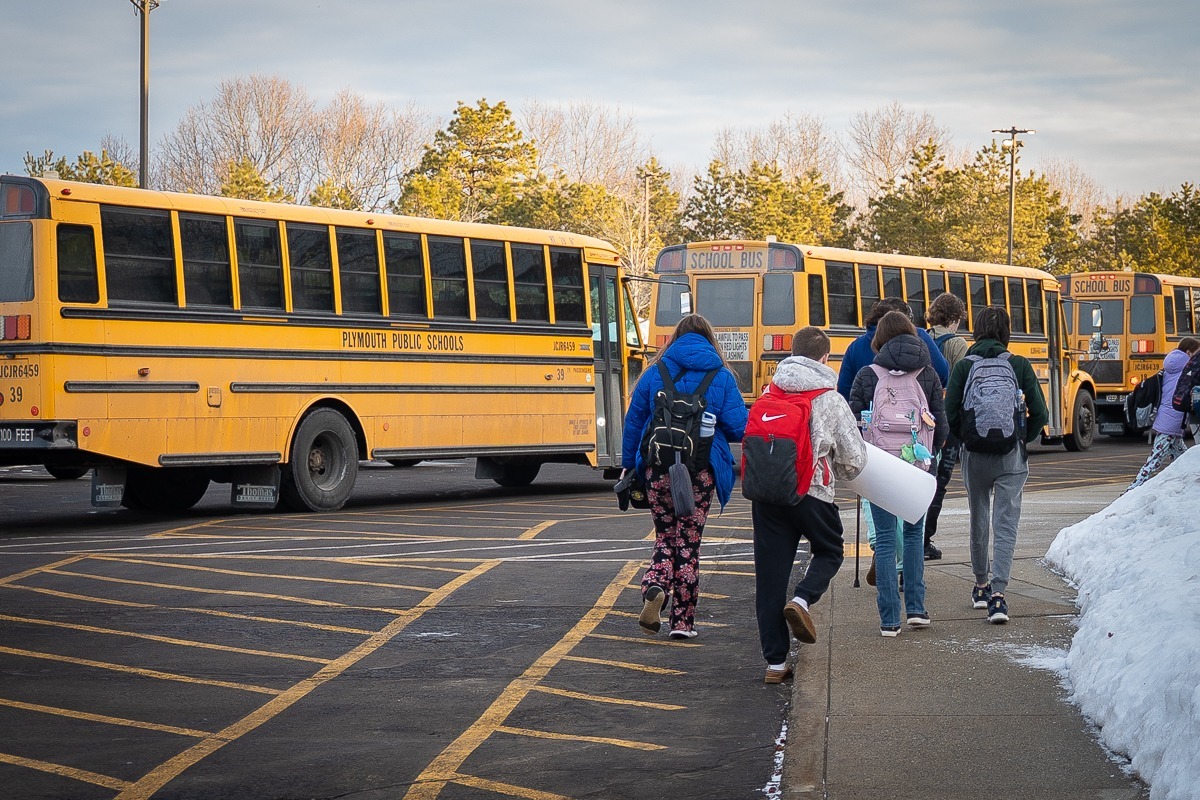
Plymouth Public Schools is signing up for another five years with First Student to provide yellow-bus transportation for students.
The School Committee approved the contract by a unanimous 7-0 vote Monday.
The contract begins in July and runs through fiscal year 2031.
The $6 million a year the schools spend on yellow-bus transportation represents 9.3% of the total school budget.
Among the reasons for the high costs are long bus routes in the largest town in Massachusetts, covering 104 square miles. The average overall ride time in the district is 40 minutes.
“We are as efficient as we can, given our geography and the length of bus routes,” Adam Blaisdell, business administrator for Plymouth public schools, told the School Committee.
The schools had considered taking over the whole operation and running the buses themselves. It was the first time Plymouth Public Schools officials had put so much consideration into such an enormous move, one which would put the burden on taxpayers to buy a fleet, hire drivers, and manage the new service.
Last year, the school system hired a consultant to conduct a feasibility study and compare the costs, and the headaches, of running its own bus service through the largest geographical school district in the state.
The report found the cost to Plymouth to run its own school buses would exceed the cost of contracting it out by $303,508 a year, not counting future costs such as pensions and other retirement benefits. However, the report also predicted the upward trend in contract costs, which means the schools could soon reach a tipping point at which it will be cheaper to run the service itself.
The schools already run all field trips and athletics with their own aging buses. The district also runs five routes by itself.
But running their own bus system would have been costly.
A school bus costs $132,000 and the schools use 65 buses. If the district were to go on its own, it would have to budget to replace its aging buses on a schedule. It would also have to hire about 80 people to drive and maintain the buses and would have to pay for pensions and other retirement benefits.
“Contracting has predictable costs,” said Blaisdell. “You know what your costs are going to be.”
If the town ran its own buses, it would have to compete for bus drivers at a time when there is a shortage of drivers.
The recent spike in fuel prices added another level of uncertainty to the costs of running a bus operation. Contracts come with a fixed cost, and the schools are not exposed to the risk of rising fuel costs.
“While there are some advantages to running our own buses, the business case is simply not there to make it attractive enough,” Luis Pizano, chair of the School Committee, told the Independent. “It would have introduced a whole another host of problems that right now, we basically pay First Student to take care of.”
The schools received two bids, one from First Student, the current contractor, and the other from NRT Bus. First Student came in with the lowest bid, about four percent lower than NRT Bus.
It currently costs the schools $499.83 to run a bus for one day. Under the new contract, the cost per bus will rise to $536.07 for fiscal year 2027 and $656.54 for fiscal year 2031.
The schools also spend an annual $900,000 on privately contracted small buses and vans for special education, vocational, charter, homeless, and foster students. First Student would take over some of the van pool from small private contractors, saving the schools some money.
Fred Thys can be reached at fred@plymouthindependent.org