
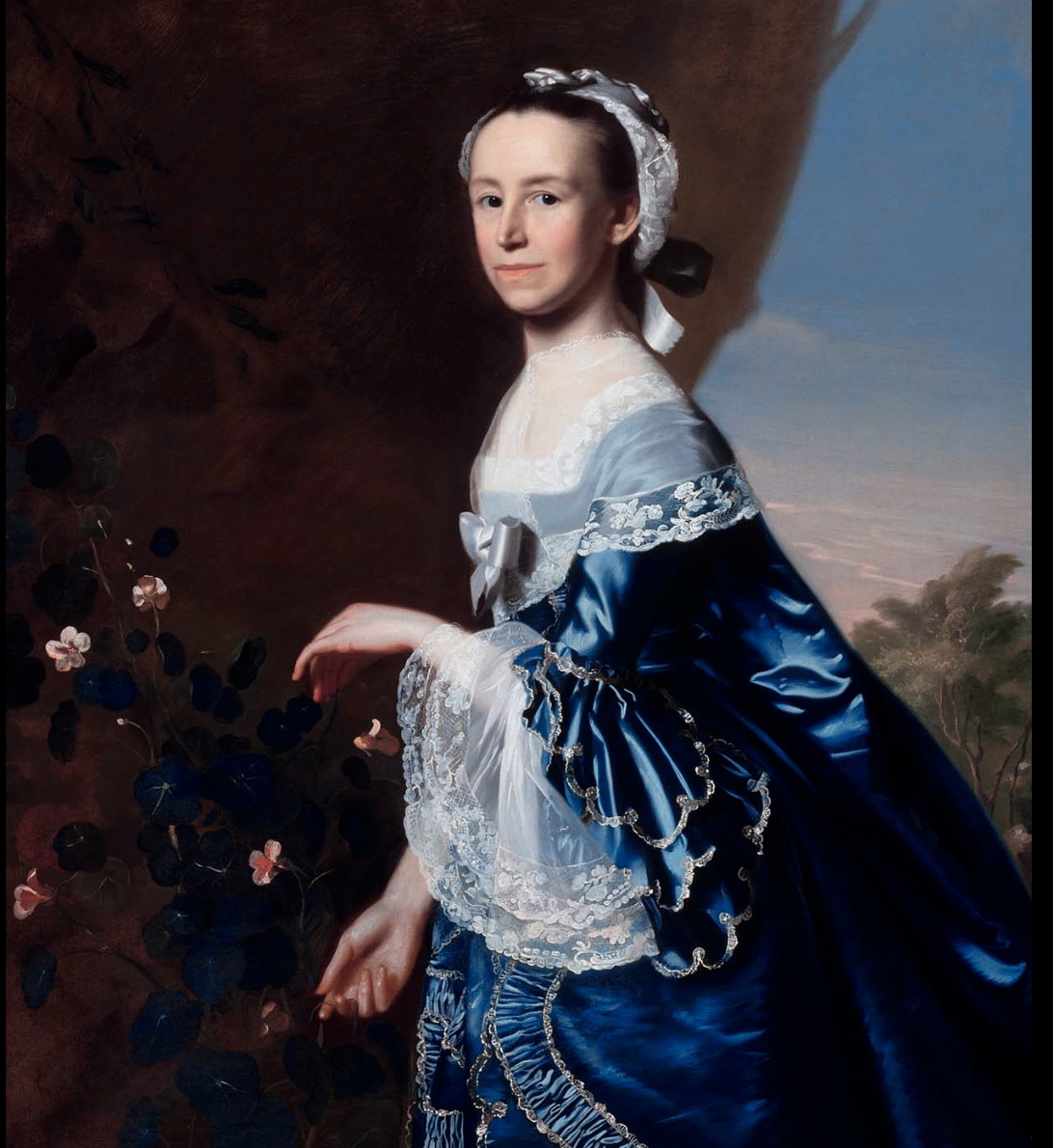
Mercy Otis Warren, the Revolutionary War-era pamphleteer and activist, holds court in the American wing of the Museum of Fine Arts resplendent in a royal blue and lacy frock; Her aristocratic bearing disguising the passions that led her to inspire widespread colonial rebellion against British rule. In due course, Warren’s writings not only advocated for the founding of a new country but, crucially, one that guaranteed individual rights.
At a time when a majority of Americans agree fundamental freedoms are under threat, Warren anticipated the dangers of tyranny. Presciently, she argued passionately for a Bill of Rights to be enshrined in the U.S. Constitution for fear of an all-powerful, unchecked centralized government. Congress’s ratification of the first 10 amendments on December 15, 1791 – guaranteeing freedom of speech, press, religion, and the right to due process – is a testament to her political prowess and vision.
In Warren’s “Observations on the New Constitution”(published under the nom de plume “A Columbian Patriot,” in 1788), she observed a brutal irony: An omnipotent U.S. government, as construed in the founding documents, posed the same threat to American liberty as the English monarchy had over a decade before. Although federalists like James Madison argued the Constitution’s structure, with its separation of powers, were ample protections against autocracy, Warren strenuously lobbied for the addition of inherent protections. Under mounting political pressures, Madison ceded to the anti-federalists. In a stunning about-face, he became a leading proponent of adding a Bill of Rights to unite the new government and secure the Constitution’s passage in key states like Massachusetts.
Warren won the war of ideas but lost the reputation battle.
For over a century, the writing of “Observations” was attributed to a Constitutional Convention delegate by the name of Elbridge Gerry. It took the discovery of a 1787 letter from Warren to a British historian – uncovered by one of her descendants – to confirm Warren’s authorship. It would be nearly another 100 years until her name gained attention through numerous books, academic writings, and documentaries. (She is currently featured in Ken Burns’ PBS documentary series, “The American Revolution”).
And yet despite her achievements, Warren’s name is largely absent in Plymouth, the town where she lived and wrote for 60 years. Every year tourists descend on “America’s Hometown” to see Plymouth Rock and the nearby Mayflower replica. However, the family’s Winslow-Warren house stands stripped of historic designation on the downtown corner of Main and North streets. A passerby will not see any acknowledgment that revolutionaries like John and Abigail Adams, John Hancock, and others gathered under Warren’s roof to strategize American independence and a new form of representative government.
This past fall I made a spontaneous decision to visit Warren’s gravesite on Burial Hill in downtown Plymouth. The lonely family plot stands before an Anglo-Norman church facing the harbor. Remarkably it was the anniversary of her death, October 19th. On nearby Cole’s Hill, less than 24 hours before, close to 3,000 demonstrators filled the waterfront to decry executive abuses. Their loud protests a continuation of Warren’s own fight for liberty.
– Marina H. Mortimer