
The Abbey Road crosswalk is one of the most recognizable images in modern culture. It’s forever tied to the Beatles and to a time when music and the peace movement were changing the world. Those simple white lines, just meant to help people cross safely, ended up standing for something much more.
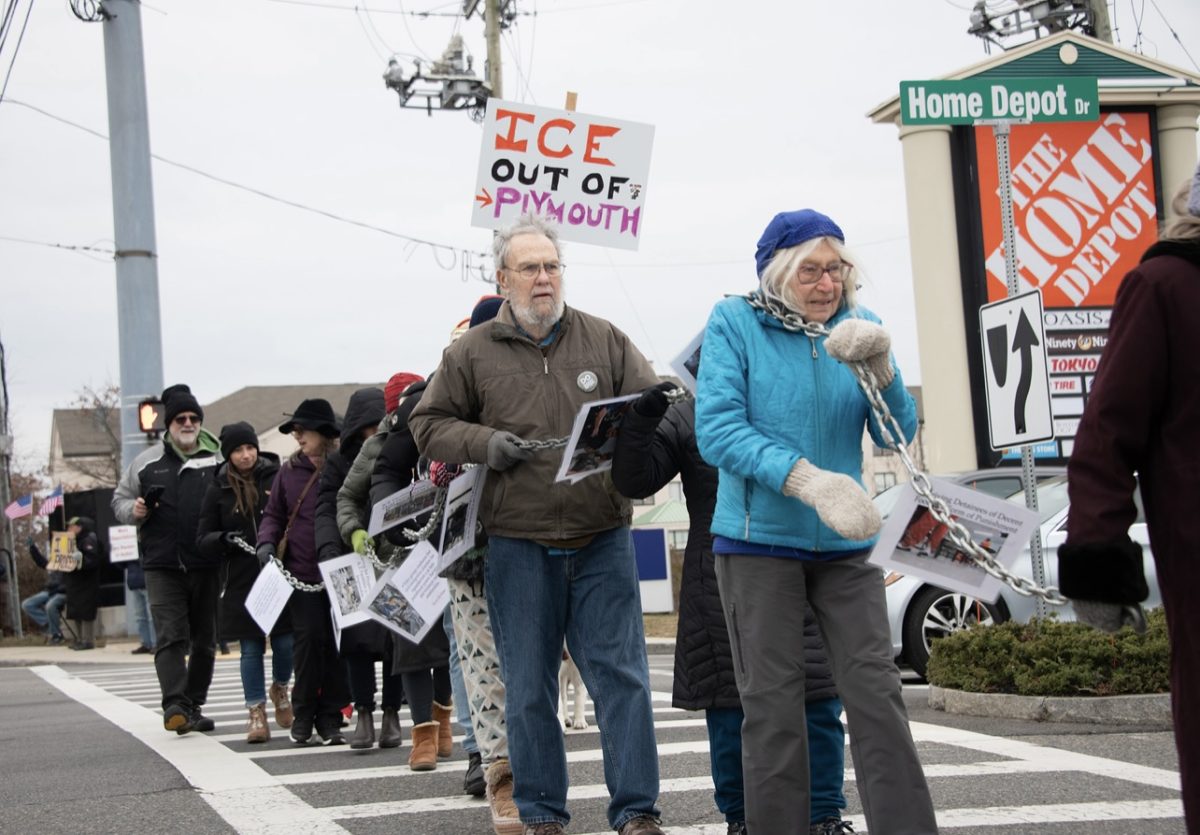
In Plymouth, a town that tells and retells the story of people fleeing oppression in search of refuge, a group of residents echoed that image during the Requiem Peace Chain Walk starting at the entrance to the Plymouth County ICE Detention Center. They carried a long chain, used for more than a quarter of a century by the Peace Abbey to denounce war and violence with messages of grievance, grief, and remembrance, as they crossed a familiar striped crosswalk, the kind found at intersections across America.
The walk became both a memorial and a protest, honoring a Vietnamese man who fled to America as a young refugee, built a life in the U.S., and was later detained at the Plymouth ICE facility and deported back to Vietnam, where he died by suicide. This thoughtful, gentle, caring man was someone I knew well, deeply admired, someone who deserved to remain in our country.
The Peace Chain Requiem March, led by members of The Peace Abbey, took place against the backdrop of a protest against ICE, organized by Together We Can, Plymouth Indivisible, and several other local activist groups. The suicide of this Vietnamese refugee showed how the wounds of war can linger long after the fighting ends, even in a place that calls itself America’s Hometown, where the Wampanoag people once welcomed those on the Mayflower seeking refuge.
Decades earlier, the Vietnamese Zen master Thích Nhất Hạnh visited and stayed at The Peace Abbey in Sherborn when he came to receive the International Courage of Conscience Award. His presence with us deepened our understanding and awareness of the suffering of Vietnamese refugees and the war’s lasting impact.
Thích Nhất Hạnh was not a refugee in the sense of fleeing Vietnam by boat or through a refugee camp, but he did live in long-term exile from his homeland, barred from returning because of his peace work and conscientious objection to war. Living in France under asylum, he walked alongside and supported many Vietnamese refugees, teaching that awareness inevitably leads to compassion, and compassion fully felt inevitably leads to action. He reminded us that we are called to care, not just for ourselves, but for all who are displaced or in danger, wherever they come from.
Here in Plymouth, the crosswalk used in the Requiem Peace Chain Walk carries another stark truth, another local meaning. It links the Plymouth County Correctional Facility where the immigration authorities detain hundreds of immigrants, and the parking lot of Home Depot. For many of those held inside, America once appeared to be their “Home Depot,” a place where they could arrive and find work and a future to build a new life, a new home.
Now, Home Depot parking lots have become sites where immigrants are rounded up, a daily staging ground for arrests and deportations. The name “Home Depot” has become an ironic and painful contradiction: the place immigrants thought would help them build a new life, instead becomes a gateway to confinement and expulsion. Plymouth, a town that honors the Pilgrims who crossed an ocean in search of safety from religious persecution, a town synonymous with welcoming the stranger, ends up being the end of the line for many.
Just a few miles from Plymouth Rock, where monuments and yearly reenactments celebrate the Pilgrims as refugees seeking freedom, men, women, and children who have fled violence, poverty, and oppression today are held in cells and sent out of the country. The contrast is hard to ignore: in the very community that symbolizes welcome and refuge in our national mythology, the current administration in Washington turns away, or sends back, those who come with similar hopes, similar dreams. The cruelty and abhorrent disrespect shown to those who seek refuge here is appalling, yet somehow not surprising, given the divisive rhetoric coming out of our nation’s capital.
The crosswalk, then, became more than a physical crossing and an apt metaphor; it was a meditation on trust and refuge. Each step along those painted lines carried the same spirit of mindfulness Thích Nhất Hạnh embodied, the quiet courage to move toward understanding, even after great loss. It also carried the memory of the first refugees who stepped onto this shore, and the question of whether Plymouth still lives up to that legacy.
But that trust was broken. After imprisonment and rebuilding his life, the man at the heart of this walk was still punished by deportation. Meanwhile, those who caused far greater harm rarely face consequences. His story reveals a painful truth: individuals often bear the grief and guilt that national leaders refuse to accept and carry, and communities that once welcomed strangers, can become sites of exclusion and fear.
The Requiem Peace Chain Walk transformed that Plymouth crosswalk, a lookalike of Abbey Road, into a space of remembrance and moral reckoning. Through the spirit of Thích Nhất Hạnh’s teaching, it became a mindful act of bearing witness, walking gently for those who can no longer walk free, and for all whose journeys end, not in welcome, but in a cell or a deportation flight or worse yet, a cemetery.
In that way, the Abbey Road image becomes a bridge across generations and continents. Decades after John, Paul, George, and Ringo crossed a London street for a photo-op, Plymouth residents now step into their own crosswalks to call for safety, dignity, and compassion for those seeking refuge, from the Pilgrims of the 1600s to today’s migrants and asylum seekers.
A crosswalk is, at its core, a promise: one group pauses so another can pass safely. When that promise is broken, by drivers, by systems, by nations, lives are damaged and sometimes destroyed. To honor that promise is to practice mindfulness in motion, slowing down and allowing others to pass in peace, as naturally as migratory birds crossing borders in the sky. Like birds that know no boundaries, the human spirit yearns to move freely across the earth; peace asks us to welcome that movement with acceptance rather than fear, so that in Plymouth, of all places, finding refuge is not a trap, but a place of safety and belonging for those who come in search of it.
– Lewis Randa
Randa is executive director of the Peace Abbey Foundation.