
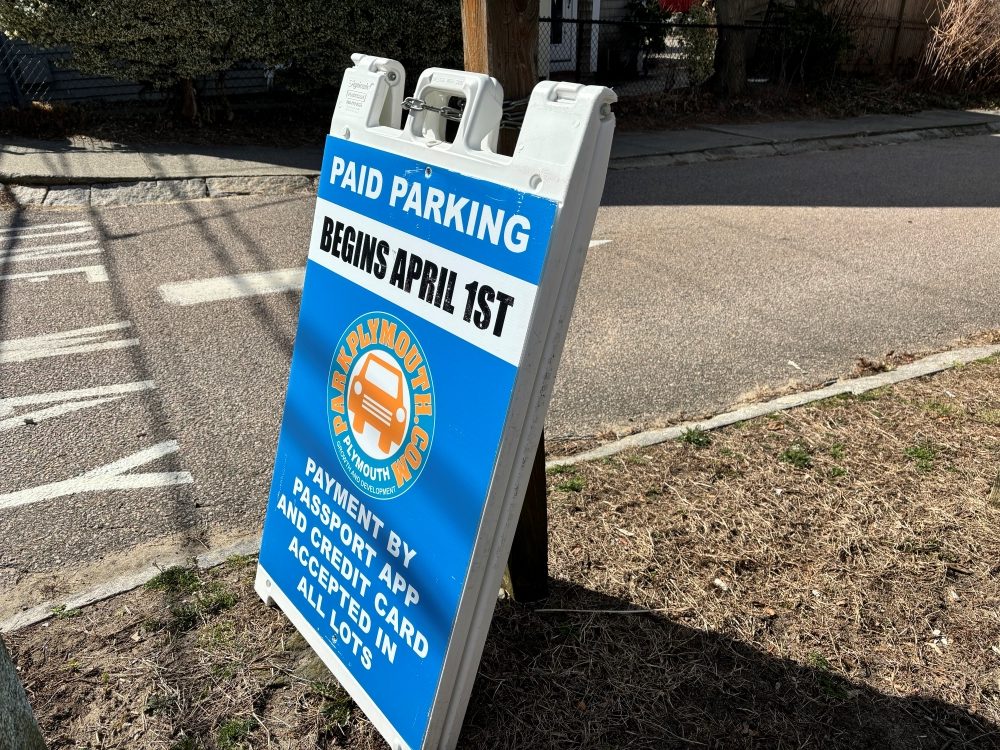
Apparently, Plymouth has a parking problem. The proposed solution is to pave more of the town.
According to the Plymouth Independent, the town is considering a $1.2 million to $1.5 million project to expand parking behind Nathaniel Morton Elementary School from 60 spaces to 150. The project would add nearly 10,000 square feet of pavement and provide free public parking outside school hours. Officials describe it as a “win-win.”
But Plymouth’s obsession with waterfront parking deserves more scrutiny. Every summer, we act as though the primary obstacle to enjoying our historic downtown and waterfront is the distance between our vehicles and the ocean. We keep looking for more land to pave and more ways to make it convenient to drive directly to the water.
Perhaps the problem is not that Plymouth has too few parking spaces. Perhaps it is that Plymouth has too many enormous vehicles.
Under the same parking-lot conditions, switching from spaces sized for full-size pickup trucks to spaces sized for compact cars would create approximately 40 percent more parking spaces in any given lot. That means we could accommodate substantially more vehicles without acquiring additional land, paving more green space, or creating more stormwater runoff.
Our “parking crisis” is partly a vehicle-size crisis. The spaces have not necessarily disappeared. The vehicles have expanded into them.
Over the past two decades, the American vehicle market has shifted sharply from sedans toward SUVs and pickup trucks. Many of these vehicles are routinely used to transport one person.
We have normalized the idea that a single driver needs a pickup truck nearly 20 feet long and more than 6 feet wide with a 10,000 pound tow capacity to commute, grocery shop, visit the waterfront, or take children to school. Then we build the town around those dimensions and wonder why every public space is under pressure.
The environmental costs are also larger than the pavement itself. Parking lots collect oil, gasoline, tire residues, brake dust, metals, and other pollutants. The asphalt itself, which is made of oil, breaks down over time too. During rainstorms, those contaminants wash into storm drains, streams, rivers, and eventually the ocean.
As Woods Hole Oceanographic Institution recently reported, land-based sources contribute about 100 times more oil to the ocean than major spills in an average year without a large accident. Even in years with a major spill, like 2010 when Deepwater Horizon happened, land-based sources contribute roughly 20 times more. Much of that pollution comes from transportation, leaking vehicles, tire wear, roads, asphalt, and urban runoff.
That should matter in Plymouth. We are a coastal community whose economy, identity, fisheries, and quality of life depend on healthy marine ecosystems. Every new parking lot creates another hard surface from which pollutants can wash toward the sea. Permeable pavement and better stormwater controls help, but the cleanest runoff is the runoff we never create.
There is a better approach than endlessly expanding parking. Plymouth should charge market-based prices for the most desirable waterfront spaces and use the revenue to expand alternatives such as the Circuit shuttle, improve sidewalks and bike connections, and make it easier to leave cars outside the most congested areas.
Plymouth does not need to pave paradise to accommodate every oversized truck and SUV. We need to rethink what we are making convenient, who benefits from more pavement, and what we are sacrificing to provide it.
– Collin Ward