
What I love most about writing for the Independent are the responses I receive from readers after publishing an article. Locals share memories and newcomers express gratitude for learning about their adoptive home.
One of the newcomers, who became a fellow Independent correspondent after moving here a little more than a year ago, is Peter Zheutlin. I enjoy spending time with Peter, especially when he asks me about the local scene. I often roll my eyes and jokingly call him a “wash-a-shore.” In response he has coined a new nickname for me: the “embedded clam.” It’s a name I love.
As Embedded Clams, locals often take for granted names and locations that most newcomers have no idea what we are talking about. I remember the feeling when I lived in California. I was often too embarrassed to ask what folks were talking about. I’m sure newer residents in Plymouth – even some who have been here a while – may feel the same. So, as a public service, I’ve compiled a small list of useful words and phrases every Plymouth resident probably should know.
The M Road
The M Road is the Plimoth Patuxet Highway (PPH). Viewed from above, the layout and intersections of the PPH and Route 3 resemble an M. The history of the M Road is interesting. Originally a portion of the PPH was conceived as the Plymouth Bypass, allowing Cape traffic heading up the original Route 3 (now 3A) to avoid the congestion of downtown Plymouth.
Beginning at Rocky Hill Road, the Bypass headed north on the present PPH and then onto the current Route 3. The Bypass, which opened in 1951, ended in Kingston at the current Exit 18 (Exit 9, as Clams will forever call it). By 1957, the portion of Route 3 south to the Sagamore Bridge was completed. The intersections and overpass of the two highways resulted in the current configuration, earning the M Road moniker. Local legend also tells the tale of the road being exactly a quarter mile long and became the test track for hot rod speeds, but I would know nothing about that….wink wink.
The Jordan or Jordan Hospital.
Contrary to what you may think, Plymouth does not have two hospitals. The Jordan is the original name for the current Beth Israel Deaconess Hospital on Sandwich Street, just south of Jabez Corner (more on that later). Jordan Hospital was named for its original benefactor, Eben Jordan, who amassed his fortune through the family’s famed Boston department store, Jordan Marsh.
Jordan maintained a summer estate in Plymouth, with a Gilded Age mansion that rivaled some of the famed Newport homes of the same era. Jordan donated $20,000 (almost $800,000 in today’s dollars) towards the building of the first hospital in Plymouth. Founded in 1901, the hospital opened its doors in 1903 and remained under the Jordan Hospital name until 2014 when it affiliated with Beth Israel.
Jabez Corner at the intersection of Sandwich Street and Warren Ave. (Photo by Bill Fornaciari)
Jabez Corner
Jay-bees (pronounced Jay-bees; calling it Jah-bez is a dead giveaway you’re not a Clam) is the intersection of Sandwich Street and Warren Ave and is home to the Corner Store and Bradfords Liquors. The corner forms the center of the Wellingsley or Hobs Hole neighborhood.
Originally settled in the mid 1650s, the Little Town – as it was also known – was one of the first settled areas outside of the original downtown establishment. The name Jabez is derived from the Churchill family, one of the original land owners … not to be confused with Jabez Howland, the son of two Mayflower passengers, whose 1630 home still stands.
The corner lot was passed down through the Churchill family until it came into the possession of Jabez Churchill. Jabez Senior passed the lot to his son Jabez Jr. and the name has been associated with the two Jabezs ever since. You can read further history of the corner and neighborhood at Jabez Corner on Jim and Peggy Baker’s website.
Skippy’s
I can honestly say I don’t know if the name Skippy’s has actually adorned the location of this Plymouth institution for the last few decades. The gas station and convenience store located at 164 South Street – currently named Mayflower Provisions – has nonetheless been known to me as Skippy’s for as long as I can remember. Originally a small gas station, Skippy’s was owned by Charles “Skip” Carafoli and his dad.
The business expanded over time to include a small grocery store and automotive repairs. My daughter, born in 1994, doesn’t know it by any other name and I can almost guarantee you most Clams wouldn’t be able to tell you its current name! Next to the home of a Dunkin’ Donuts and Stevens the Florists, Skippy’s is one of the last places in town to get local favorite gnocchi bread. Perhaps to be the subject of a future column.
Puritans, Buttners, Bernards
These three retail institutions have been gone for nearly 40 years, yet Clams often refer to them or their buildings as though they still exist.
Puritan, or Puritan Clothing Company, was at 56 Main Street. The building is now home to a pawn shop, the antique mall and what was until recently the New World Tavern. Founded in 1919 by the Penn and Maccaferri families, the Maccaferis took over the Plymouth store while the Penns got the Cape Cod stores. The store carried both men and women’s clothing, shoes, school gym uniforms, and scouting needs. Every fall it was my go-to location for back-to-school shopping and Levi cords in a rainbow of colors.
Buttners, further north, was located at 8 Court Street. It carried women’s apparel, white goods like sheets and towels, children’s clothes, and a small gift store. I have the fondest memories of the gift shop. Located on the mezzanine, it was reached by climbing the central staircase that creaked and groaned under every step. Buttners eventually expanded to encompass the buildings now housing Bangkok Thai to the north, and a small series of shops to the south.
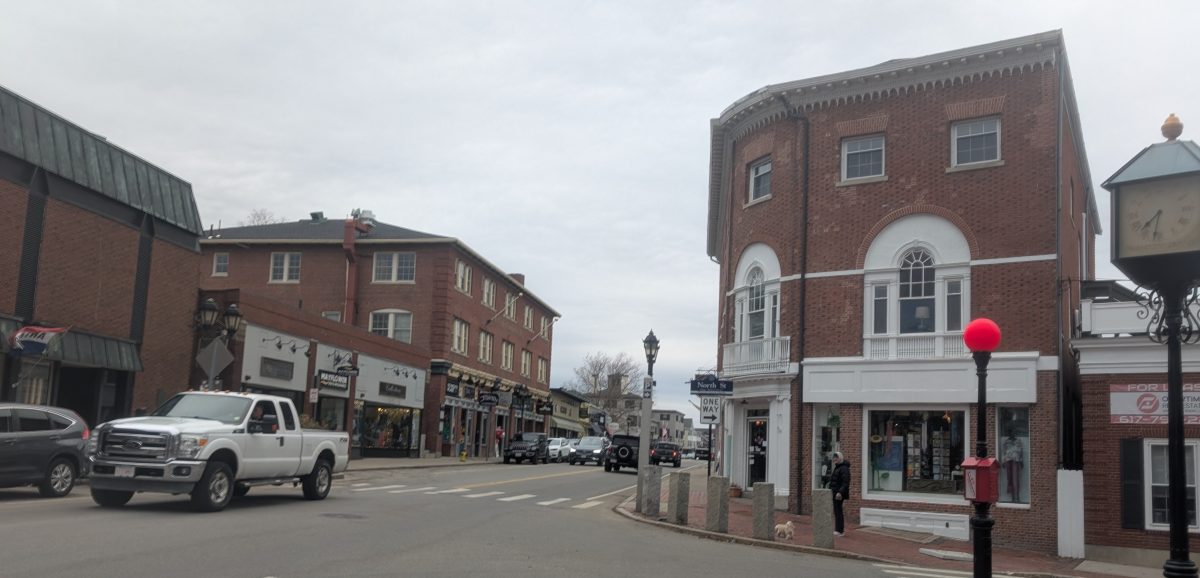
Bernards, of all the buildings, had the most prominent location. It sat at the corner of Main, North, and Court Streets with a rounded front to address all three streets. Bernards was a women’s clothing store and owned locally by the Kusmin family. In all the years of my youth, I don’t think I ever stepped foot in that store.
All three stores fell victim, in one way or another, to the opening of the Independence Mall in Kingston in 1989. Shopping tastes changed and the lure of the mall spawned the death of the stores and our downtown as well. As a sidenote, while employed as an architect for the Gap, I happened to see the study for the location for a new Gap and Gapkids in 1990 in Plymouth. Downtown was looked at but passed over in favor of the mall.
So many of these local designations are still used as landmarks when giving directions, as if they still existed. Much to the chagrin of my daughter, I expressed excitement over the new Himalayan restaurant about to open and gave her its location in the Buttner Building. Although she groaned, she knew exactly where I meant. And now, hopefully, you will as well.
Architect Bill Fornaciari is a lifelong resident of Plymouth (except for a three-year adventure going West as a young man) and is the owner of BF Architects in Plymouth. His firm specializes in residential work and historic preservation. Have a question or idea for this column? Email Bill at billfornaciari@gmail.com.