
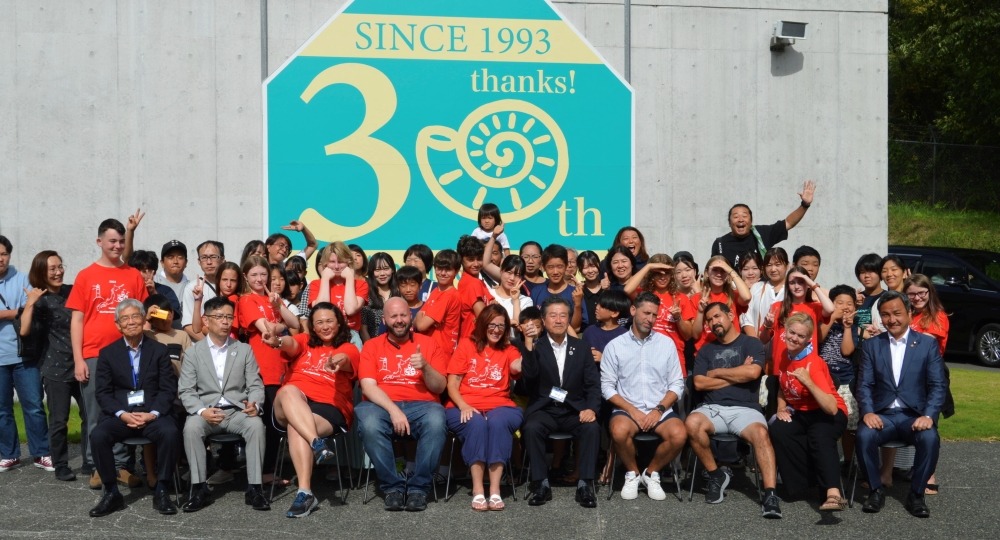
A delegation of 10 students, two chaperones, and eight “VIPs” are headed to Japan for an eight-day trip to Plymouth’s sister city of Shichigahama on July 29. Officials tout the excursion as beneficial to the town, but critics say it’s a junket that costs $30,000 and doesn’t produce a quantifiable return.
Select Board chair Kevin Canty, one of the VIPs going on the trip, says it has value on several levels.
“This exchange has been happening for decades and provides a unique opportunity for town officials to learn lessons from another community while also networking amongst themselves and provides students with a life changing opportunity to experience a week in the life of another culture,” Canty said in an email.
The arrangement between Plymouth and Shichigahama began in 1990. Every other year – except during the pandemic – a group from Plymouth goes there, and the following year a group visits from Shichigahama, which is on the Pacific coast of the main island of Honshu, 230 miles north of Tokyo.
At Tuesday’s Select Board meeting, resident Stevie Keith told members he is skeptical of the trip’s merits.
“Cultural exchange is great, but cultural exchange for adults is called a vacation,” Keith said during the public comment section of the meeting. “Are there strategic partnerships, economic exchange or education outcomes we can see? Will the public receive a formal report or a debrief when the delegates return?”
Canty said the trip doesn’t include a lot of down time for town officials. Their days are 10 to 13 hours long, he said, packed with visits to various locations to learn about how Shichigahama delivers services to its residents. The Japanese town, with a population under 20,000, is much smaller than Plymouth.
“Some people think it’s a vacation, but that couldn’t be farther from the truth as it is very much a working trip where the VIPs are representing Plymouth in an official capacity throughout the experience, similar to a state visit by a congressional delegation,” Canty said.
Town Manager Derek Brindisi, who went on the journey in 2023 – as did Canty – described it as “one of the best experiences I’ve ever had.”
Brindisi said the trip was mostly about engaging with local officials. Some of their conversations centered around the emergency response to the 2011 tsunami, in which 90 residents died.
“It’s definitely a mutually beneficial relationship [for] the two communities,” he said.
Keith also raised questions about how the officials going on the trip were selected. Former Select Board member Betty Cavacco, who has been at odds with Canty on several issues, had similar concerns.
“I think it’s a junket,” she said during Tuesday’s meeting.
In an interview Thursday, Cavacco said she was twice asked to go to Shichigahama during her tenure on the board.
“I never went because I couldn’t afford to pay my own way and I didn’t want that money taken away from the kids,” she said.
During Tuesday’s meeting, Cavacco also accused Canty of deciding who gets to on the trip.
“I do have an issue with the chairman going in and inviting the people that he thought was good instead of bringing that back to the committee,” she told the Select Board.
Canty pushed back against Cavacco’s assertion.
“The composition of the delegation was discussed at a Distinguished Visitors Committee meeting and then voted on by the Distinguished Visitors Committee,” he said in an email Thursday. “It was a unanimous vote of the members in attendance. Ms. Cavacco’s version of events have no basis in reality.”
The selection committee was made up of Canty, Chris Talamo, Len Levin, Steven Lydon, Town Clerk Kelly McElreath, and Robert Morgan.
This year’s delegation will include Canty as a representative of the Select Board, Steve Bolotin representing the Planning Board, Kathy Jackson representing the School Committee, Pompey Delafield representing the Committee of Precinct Chairs, Fire Chief Neil Foley, McElreath, assistant DPW director James Downey, and Rebecca Durocher, the school system’s assistant director of special education.
The town pays for airfare and ground transportation in Japan for the town officials, Canty said. Shichigahama pays for hotels and meals. Bolotin, however, said he is paying his own way.
Brindisi estimates that the town pays about $30,000 for the trip: $10,000 from the schools, $10,000 from the Select Board’s budget, and $10,000 from the Visitor Services Board.
The families of the seventh- and eighth-grade students going pay for their airfare and ground transportation, about $3,000 each, though the town hopes to reimburse them in part through available funds and donations from the Rotary Club and other organizations, Canty said. Students and chaperones stay with host families, while town officials stay in hotels.
“What was most impactful at the end of the trip “was the hugs and the tears when the students were saying goodbye to their host families,” Brindisi said. “They’re going to have these relationships for the rest of their lives.”
Cavacco argued that instead of paying for so many town officials to travel, consideration should be given to awarding scholarships for students who want to make the trip.
“When is the time that we are going to concentrate on the children that maybe didn’t have the $3,000 to be able to go there?” Cavacco asked the Select Board. “You should concentrate on the kids that can’t afford this kind of trip.”
Fred Thys can be reached at fred@plymouthindependent.org.