
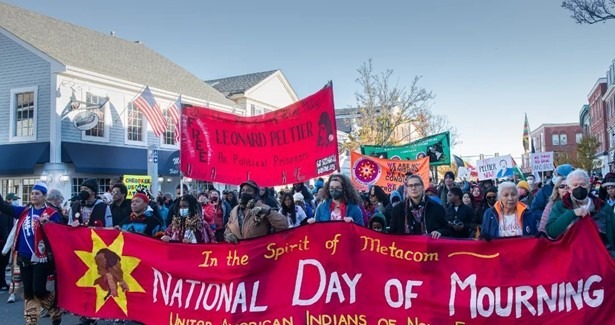
The National Day of Mourning, the annual gathering to remember Native Americans and the suffering they endured through colonization, will take place again on Thanksgiving in Plymouth as it has for more than 50 years after the town agreed not to impose new restrictions on the event.
The United American Indians of New England and its co-leader, Mahtowin Munro, sued the town on Monday, alleging that conditions recently set by the town violated a 1998 agreement.
They argued that requirements the group obtain a permit and insurance were impossible to meet and could derail the event, described in court papers as a “solemn, spiritual and highly political day” where participants “mourn Native ancestors… the genocide of Native people and the theft of Native lands.”
The first National Day of Mourning was in 1970.
In 1997, the event turned violent. Participants clashed with police when they attempted to march from Coles Hill through downtown. Some were pepper sprayed and knocked to the ground. Twenty-five people were arrested.
Charges against 23 protesters, many of whom were Native Americans, were dismissed at the request of the Plymouth Select Board, according to news accounts at the time.
Under a 1998 agreement, the town agreed to pay $135,000, including $120,000 to the ACLU Foundation of Massachusetts and $15,000 for two commemorative plaques acknowledging the National Day of Mourning.
The 1998 agreement also explicitly stated that in the future, event organizers would not be required to obtain permits or insurance, and that the town would make available a mobile stage for their use on Coles Hill.
On Tuesday, the United American Indians of New England asked a judge to bar the town from imposing the new conditions, which were communicated to the group only a few weeks ago.
After a brief hearing in Plymouth Superior Court Judge Joseph Leighton, who suggested he was leaning toward issuing the court order banning town from imposing restrictions, gave the lawyers 90 minutes to reach an agreement.
It took a little longer.
After about two hours, the sides announced a settlement.
The town basically backed down, agreeing to impose no new requirements this year — no insurance, no permit.
According to the new agreement, the town will “facilitate, prepare, and enable the National Day of Mourning activities to take place consistent with the historical practices after the 1998 settlement.”
For its part, United Indians of North America is required to release the town from responsibility for anything that takes place during the event.
The sides also agreed that before Feb. 1, 2026, they will meet to negotiate agreements for future National Days of Mourning.
Select Board member Kevin Canty, who attended the hearing and is an attorney, called the settlement “a significant step that helps address the town’s liability concerns while still allowing the event to go forward. as planned.”
“It also establishes a framework for the two sides to negotiate further on how to best work together to make sure this event can continue to be successful for years to come. We reached a true compromise, and I’m very grateful,” Canty said.
The town’s lawyer asked the organizers to get insurance because the town’s own insurer recently informed officials that any third-party group staging events needed adequate insurance, Canty said.
Over the past few weeks, the sides negotiated to try to avoid litigation, but were unsuccessful, the group argued in court papers.
Native Americans and others from around the country take part in the National Day of Mourning, which begins at noon on Coles Hill, overlooking Plymouth Rock.
“It is a day of remembrance, religious and spiritual significance, involving prayer, ceremony and solemn invocations, as well as a protest against the racism and oppression that indigenous people continue to experience,” wrote David Nathanson, a lawyer for the group, to Kathleen McKay, the town’s lawyer.
Andrea Estes can be reached at andrea@plymouthindependent.org.