
This is the second installment of a two-part series on the Great Fire of 1900 and the prospects of such a blaze taking place today.
In August, local fire officials kept an anxious eye on Hurricane Erin as it moved north along the East Coast. Most predictions had the storm staying steering clear of New England. But even a slight deviation from the projected path could have spelled trouble for the region, including Plymouth, because of persistent dry conditions.
“Mother Nature is unpredictable,” said Plymouth Fire Chief Neil Foley. “If the conditions are right – wind, drought and fuel – anything can happen.”
Fortunately, Erin didn’t end up generating the kind of winds that can turn a small fire into a conflagration, as happened with the Great Fire of 1900. Still, it illustrates the town’s precarious position when it comes to wildfires. Plymouth is unique because of its large expanse of pine barrens, about 26 square miles. When that land is dry – as it has been this year – conditions can pose a volatile fire threat.
“The fuel type in Plymouth – pine barrens – is second only to chaparral in California for flammability,” said David Celino, chief fire warden of the Massachusetts Department of Conservation & Recreation. He keeps a close watch on forests across the state, including Myles Standish State Forest – part of one of the largest Atlantic coastal pine barrens ecoregion north of Long Island. “Pine barrens can burn very quickly, like in the Plymouth fire of 1957. That one burned about 15,000 acres in just 12 hours.”
To say a blaze like the Great Fire of 1900, which scorched more than half the town, could never occur again is to ignore the dry, wind-blown facts. Truth is, if a “perfect storm” of conditions presented itself, Plymouth could be faced with a serious situation – especially in an era of warming temperatures and reduced rainfall brought on by climate change.
“In my opinion, it is the greatest danger Plymouth faces today,” said retired Plymouth Fire Captain John Hedge, who battled his share of destructive wildfires during a lengthy career. “There are a lot more people living here today.”
Indeed, Plymouth has seen huge growth in the southern part of town over the past few decades. Large developments like The Pinehills, White Cliffs and Ponds of Plymouth – to name a few – have added tens of thousands of residents to an area that was sparsely populated 125 years ago.
“If a fire comes out of the woods again, you have all these people there now,” Hedge said. “It could be real trouble. You cannot see when a fire is on you, the smoke is so dense. I pray this never happens again.”

In 1977, Select Board member Bill Keohan was a seventh grader at what was then Plymouth-Carver Intermediate School, when a blaze forced the cancellation of classes.
“The fire was in the Town Forest, which is next to PCIS,” he said. “We could see the smoke billowing over the school. Mr. Brown, the principal, came over the PA to tell us they were sending us home.”
Keohan added cautiously, “It seems like we haven’t had a major fire in some time. Are we prepared?”
The answer, according to experts, is yes. New technology, training, and techniques for fighting woodland fires – along with modern communications and a critically important early warning system – help mitigate the danger. But that, of course, does not mean a serious wildfire couldn’t take hold.
“Fire towers are crucial to this effort,” said Michael T. Marquardt, DCR’s forest fire warden for Plymouth County District 2, which covers the state forest in Plymouth.
Plymouth has a 75-foot-tall fire tower deep in the Pine Hills, near Long Ridge Road. That structure, along with others in Kingston, Carver, and Middleborough, help keep watch on activities in the state forest.
“When conditions are at Level 3 or higher, we staff the towers and watch for any sign of smoke and fire,” Marquardt said. “We spring into action as soon as we see something.”
Plymouth has a history of wildfires that pre-dates the Pilgrims. The Wampanoags, the region’s indigenous inhabitants, dealt with the threat by burning off brush and dead trees on a regular basis. The town’s English settlers kept up that practice during colonial times with prescribed burns, but those planned fires eventually fell out of favor.
Over the centuries, Plymouth wildfires have caused great damage and cost lives. The 1957 fire burned through the state forest to the sea, scorching the area now home to The Pinehills residential community. Hedge and retired Plymouth Fire Chief Thomas Fugazzi were children then. They remember watching that blaze ravage the landscape.
“It was in the spring,” Fugazzi recalled. “That was the time of year when we paid a lot attention to wildfires – that dry period before summer started.”
A 1937 fire burned through seven miles of woodlands and killed two firefighters when the wind shifted and trapped the men. James Devitt, 20, and Herbert Benton, 38, died and others were badly burned by the blaze. A memorial plaque at Station One on Sandwich Street honors the sacrifice of the two men.
In 1964, another fire ripped through Myles Standish State Forest, burning some 5,500 acres of woodlands and destroying 26 structures. It happened just before the rapid development of the southern half of town began in the late 1960s.
Other fires burned smaller areas in the 1990s and into the new millennium. Just last Saturday, a wildfire broke out near Darby Pond along the Kingston town line, though quick action by the Plymouth Fire Department put it out in a few hours. Last year, a fire along Savery Road burned some 30 acres before it was brought under control.
“We had a lot of resources to help us with that one,” Foley said. “We can get a lot of aid from neighboring communities and the state when we need it.”
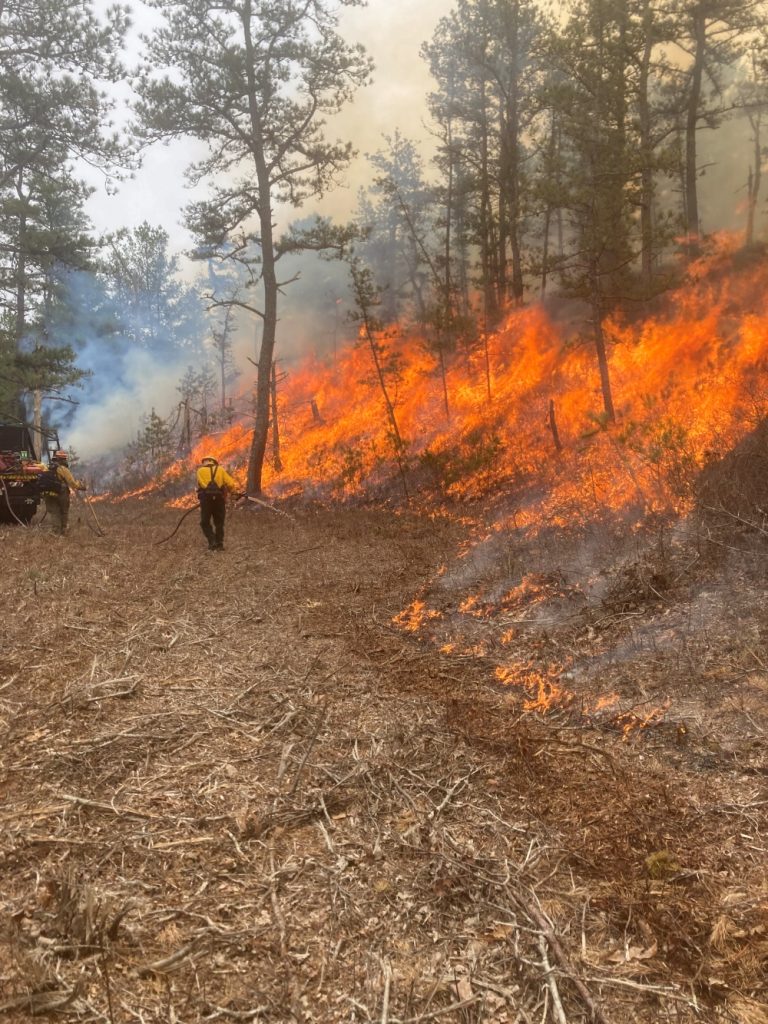
Along with mutual aid between towns and fire towers, Plymouth today has a lot of tools to deal with wildfires not available in 1900: modern firetrucks that can bust through dense undergrowth to get close to the blaze, tanker trucks with hundreds of gallons of water, communication systems to direct crews to hot spots, powerful chainsaws to cut down trees, even air support.
“We can call out the National Guard for help,” Celino said. “They have Cobra helicopters to help us battle fires. If it gets really bad, we can call in large tanker aircraft from Quebec. We did that once, but then got the blaze under control before the plane arrived.”
Established in 1949, the Northeastern Forest Fire Protection Compact enables the six New England states, New York and eastern Canadian provinces to all work together in the event of large fires. Crews and equipment from across the region can be quickly dispatched to fight major blazes whenever they erupt.
Training is another key improvement over the past 125 years. More is understood about fire dynamics and how to deal with wildfires than in 1900. In Massachusetts, all new firefighters go through an intensive one-week education program about how to fight fires in wooded areas.
“All our recruits get wildfire training before the go to the fire academy,” Foley said. “We want them to get a taste of what to expect when the inevitable happens.”
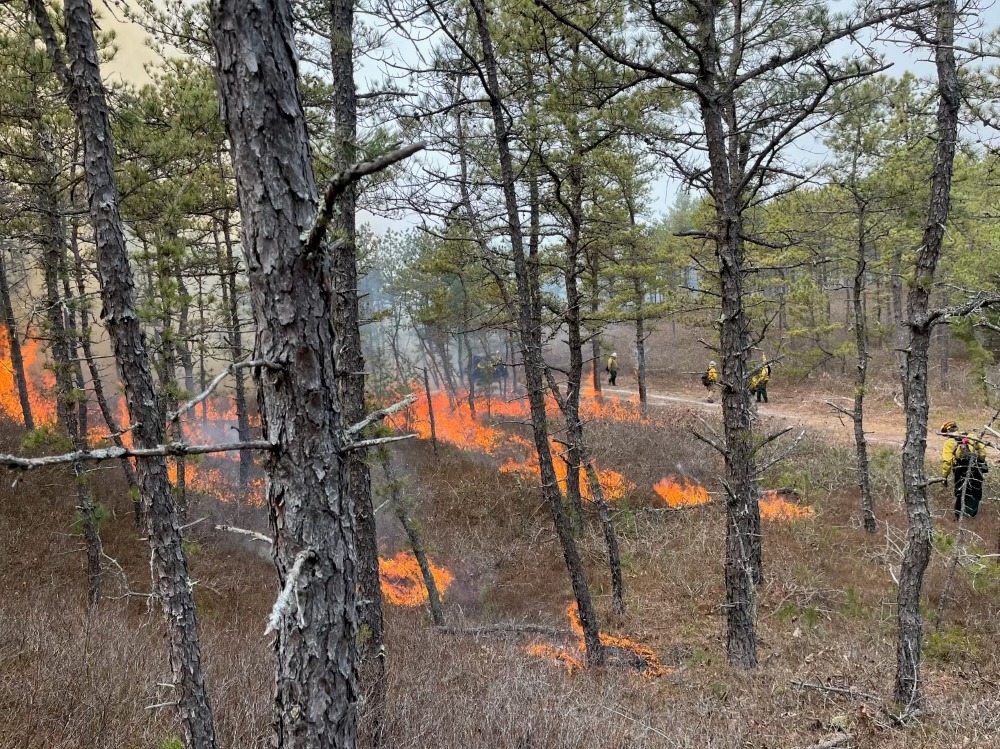
In a nod to the Wampanoags, prescribed burns are also part of the effort to reduce the danger. Plymouth Fire Department and Myles Standish State Forest work together to set fire to selected woodland areas throughout the town to reduce the amount of fuel on the ground.
In addition, officials implemented a program to clear a 200-yard buffer around the borders of the state forest. Over the past several years, bulldozers, mowers and other heavy equipment have chopped down thick brush and dead trees to reduce the chance of a wildfire spreading from Myles Standish to populated residential areas.
“We use contractors for this Hazardous Fuel Reduction Program,” Marquardt said. “We want to keep the vegetation under control.”
Residents need to do their part to protect hearth and home. According to Foley, it is important to clear away brush and other flammable materials from structures near woods and forests. He urged everyone to follow the guidelines established by the National Fire Protection Association to prepare their homes for wildfires.
“DCR also provides education and home assessments for property owners and neighborhoods,” the Plymouth chief said. “Firewise USA is also another good resource.”
Foley also asked people to participate in the Community Wildfire Protection Plan, which is being formulated now by the town. Local input is critical to determining public concerns. Residents can take a survey to help shape this program.
While these efforts are important for controlling the risk of out-of-control wildfires, fire officials agree that it is impossible to prevent a major conflagration in certain situations. If conditions are in a “perfect” state – such as with the hurricane winds and severe drought of 1900 – everyone is at the mercy of Mother Nature.
“When you realize the potential of what we are dealing with, it raises the hair on the back of my neck,” Celino said.
Dave Kindy, a self-described history geek, is a longtime Plymouth resident who writes for the Washington Post, Boston Globe, National Geographic, Smithsonian and other publications. He can be reached at davidkindy1832@gmail.com.