
As Plymouth and Kingston jockey for position in the race to attract a new Costco, the owner of the potential Plymouth site hoped a green light from the town to build a gas station on its land would accelerate it into the lead.
But faced with opposition from some residents and the owner of the Mobil gas station across the street, the Plymouth Zoning Board of Appeals pumped the brakes Monday night on the application of T.L. Edwards Inc., which wants to build a gas station and convenience store at the corner of Cherry Street and Commerce Way — the entry point for its gravel yard and rock crushing operation visible from Route 44.
The delay points to the long road ahead for customers who want to shop for bulk bargains at the popular warehouse club, since it will likely be several years before a new Costco is fully permitted and built at either site.
“We have two attorneys setting us up for a lawsuit, and I’ve had enough of lawsuits,” said ZBA member Edward Conroy, who ultimately moved to delay action on the gas station permit so the board could gather more information about the case.
The two attorneys both cited technical problems with the required notification of direct neighbors and the general public who may want to weigh-in on the proposal. More substantively, both the attorney representing “concerned citizens” and the Mobil station asked for an independent third-party engineering review of the site plan. They want to ensure compliance with local and state regulations because a portion of the site falls within the state’s water protection zone and the town of Plymouth’s aquifer protection district.
Three public water supply wells are within the protection zone. Two Kingston wells are next to the mall property, about 2,000 feet from the T.L. Edwards site. One Plymouth municipal well is about 2/3 of a mile to the south, in the Industrial Park on the other side of Route 44.
“Allowing this prohibited use recklessly exposes the Plymouth drinking water supply to a risk of contamination,” said Valerie Moore, attorney for the gas station and convenience store at 131 Commerce Way, which is not within the water protection zone.
Erik Schoumaker, the project engineer for T.L. Edwards, walked the board through the site plan, showing that the proposed gas pumps and storage tanks are not within the water protection zone, but other parts of the project are, including the underground stormwater collection system.
He said a review by the Plymouth Department of Public Works, which prompted several refinements including installation of monitoring wells to check for any impact on the ground water, found the gas station plan in compliance with the water protection regulations.
But Moore disagreed, arguing state law requires the entire site to comply with the tighter restrictions of the water protection zone. “This site straddles the aquifer protection district which precludes new fuel tanks of this size,” she said. “In Massachusetts, when a property is split-zoned liked this, if a use is not allowed in one of the districts within that property, but is allowed in the other district, then the more restrictive use applies to the entire property.”
Kingston and Plymouth have been courting Costco for over a year. Both communities changed the zoning of the proposed sites to accommodate the development. Kingston lifted a long-standing moratorium on new connections to its water supply. Now the question of the best place to build a Costco gas station is a central point of contention.
In Kingston, the main Costco club is planned for the shuttered Macy’s department store site at the Kingston Collection Mall. But building an associated gas station near the club is complicated by the proximity of two of the town’s drinking water wells. There is a water protection zone around those wells prohibiting a gas station or other uses because of the risk of contamination to the ground water.
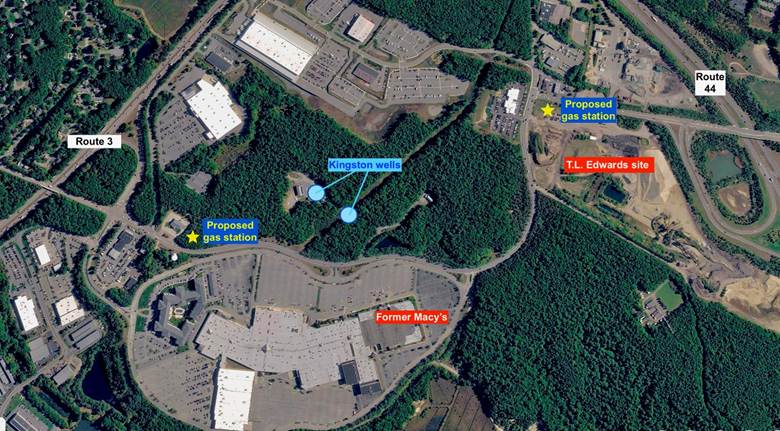
To get around the water protection zone, Kingston Town Meeting last April approved a land swap between the town and the mall owner, exchanging parcels to create just enough land to squeeze in a gas station next door to the town’s fire station on the approach road to the mall.
Most of the site is outside of the water protection zone, but it would not be the typical model for Costco’s gas stations, which are generally closer to the main wholesale club and accessed by the same parking lot to accommodate the often-long lines for its celebrated low-price gasoline.
William Sims, attorney for T.L. Edwards who was not at the ZBA hearing, emphasized the proposed gas station in Plymouth is not in the water protection zone and would be further away from the Kingston wells than the potential site near the Kingston fire station. Plus, building the gas station on the gravel yard site would be integrated with a Costco parking lot.
“We are competing with the Kingston Collection and we hope Costco will like our site,” Sims said.
Florida-based Second Horizon Capital, owner of the Kingston mall, declined a request to be interviewed for this story or to answer specific questions sent by email. Instead, the company emailed a statement to the Independent.
“Mall redevelopment is a significant undertaking,” the statement said. “We remain committed to the long-term repositioning and transformation of Kingston Collection. Additional details will be shared as plans progress.”
Whether the development ultimately lands in Kingston or Plymouth, not much would change for future customers or employees of a new Costco, since the competing sites are about half a mile apart—just as easy to shop or work at either location. The big difference for the towns is the prospect of about a quarter of a million dollars in property tax revenue.
The newest Costco in the region opened last year in Sharon. It’s a wholesale club and gas station assessed at $24,457,000. The Costco in Dedham, which also has a gas station, was built in 1997 and is assessed. at $18,887,600. The Costco in Avon, built in 1991, does not have a gas station and is assessed for $10,423,300. In Plymouth, the BJs club and gas station off Long Pond Road was built in 2004 and is assessed at $17,454,800.
A $20 million assessed value for a new Costco and gas station, would translate to $256,400 in annual real estate taxes for Kingston or $251,000 for Plymouth, at current rates. It could roughly triple the revenue the towns currently reap from those sites.
Meanwhile, the land swap with Kingston approved at Town Meeting has not been finalized and no applications related to a potential Costco have been filed in Kingston.
“I hope we see some activity this spring,” said Kingston Town Administrator Scott Lambiase. “With these kinds of projects, typically they would want to do some due-diligence, soil borings to see what they could actually do on that site before moving ahead.”
The Plymouth ZBA will continue its review of the gas station project at 6 p.m., April 27, at Town Hall.
“Nothing is agreed to and nothing has been signed, but we continue to have serious discussions with Costco and would love to have them in Plymouth,” Sims said.
Costco posted $269.9 billion in sales in 2025 from its 914 clubs around the world. It opened 24 new clubs in 2025. The company does not comment on possible locations until they are within three months of opening.
Michael Cohen can be reached at michael@plymouthindependent.org