

The second in a series of articles about Plymouth’s open spaces.
When Lewis and Clark, at the behest of President Jefferson, left St. Louis in 1804 on their two-year journey to the Oregon coast and back they packed a lot of stuff, including 400 pounds of lead, three bushels of salt, 193 pounds of portable soup, and a 55-foot iron-framed boat that often needed to be portaged. They were, after all, taking a party of 30 through 2,000 miles of wilderness. Along the way, Lewis took time to fill volumes with notes and detailed drawings of the flora and fauna they encountered. Nevertheless, I would bet dollars to doughnuts that Lewis and Clark covered more ground per hour than I do when walking a nature trail with my dogs, Tot and Salina.
On a recent picture-perfect day, we walked the short trail (1,600 feet) in the Rocky Point Preserve, a 24-acre town conservation property. There wasn’t a rock, stick, or plant that didn’t warrant extensive olfactory investigation by the dogs, presumably to decide which select few were worthy of being peed on. So, to say our walk to the absolutely magnificent views of the bay took a little longer than expected would be an understatement. Without dogs, you can traverse the entire path in about 10 minutes.
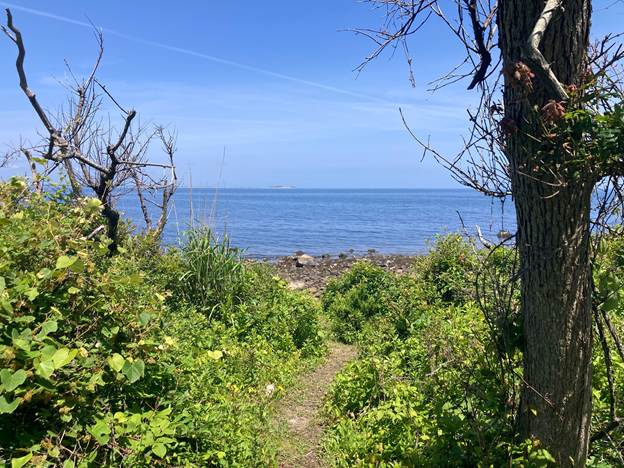
Located just north of the former nuclear power plant site on Rocky Hill Road, this small park seems to draw little attention. Indeed, the parking area can accommodate all of two cars, or one Tesla Cybertruck, whichever gets there first. Most of the path is wide (an occasionally used dirt road, by the looks of it), until for the final couple of hundred yards it narrows to about 18 inches or so. There’s nothing unique about the trail until the payoff at the end – two overlooks with views of the bay that take your breath away and, except for the breeze riffling the leaves in the trees, complete and utter silence. To the northwest, the Gurnet and Saquish appear closer than they do from downtown Plymouth, perhaps because you’re standing, by my reckoning, about a couple of hundred feet above sea level. There’s no beach access here. Besides, the beach, as the name suggests, is composed almost entirely of rocks and boulders.
Use caution here. The only barrier between you and the sheer vertical drop to the rocky beach below is a rudimentary railing, three two-by-fours nailed together, a safety net of dubious utility whose main function appears to be a visual cue to venture no further. If you bring your dogs here, be sure and leash them and if you bring young kids here, leash them, too. (Please, no angry emails. I mean that metaphorically.)
I’ve only lived in Plymouth since December, and the town has been slowly revealing itself to me. But nothing thus far has been as pleasant a surprise as the bike path/rail trail that runs parallel to the shoreline from Lothrop Street on the waterfront to Cordage Park. It’s known by many names: North Plymouth Rail Trail, Seaside Trail, Seaside Rail Trail, Plymouth Seaside Grace Trail, and, my favorite, Grace Trail. It’s only about 1.5 miles long (the All Trails app puts it at 1.7 miles), but oh what a stretch it is. Plymouth has delighted me in many unexpected ways, and I’ve liked it from the start, but I think the day Tot, Salina, and I walked Grace Trail was the day I fell in love with the town.
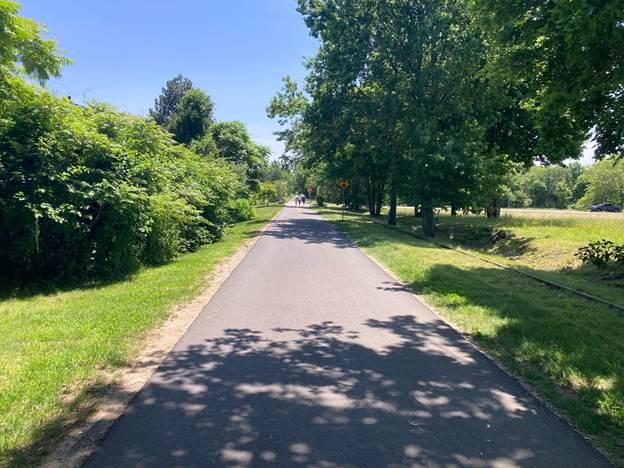
We started in Nelson Memorial Beach Park. The parking lot here isn’t large but there’s ample free municipal parking just across the street from the entrance. The water views, especially on the sunny, breezy day we were there, were as beautiful as any to be found on the Cape and Islands. The sea air was intoxicatingly fresh, and this being a rail trail, it was flat. There were almost no bikes on the trail but hundreds of pedestrians, including a lively group of Hedge Elementary School kids and their teachers enjoying “beach day” on the next to last day of the school year. From a high branch in a dead tree by the bay, a bald eagle surveyed the scene. You won’t find the solitude so many of Plymouth’s other open spaces offer, but you won’t find another place so proximate to downtown that offers such a pleasant stroll.
Grace Trail isn’t named for someone named Grace; it was the first of 10 such trails around the country with designated stops along each that encourage you to “access your inner wisdom, courage, and hope.” Grace is an acronym for Gratitude, Release, Accept, Challenge, Embrace. Along the trail are five large rocks engraved with questions that relate to these words and designed to inspire self-reflection. The first, for example, is “What am I grateful for?” Other Grace Trails, the brainchild of Plymouth resident Anne Jolles, can be found in Troy, TX; Shawanu, WI; and East Lyme, CT, among other places. I couldn’t wait to walk Plymouth’s Grace Trail again, so I went back the next day. That bald eagle was still there on the same branch of the same tree.
Eel River Preserve, located at 2 Boot Pond Road, on the corner of Long Pond Road, is also a town property, 40-acres with three miles of walking trails, including sections of wooden bog bridges. Like Massachusetts Audubon’s Tidmarsh Wildlife Sanctuary, which I wrote about in my last column, Eel River Preserve comprises retired cranberry bogs restored to their native state. An astonishing 17,000 Atlantic white cedar trees have been planted here which, according to the town website will “make the Preserve one of the largest Atlantic White Cedar swamps in the state” when they reach maturity. Which begs the question, how many Atlantic White Cedar swamps could there possibly be in Massachusetts? The answer, I was surprised to learn, is 32.
It’s a beautiful place awash in blooming multiflora roses that subtly perfume the air. But among the roses are thorns in the form of…ticks. Ticks, ticks, and more ticks. In addition to the dozens I picked off the dogs and myself, two hours after we got home, I was still at it. No bites (at least not yet) but be forewarned. For now, I’ll stick to the Grace Trail where I can be grateful there are no ticks, thank you.
Peter Zheutlin – a freelance journalist who has written frequently for The Boston Globe, The Christian Science Monitor, and many other publications – brings the perspective of a Plymouth newcomer to the Independent. He is the author or co-author of nine books, including the New York Times bestseller “Rescue Road: One Man, Thirty Thousand Dogs, and a Million Miles on the Last Hope Highway.” Zheutlin can be reached at pzheutlin@gmail.com.