

The weekly Farmers Market on the South Street library’s lawn went on as usual Thursday afternoon. Vendors sold organic fruits, vegetables, and homemade goods under pop-up canopies pitched across the tamped down grass.
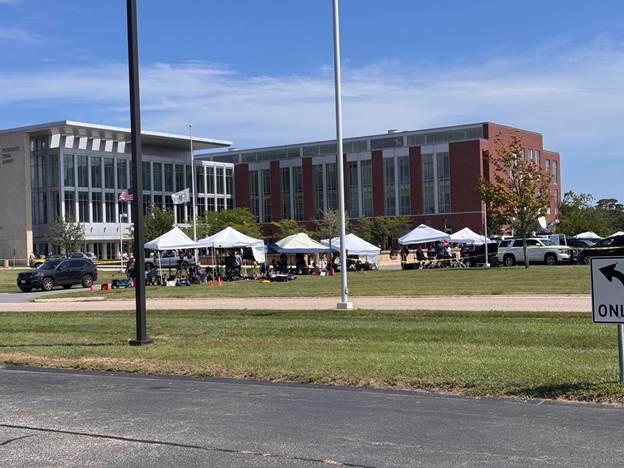
Less than a half mile away on Obery Street, the same type of coverings shielded people from the late summer sun’s reach. Underneath, TV crews prepped for live shots, fiddled with computer equipment, or hurriedly downed take-out salads and sandwiches.
“Who ordered the vinaigrette?” someone asked.
But the scene was vastly different from the one at the library and a different question – one holding infinitely more weight – hovered over everything and everyone: Was she responsible for murdering her three children?
“She,” of course, is Lindsay Clancy. The site was Plymouth Superior Court.
As most everyone knows by now, the former nurse is on trial for killing Cora, 5, Dawson, 3, and Callan, 8 months old, in the basement of the family’s Duxbury home in January 2023. After strangling them with exercise bands, Clancy, 36, cut herself and then attempted to take her own life by jumping from a second-story window, leaving her paralyzed from the waist down.

No one disputes she carried out the unimaginable acts. At issue is whether Clancy knew she was committing the atrocities. The prosecution called it first-degree murder. The defense, headed by high-profile attorney Kevin Reddington, offered the so-called insanity defense, citing postpartum psychosis.
After almost five weeks of testimony, the case went to the jury Thursday. The 12 jurors weighted with determining Clancy’s fate deliberated for about four hours before being sent home by Judge William Sullivan. They will reconvene Friday morning.
“Don’t read anything about this case, don’t talk about this case with anyone,” Sullivan told the nine women and three men.
The trial is drawing national and even global attention. The “Plymouth” dateline has shown up in hundreds of stories and posts. NBC’s “Dateline” referred to the town as “a suburb of Boston.” Friday’s episode of the hugely popular New York Times podcast “The Daily” focused on the goings-on in Plymouth.
But even though the proceedings are being held here, the story is not truly a local one. The courthouse, a modern and foreboding fortress that dominates the flat landscape, is at once close and distant, removed from the everyday lives of most Plymouth residents.

The 150 or so people gathered outside as deliberations began were mostly from media outlets, a throng punctuated by podcasters, true-crime geeks, and mental health advocates.
“Each minute past 30 shows that [Reddington’s] going to get a favorable outcome,” one man said to no one in particular.
Nearby, a woman with bleached white hair and ample tattoos, told her companion, “Don’t take this the wrong way, but you can’t understand how I feel about Lindsay because you’re a man.”
A thin man in a tight-fitting stretch shirt pointed his microphone toward a middle-aged woman who seemed eager to offer her opinion.
“Do you think there’s any credence that Clancy might have wanted to get her to do it? he asked.
“Patrick?” she said. “Yeah, absolutely.”
As they spoke, an. aluminum light tripod, captured by a gust of wind, skidded across the pavilion outside the court entrance.
A jagged row of microphones on stands awaited post-verdict comments from the prosecution and defense.
But the gear stood unattended Thursday.
By early morning Friday, the crowd will reassemble. The waiting will resume, along with the chatter. Maybe word will come from inside: The jury has reached a verdict.
Guilty of murder? Not guilty by reason of lack of criminal responsibility? A deadlock?
TV lights will glare, photographers and reporters will jockey for position, onlookers will cheer, cry, gasp, scream. Eventually, the “breaking news” newscasts will cease, the canopies will come down, the equipment packed away.
“Live from Plymouth” will give way to just living in Plymouth. And this sickening trial that struck close to home for so many will eventually become a faded footnote in local history. Let’s hope the names Cora, Dawson, and Callan remain vivid.
Mark Pothier can be reached at mark@plymouthindependent.org.