
At what point do you stop pouring money into a car with sentimental value and a growing list of problems?
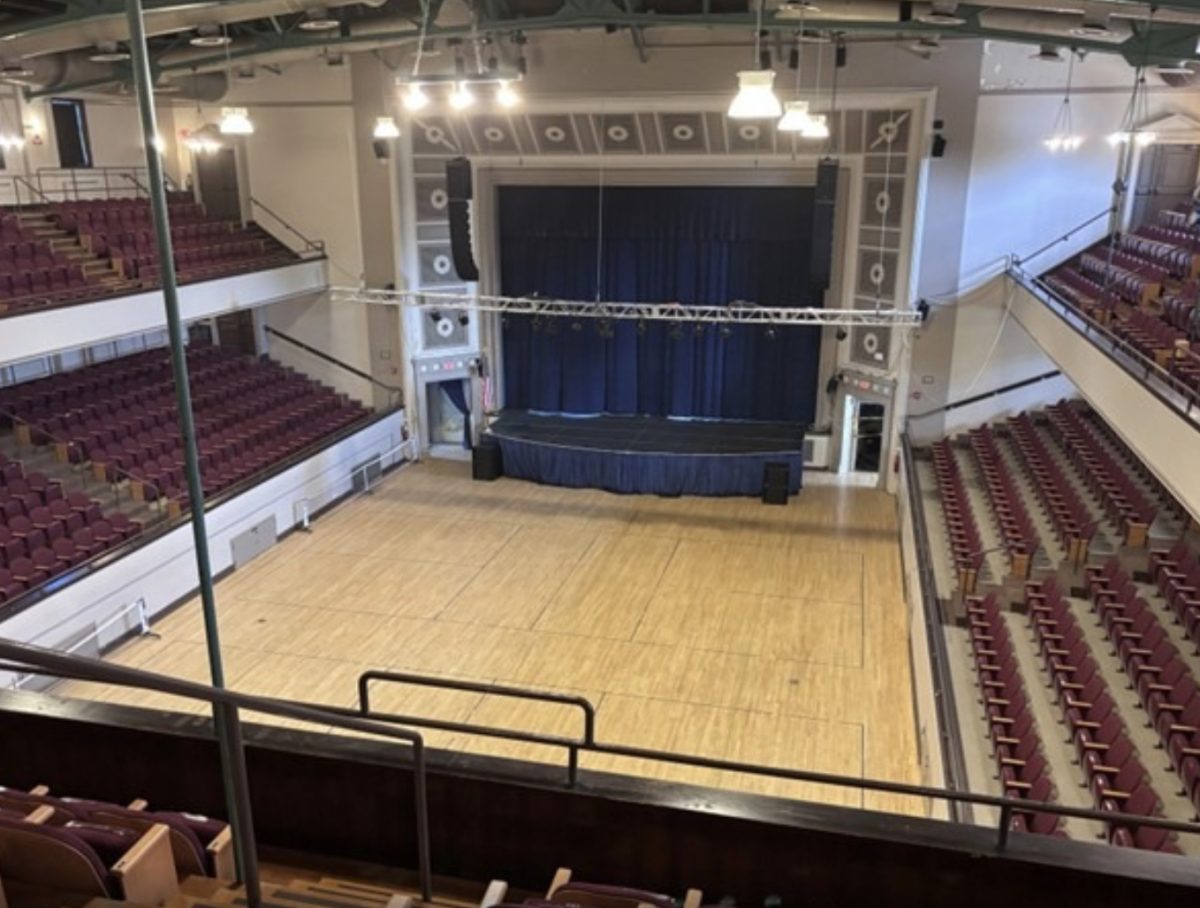
It’s not a perfect analogy, but close enough to apply to Memorial Hall. The century-old downtown venue has been decaying for years. I first wrote about its sad state last July, after touring the space with Town Manager Derek Brindisi; Joe Goldberg, its events director and facilities manager; and Karl Anderson, the town’s facilities manager.
Within weeks, a proposal to use $15 million in Community Preservation Act funds to partially restore the building was proposed and then pulled amid scrutiny of the hall’s long-term viability.
The project had been estimated at $22.6 million in total, but even a more comprehensive renovation – pegged at $34 million or more – would not include all the amenities and technological upgrades needed to lure major touring shows to the town-owned building.
Brindisi warned that without some Band-Aid fixes – mostly to deal with water seeping through the foundation – Memorial Hall would have to close within two years. The Select Board OK’d spending $750,000 on emergency repairs.
The question has since become: Should the 1,448-seat hall be saved or torn down and replaced by a state-of-the-art facility that could compete with similar-size performance venues in other communities? From my layman’s perspective, the latter option seems more sensible. Anyone who’s undertaken a home renovation job knows it costs much more and takes longer than initial estimates.
With that in mind, Town Meeting in October signed off on using $90,000 in CPA money for a feasibility study that has yet to begin. The research will focus on what historical aspects of the building might warrant preservation.
Now Memorial Hall has a new issue. A crack was recently discovered in one of its two massive steam boilers, which date to around the 1950s. The boiler heated the hall’s Blue Room, the Hall of Flags – an area devoted to local military veterans – the kitchen, restrooms, and other spaces. The second furnace heats the main hall.
The cracked boiler can’t be repaired. Replacing it will cost an estimated $145,000, Brindisi said Thursday. The work will likely require the Finance and Advisory Committee to authorize an emergency funds transfer.
A February 25 performance by the Robert Cray Band and a February 26 show featuring Lyle Lovett and John Hiatt were postponed because of last week’s blizzard (the Lovett-Hiatt date is reset for March 9), but “had the storm not occurred and temperatures remained as cold as they were, we likely would have needed to reschedule events because of the boiler,” a town spokesperson said in an email.
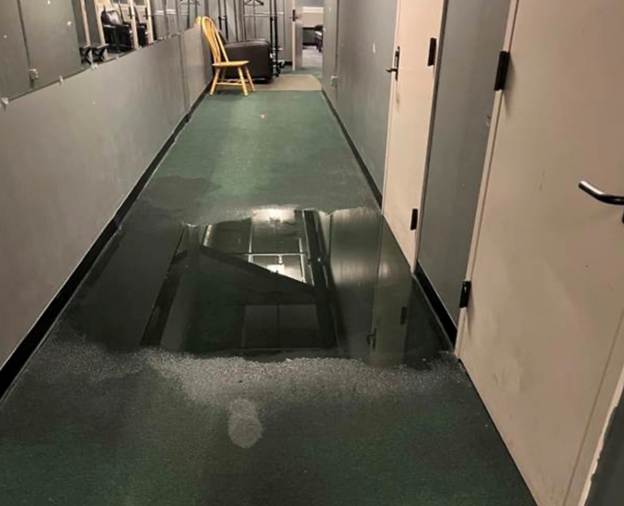
There is one piece of good news in all this: The emergency work to stop water from getting in through the foundation has been completed, which should keep the dressing room and electrical panel areas dry. But water continues to seep through the east and north walls.
Brindisi told me the boiler failure hasn’t caused him to reconsider backing the idea of spending tens of millions of dollars on Memorial Hall, but he’s a pragmatist. Another option up for consideration, he said, is to sell the building to a nonprofit. It’s a model that has worked in other cities and towns, including the Hanover Theatre in Worcester and the Music Hall in Portsmouth, NH.
“Maybe the building gets torn down and replaced with a more 21st century version,” Brindisi said.
The Plymouth Foundation also plans to issue an RFP, or request for proposal, “to hire a consultant to help us do an analysis of the future of this building,” he said.
Ideally, Brindisi said, the Select Board will be presented with two or three options. Putting off action won’t be one of them. The space is a cornerstone of the town’s cultural scene. Downtown restaurants and bars depend on the business it generates.
Stepping back, the serious issues with Memorial Hall are indicative of the town’s failure to do proper long-term planning – and perform regular maintenance – for some of its most valuable community assets. Too often officials have been reactive rather than proactive, resulting in costly crisis scenarios like this one.
To be fair, Memorial Hall was in rough shape long before Brindisi became town manager or most current Select Board members were elected. But it’s their mess to deal with, and the longer it takes to do so, the more expensive the resolution.
The water woes have long been known. Fifteen years ago, a private firm conducted an analysis of the structure using infrared technology. It found water was getting into the building then, according to a report, but “no professional remediation” action was taken.
That’s just one aspect of the decay allowed to progress unabated. The HVAC system is another. Brindisi said last year that replacing it would take about $5 million. You can bet the figure has increased.
Beyond that, the main room is not a comfortable venue for a show or concert, no matter what the temperature. It’s a creaky gymnasium, better suited for volleyball than a philharmonic orchestra or ‘80s band. Even if the heating and air conditioning worked properly, even if the lower level didn’t flood with several inches of water, audiences would still be crammed into tiny seats while performers wrestled with inferior stage facilities and a dressing room that makes a no-tell motel look inviting.
Circling back to that old-car analogy, Memorial Hall may have racked up too many miles without regular oil changes to save it from the scrap heap. Especially by the time consultants’ reports are commissioned and completed, boards debate what to do next, and Town Meeting finally acts. Let’s hope the transmission doesn’t go in the interim.
Mark Pothier can be reached at mark@plymouthindependent.org.