
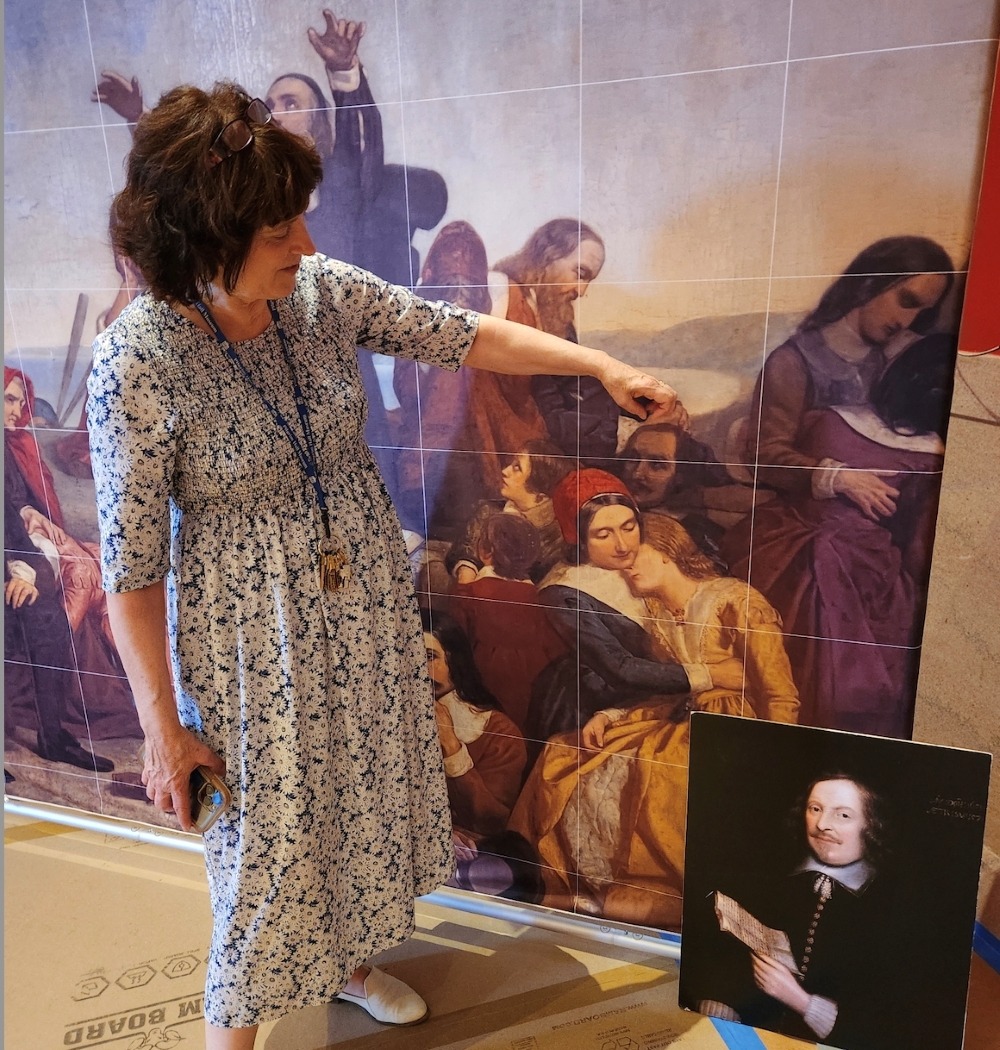
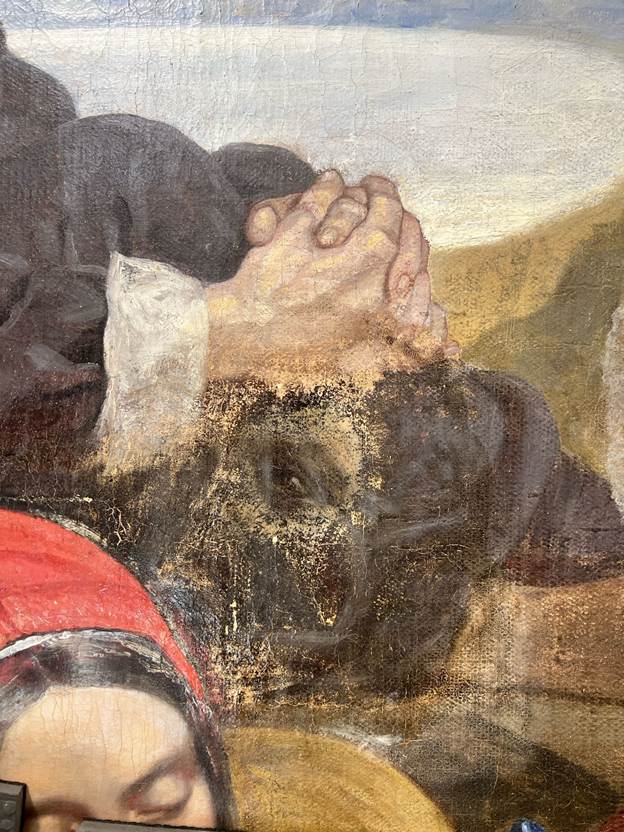
For 145 years, a disembodied head has stared at visitors to Pilgrim Hall Museum. No, it wasn’t a spectral visage or a floating face from another dimension. It was Mayflower passenger and eventual Plymouth Colony governor Edward Winslow popping up in a painting he wasn’t supposed to be in.
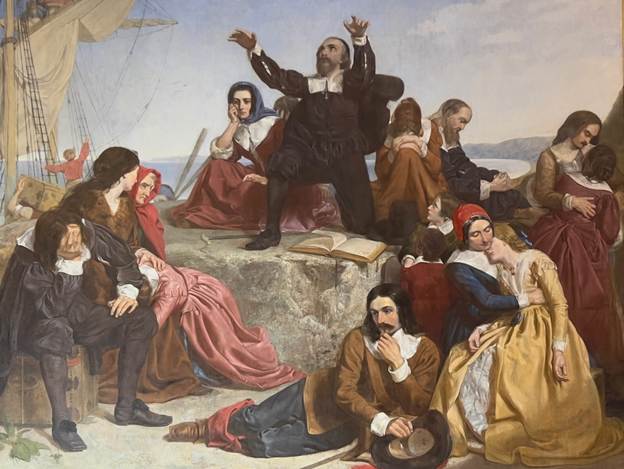
Renovations at the 201-year-old downtown museum aimed at preserving the Pilgrim legacy revealed that one of the large murals in the main hall was touched up sometime after it was painted in 1847 by English artist Charles Lucy. Depicting an emotional scene just before the Separatists left Holland in 1620, the massive “Departure of the Pilgrims from Delft Haven” had the head of Winslow added just below the clasped hands of William Brewster.
“People have wondered for decades about the head,” said Donna Curtin, Pilgrim Hall’s executive director. “It’s very dark and seems crammed in there. Also, it depicts Winslow as an older man, not the youth he was in 1620 when this took place. It looks the same as the portrait we have of Winslow, which was painted when he was nearly 60.”
Curtin directed conservators to check the painting closely, including the head, as they removed more than 150 years of grime and soot from the oil-painted canvas. While they were cleaning the 14-by-9-foot mural – which weighs more than 600 pounds with its wooden frame – the restorers discovered two areas had been altered: Winslow’s head and the face of Miles Standish, whose mustache had been painted over.
“These were not part of the original plans by the artist,” Curtin said. “We have an undated engraving, presumably done not long after Charles Lucy completed the painting, showing no head and Miles with a mustache. Standish’s collar was also shortened.”
“Departure of the Pilgrims from Delft Haven” depicts a range of emotions of the Pilgrims as they prepared to leave Holland for an uncertain future in the New World. Fear, despair, and pain of leaving loved ones clearly show in their faces. The central figure is the Pilgrim’s spiritual leader Rev. John Robinson, who leads his congregation in prayer. Also included are John and Catherine Carver, William Brewster, William Bradford and his wife, Dorothy, and Winslow’s wife, Elizabeth – but not Winslow.
It was painted as part of an 1847 competition to replace artwork destroyed in a fire at Westminster Hall, a medieval great hall at the Palace of Westminster, where British Parliament meets in London. Lucy won 200 pounds – about $27,000 today – but his painting was not selected to be hung at the hall.
Instead, it went on tour across England, where crowds viewed the mural while listening to a lecture on “The Pilgrim Fathers” by Rev. Hugh Stowell Brown, an English Baptist preacher. Eventually, the painting was acquired by former Massachusetts Gov. Alexander Hamilton Rice, who donated it to Pilgrim Hall in 1880.
Last year, the museum began a major capital restoration project to replace its failing roof, along with other improvements, paid in part by a grant from Community Preservation funds. The decision was made to also restore two of the three large murals in the main hall: the Delft Haven one and “Embarkation of the Pilgrims” by Edgar Parker in 1875, a copy of an 1843 painting by Robert Weir, which hangs in the US Capitol building, funded in part by the town’s promotions fund.
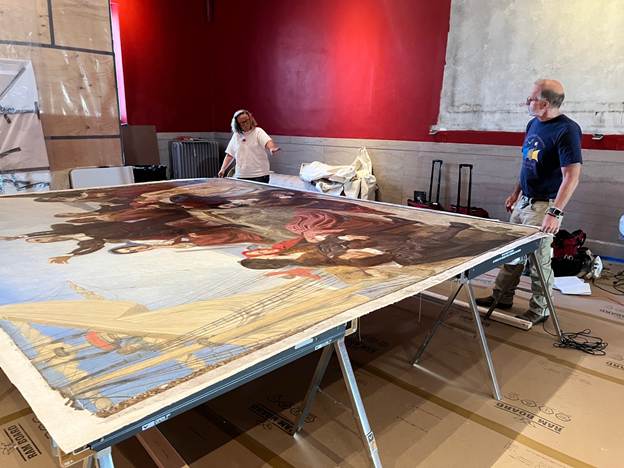
While work continues on the $6.4 million restoration of Pilgrim Hall, questions remain regarding the Lucy painting – namely, when and why were the changes made in the first place? Research is underway to determine how the alterations came to be, though that may take some time.
“We can’t get to our records right now,” Curtin said. “We had to triple seal our archives to protect it from the restoration work. The answer may be in there.”
After it was determined that the added head and other changes were not supposed to be there, the decision was made to restore the painting to its original appearance. The added paint was painstakingly removed to show the original artwork of Brewster’s feet and legs as painted by Charles Lucy.
However, large photos stand next to “Departure of the Pilgrims from Delft Haven” showing the disembodied head so visitors to Pilgrim Hall can view the before-and-after scenes of what was restored. You can do so until Aug. 3, when the main hall – but not the entire museum – temporarily closes for more improvements.
“In addition to removing the overpaint, the cleaning of the painting reveals detail not seen on the painting in more than a century,” Curtin said. “You can clearly see the folds of bows on clothing and the patterns in the lace covering the heads of women. It’s amazing.”
Dave Kindy, a self-described history geek, is a longtime Plymouth resident who writes for the Washington Post, Boston Globe, National Geographic, Smithsonian and other publications. He can be reached at davidkindy1832@gmail.com.