
I was sitting in my dentist’s office in Needham the other day flipping through the latest issue of Boston Magazine, the annual “Top Places to Live” in the Boston area issue, the one where one of the most unaffordable towns in the entire United States always ends up on top. This year the top spot among 141 towns evaluated went to Brookline where the median price of a single-family home is close to a whopping $3 million.
The other usual suspects – Newton, Weston, Wayland, and Wellesley among them — also fare well every year because with money come amenities such as good schools, good restaurants, lots of open space, top notch public services, and fancy wine and cheese shops. Dover, where I lived before moving to Plymouth a little over a year ago, doesn’t excel when it comes to retail — a Dunkin’ in the town center is, surprisingly, about as high end as it gets — but it is one of the area’s wealthiest towns and one of its most beautiful. Dover, in many places, looks like The Berkshires. And don’t get me started on the Dover DPW’s prowess at clearing the streets after a snowstorm. Remarkable.
So, as I flipped through the pages looking at which towns top the various lists – for schools, quality of life, affordability and so forth – I was surprised to see the most walkable town in all of Boston Metroland, according to Boston Magazine is, wait for it…Plymouth.
Now, this surprised me and struck me as completely counterintuitive. By area, Plymouth is the largest town in the entire Commonwealth. It can take an hour to drive from its northeasterly point, Saquish, that orphaned piece of Plymouth you can only reach by driving through Kingston and Duxbury, to its most southerly point near Buttermilk Bay. How is it possible this would be the most walkable town in the Boston area?
Then I started to think back on my own columns written for this newspaper over the last year and realized how many of them involved walkabouts. There was the trail that leads to Ellisville Harbor. The paths that crisscross Massachusetts Audubon’s Tidmarsh Wildlife Sanctuary, the first cranberry bog in the nation completely restored to its natural state, and, just across Beaver Dam Road, The Foothills Preserve, a town property. I traversed the footpath at Rocky Point Preserve, also owned by the town; The Seaside Grace Trail which begins in downtown proper; and the lovely but tick-infested Eel River Preserve. The jetty, with its unique views of downtown and Long Beach was a favorite. A couple of columns were the result of wandering around downtown, enjoying Plymouth’s truly appealing waterfront and poking my head into its eclectic shops. And, of course, there was my long walk with fellow Independent columnist Bill Forniciari to the tip of Long Beach and back on a hot summer day.
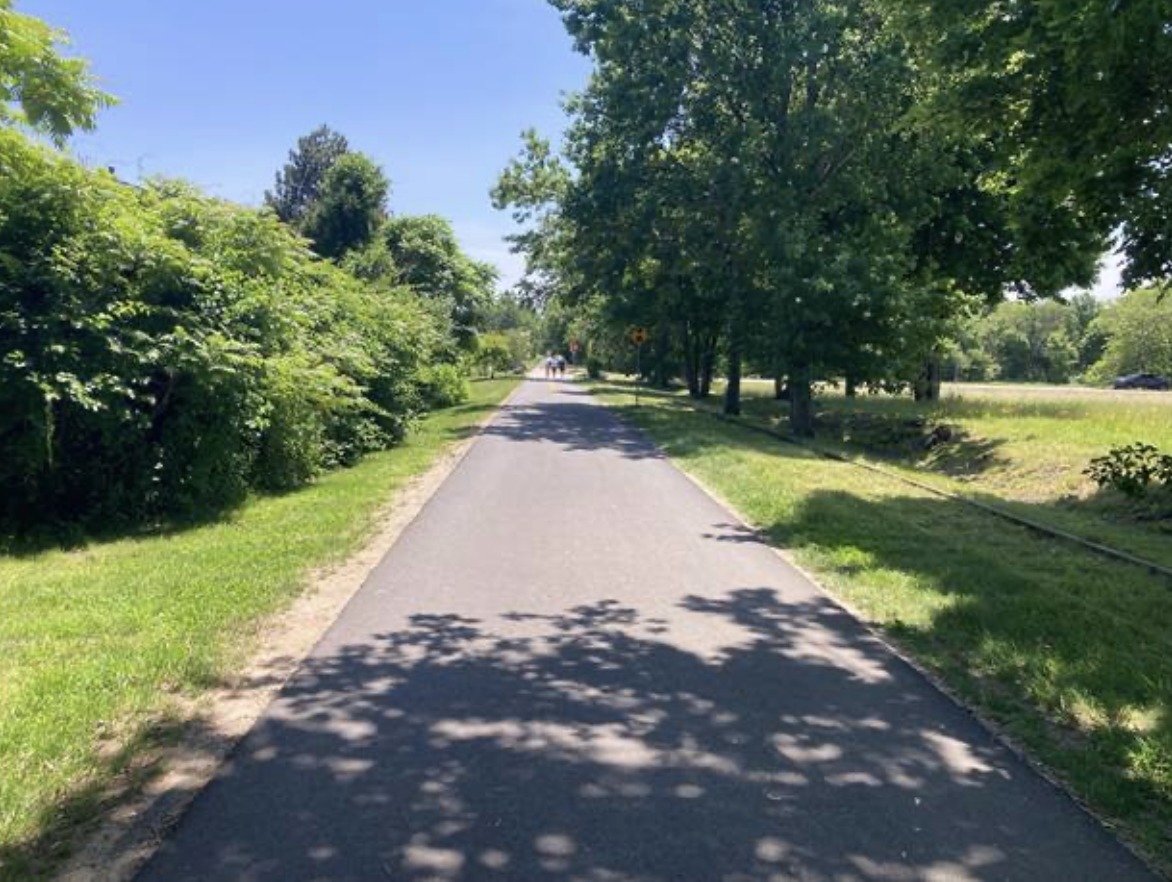
When people, and magazines, talk about walkable cities and towns they usually mean pedestrian-friendly places where you can access on foot a lot of what makes them special. You certainly can’t easily or quickly get around the great expanses of Plymouth on foot. Hiking trails, footpaths, and beaches are not what we usually think of when we ask whether a town is “walkable.” But if those are part of the equation, Plymouth has an abundance of places to explore on foot, and I have only scratched the surface.
Downtown Plymouth is indeed walkable. It’s fairly compact, and little gems such as Bradford Gardens and Burial Hill make it a pleasure to wander on foot.
But even the editors at Boston Magazine seemed surprised Plymouth came out on top as the most walkable town in Metro Boston. I wondered, did they take hiking and walking trails into account? Beaches? Just how did a town of 134 square miles get named the metro area’s most walkable town? Dover, by contrast is 15 square miles, Cambridge 6.5, and Number One Brookline a mere 7.
So, I e-mailed Brittany Jasnoff, the magazine’s Executive Editor. to find out their methodology. “Our data is compiled by the research firm DataJoe,” she replied, “which sourced mobility data for all towns from WalkScore.com.”
WalkScore, with a stated mission “to promote walkable neighborhoods” and is now part of the real estate company Redfin, will give you a “walkability” score for tens of thousands of addresses in the United States. Plymouth scored 92 out of 100. WalkScore’s website labels such a score as “a walker’s paradise,” which it describes as a place where “daily errands don’t require a car.”
But here’s the rub. If you enter “Plymouth, MA” into the WalkScore search box, the “address” is right smack in the middle of town on Main Street. But enter 208 S. Meadow Road, for example, which is the address of Speedwell Coffee Roasters, and the walkability score plummets to 17, meaning almost all errands require a car. In other words, Plymouth is eminently walkable if you live in the dead center of downtown, but getting to a grocery store – perhaps the most common errand of all – still requires a car. Given Plymouth’s size , the vast majority of us live many miles from downtown.
My address in The Pinehills, where most errands require a car, yields a low walkability score of 35. Yet I have, within a two-minute walk, four restaurants, a full-service if overpriced grocery store, a liquor store, a dry cleaner, a post office, a coffee and chocolate shop, a book store, several medical practices, an urgent care center, two banks, a golf course, and many miles of paved walking trails. So, WalkScore doesn’t strike me as the most reliable source.
There’s a lot of great walking to be done in Plymouth, but is Plymouth a “walker’s paradise?” The answer is absolutely “yes,” just not in the way Boston Magazine and WalkScore might lead you to believe. It’s not the nature trails, the parks, and the beaches they measured, but the ease of doing errands. Whether for errands or to reach its rich but far-flung walking attractions, most of us will still need a car, or at least sturdy bike. But at least you can still find a nice house for under $3 million.
Peter Zheutlin – a freelance journalist who has written for The Boston Globe, The Christian Science Monitor, and many other publications – brings the perspective of a Plymouth newcomer to the Independent. He is the author or co-author of nine books, including the New York Times bestseller “Rescue Road: One Man, Thirty Thousand Dogs, and a Million Miles on the Last Hope Highway.” Zheutlin can be reached at pzheutlin@gmail.com.