
In 1928, Doubleday published “The Outermost House: A Year of Life on the Great Beach of Cape Cod,” by the naturalist Henry Beston. It became a classic of nature literature. Beston drew up the plans for a small beach cottage in 1925, intending to use it occasionally. He soon found he didn’t want to leave and spent a year there chronicling life on the Great Beach, as he called it. Perched on a dune two miles south of the Nauset Coast Guard station in Eastham, the cottage’s 10 ocean-facing windows gave the feeling of being in boat at sea. It later became known at The Outermost House. In 1978, it succumbed to the sea.
Shortly after moving to Plymouth last December, I started staring at maps of the town and noticed a few oddities that piqued my curiosity. One was a spit of land orphaned from the rest of town and attached to the southern end of Duxbury Beach. That’s the Gurnet and Saquish, which I wrote about in two previous columns. Another was a small warren of streets, also isolated from the rest of town and just a stone’s throw from Buzzard’s Bay, called Buttermilk Bay, which I also wrote about.
Then I spotted what must be Plymouth’s oddest geographic anomaly, a single house at the tip of a little peninsula called Oliver Neck that sticks out into White Island Pond. The body of water is really two connected ponds, the larger in Plymouth (159 acres) and the other straddling Plymouth and Wareham (122 acres). I came to think of this house at the end of Oliver Neck as Plymouth’s outermost house.
To get there by car you must cross the town line into Wareham, then back into Plymouth, back into Wareham again, and, finally, at the end of Oliver Neck Road, back into Plymouth, where the house sits surrounded by water on three sides and a piece of Wareham on the other.
I asked my friend, architect and fellow Independent correspondent, Bill Fornaciari about it, because there doesn’t seem to be a blade of grass in Plymouth that Bill isn’t familiar with. He told me the house was built by a Mormon man who has since moved his family to Utah, and that it has an underground bunker designed to survive the End Times. I knew then I had to find the house and, if possible, have the owners give me tour.
But it turns out that you can’t get there from here. Sort of.
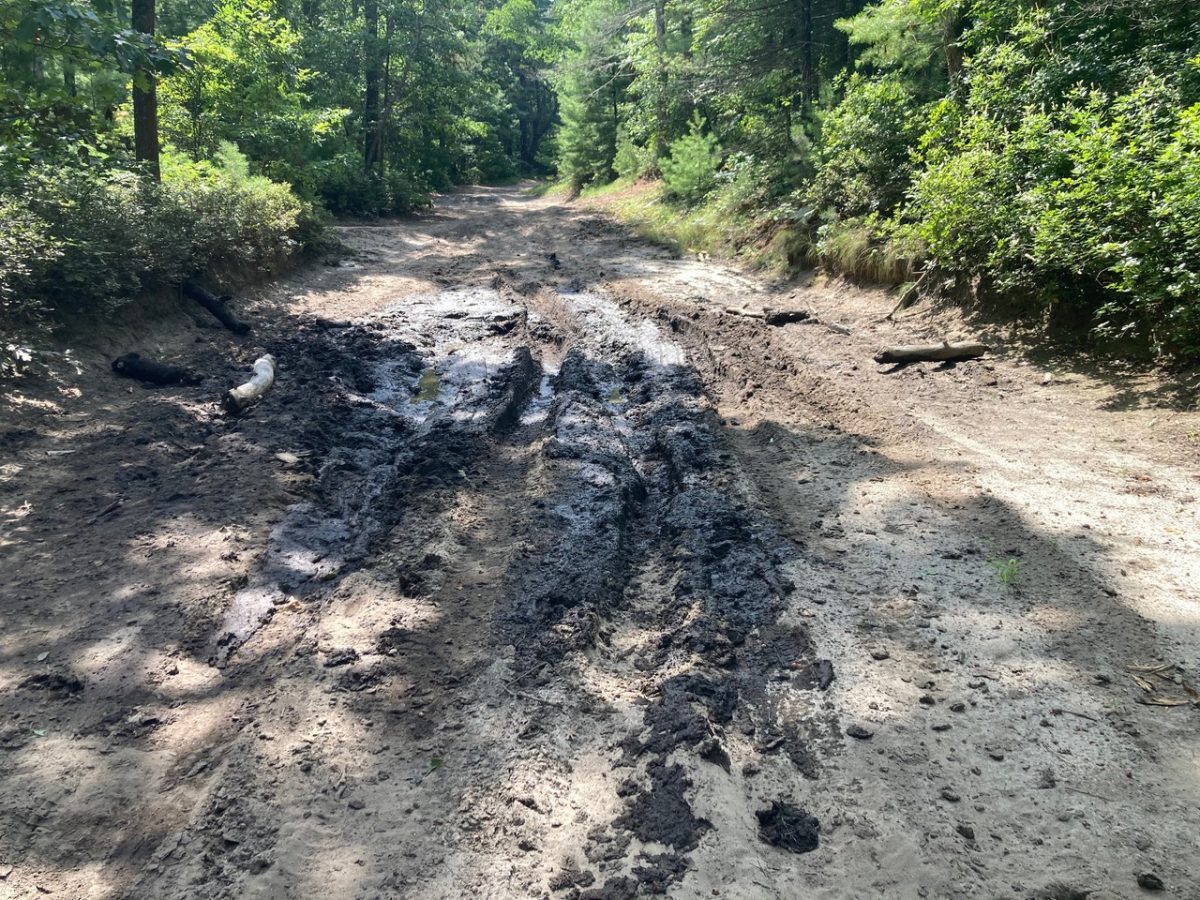
On Google Maps there appears to be a road on the southeast side of White Island Pond that connects Fairhaven Way in Plymouth (just west of Ezekial Pond) to Barker Road in Wareham. Barker Road is the only access to Oliver Neck Road. But that connecting “road” is passable only if you have a Bradley Fighting Vehicle or something similar. Much of it is sand that’s at least a foot deep. I know because I tried to drive it from the Wareham side when I finally did get to Barker Road by going all the way around White Island Pond into a dowdy neighborhood in Wareham called White Island Shores. I ignored the “Road Closed” sign at the end of Barker Road and went as far as I could by car – a few hundred yards – and then walked a ways just to see what I could see, which wasn’t much.
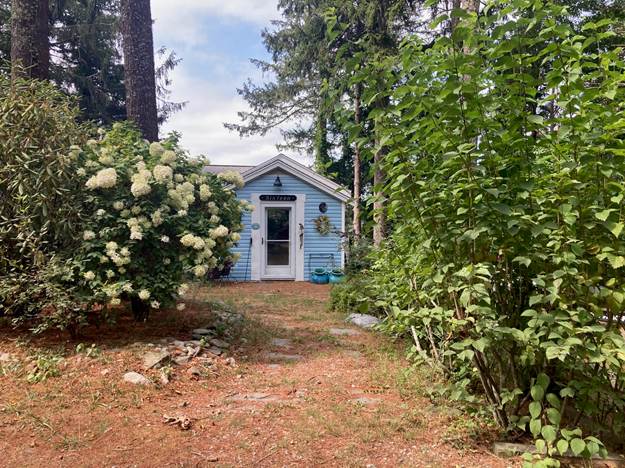
Oliver Neck Road isn’t paved and is lined with modest houses on the shore of the pond. The further out I got, the more rudimentary the roadway became until reaching what is essentially the driveway to the outermost house, a treelined pathway. But there was a “Keep Out” sign posted to a tree and just beyond that I spotted a security camera. I decided that discretion is the better of valor and, sad to say, I never did so much as glimpse Plymouth’s outermost house.
As you travel along Oliver Neck Road, there’s no way to know when you’re crossing from Wareham into Plymouth and into Wareham again. I knew only that the “Keep Out” sign was probably close to the final tiny piece of boundary separating the two towns at the peninsula’s tip. Alas, this tiny piece of Plymouth is off limits.
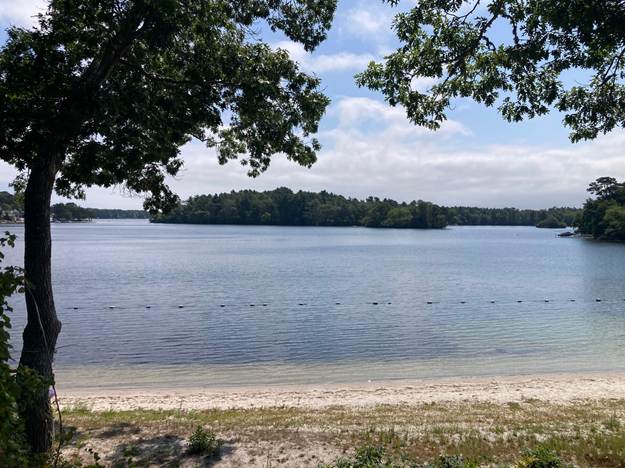
Since I’d never been to this remote corner of town, I decided to drive around White Island Pond. The houses on the pond, especially on Sandy Beach Road, are an eclectic mix of mostly small, older cabins, a few modest houses, and a handful of substantial, modern, well-manicured homes. There’s a pretty private beach at one edge of the pond for residents of the White Island Shores Community Association, with a swimming platform and boats docked at nearby homes, but that’s all within the boundaries of Wareham.
When I was writing about Saquish, Plymouth Fire Chief Neil Foley, told me that if there’s a fire call on Saquish, the Duxbury Fire Department responds and, if needed, Plymouth sends comparable resources to Duxbury. It is, after all, a long drive to Saquish from the rest of Plymouth.
So, I was curious about Oliver Neck, too, which, though less than half a mile long, comprises two non-contiguous parts Wareham and two non-contiguous parts Plymouth. With the exception of just one or two of the approximately two dozen houses on Oliver Neck, the remainder are in Plymouth. The Bourne Road fire station is only about a mile from Oliver Neck, but because of that impassable road, equipment responding to a fire call would have to go a few miles the long way around the pond to get there.
“The Plymouth Fire Department does respond to Oliver Neck Road,” Foley said in an email, “which did become a lot easier when the Redbrook development went in as it gave us a more direct route to Wareham Road. Even still, in the event of a structure fire, we have a long-standing mutual aid agreement with the Wareham Fire Department for fire-related calls to this area. In that scenario, both Plymouth and Wareham would respond simultaneously. Regardless of who is responding, this is a remote area with extended response times for both agencies.”
It’s another reminder that Plymouth is a sprawling community with some unusual public safety challenges and some very idiosyncratic geography.
Peter Zheutlin – a freelance journalist who has written frequently for The Boston Globe, The Christian Science Monitor, and many other publications – brings the perspective of a Plymouth newcomer to the Independent. He is the author or co-author of nine books, including the New York Times bestseller “Rescue Road: One Man, Thirty Thousand Dogs, and a Million Miles on the Last Hope Highway.” Zheutlin can be reached at pzheutlin@gmail.com.