
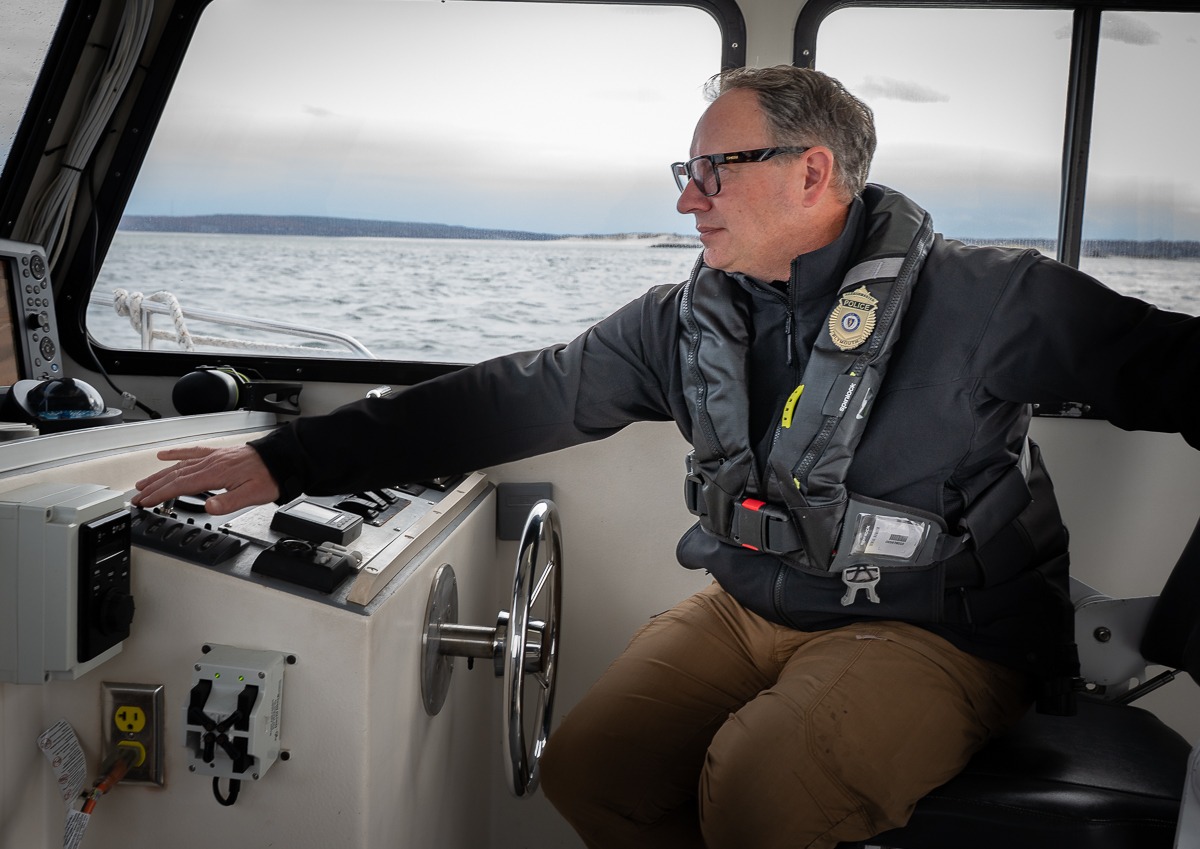
Chad Hunter covers a lot of ground in his job. Make that water.
As Plymouth’s harbormaster, Hunter’s domain is larger than you might think. It extends well beyond what’s visible from atop Coles Hill. Three miles out to sea from any land point in Plymouth and all its many ponds are within his jurisdiction. That’s over 100 square miles of water, about 80 of them ocean. His responsibilities, too, are diverse. Being the inner harbor’s traffic cop is only part of the beat, an apt metaphor since the harbormaster is part of the Police Department. While on the job, he carries a gun and handcuffs, though in his 16 years as harbormaster he’s never had to use them.
Hunter, 45, is a Plymouth native, a graduate of Plymouth South High School and Curry College, where he majored in criminal justice. He grew up on the water and it’s in his blood. His grandfather was a commercial fisherman, as was his father, before he became a whale watch captain for Captain John Boats.
Right out of high school, Hunter started working for the harbormaster during the summers of 1998 and 1999.
“That opened my eyes to what the harbormaster did,” says Hunter, “I thought it was such a cool job but there are very few openings. Most harbormasters stay on the job for 20 to 30 years.”
As a seasonal employee, Hunter attended a five-month program at the Massachusetts Maritime Academy in Bourne, where he received training as a police officer and earned his harbormaster certification.
“I was just a kid,” he says. “I didn’t know I’d ever be a harbormaster.” He took a full-time job as a campus police officer at Mass Maritime. Five years later he heard there was opening in Plymouth for an assistant to Harbormaster Tim Ruthier, who hired him in 2006. When Ruthier retired in 2009, Hunter got the job.
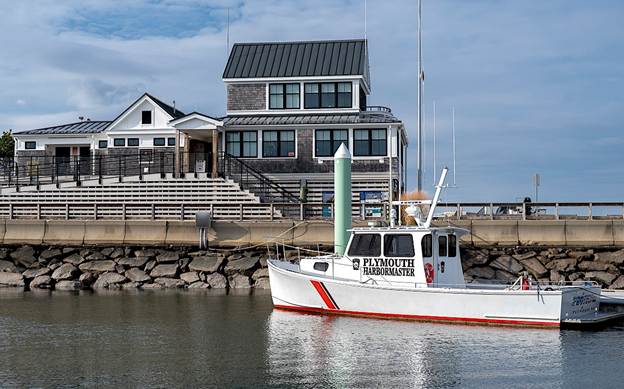
The harbormaster headquarters near Town Wharf, which opened in 2020, is big step up from the comparatively primitive shack that preceded it. Hunter’s office on the top floor has sweeping views of the harbor.
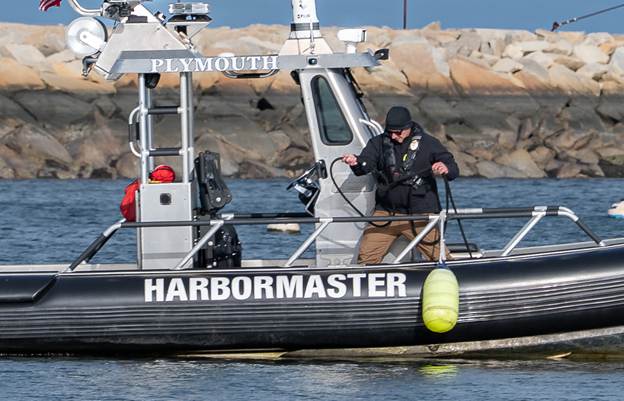
The harbormaster position in Plymouth dates to 1897 when the job mainly consisted of managing the pier, moorings, and collecting fees for their use from commercial vessels. There were few, if any, recreational boats in the harbor.
“The job has changed drastically since then,” says Hunter. “We still collect fees, but recreational boating has surpassed the commercial use of the harbor.” Today, Plymouth’s commercial fishing fleet comprises about four dozen lobster boats and a single ground fishing boat (so-called “ground fish” include haddock, cod, and flounder). There are also skiffs that work the oyster farms.
With the explosion of recreational boating the harbormaster’s primary responsibility became boating safety and education, and enforcement of boating laws. But, as Hunter points out, “anyone can buy a boat, put it in the water, and go.”
“Many don’t even know they’re required to have life jackets, fire extinguishers, and so forth. Every year we get complaints about violations and dangerous operators.”
When he responds to such calls the goal is to educate. “We lend lifejackets when needed and boaters return them when they come back in,” Hunter says. “We don’t use a heavy hand.”
“You can’t ban anyone from the water,” Hunter adds. “There’s no license to revoke. You can fine people, but we don’t arrest, except in extraordinary circumstances.”
In January, Governor Maura Healey signed the Hanson-Malone Act, mandating that anyone with a power boat or a motorized sailboat take a course in boating safety. The law goes into effect next April. The act is named, in part, for David Hanson, a teenager who drowned when his skiff was swamped at night off the Gurnet. The 12-hour course, offered by the state Environmental Police, will be available at the harbormaster’s office starting in January.
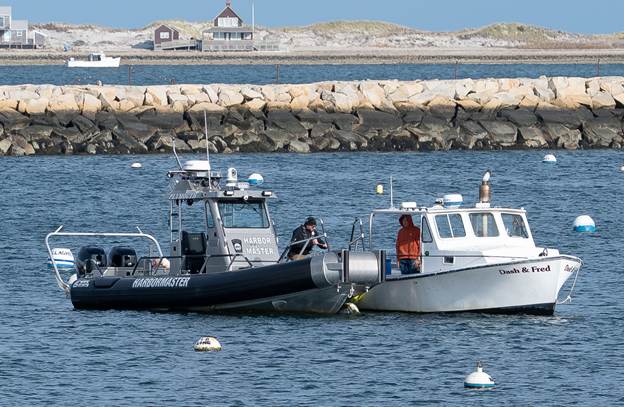
Search-and-rescue is another part of Hunter’s job. “We are first responders,” he says. “Boating emergencies are mostly ocean-side and the Coast Guard is the lead. They are far better equipped. They have planes, helicopters and sophisticated software that analyzes wind, tides and currents that can help predict where a boat that’s adrift will likely be. If I have to respond alone, it’s more of an educated guess based on local experience.” The Coast Guard is also responsible for navigational aids.
“Unmanned boats adrift plague the harbormaster and the Coast Guard,” Hunter explains. “Usually these are boats that have just come loose, and no one is missing, but you have to be sure.”
Plymouth sits in something of dead zone when it comes to Coast Guard coverage, which means Hunter must fill the gap. The nearest full time Coast Guard stations are in Hull and Provincetown. Scituate has a seasonal station, and Sandwich has a station with limited hours. Hunter’s full-time staff of four officers are on duty 24/7. The busiest time for search and rescue tends to be within an hour after sunset. Most boaters try to be back in harbor by sunset, and those still on the water often get worried when darkness descends.
The harbormaster’s responsibilities are always growing. For example, Plymouth has a 10-year contract with American Cruise Lines, whose 100-passenger, high-end “American Glory” docked in the harbor overnight 36 times this year. It’s the first cruise ship line to have regular presence in Plymouth. The seven-day cruises take passengers to various New England points such as Provincetown, Martha’s Vineyard, and Newport. Plymouth’s historical significance has made it a popular stop, too. “At 241 feet ‘American Glory’ is the biggest ship to come into Plymouth,” says Hunter. It has only a seven-foot draft, unusual for a ship its size, making Plymouth Harbor accessible. At low tide the channel is 15 feet deep.
Hunter also helps coordinate major engineering projects needed to keep the harbor operating. Channels need to be dredged to keep traffic moving. If a boat runs aground in a channel, it can paralyze the entire harbor.
“The U.S. Army Corps of Engineers is responsible for dredging channels,” says Hunter. “The entrance channel and mooring field were last dredged in 2019-2020, which involved the removal of 385,000 thousand cubic yards of material.”
In connection with Plymouth’s 400th anniversary, between 2017 and 2022 nearly $38 million – a combination of federal, state, and local funding – was invested in the harbor, including repair and rebuilding of piers and boat ramps, along with dredging.
Over the past decade another challenge has emerged; the increasing presence of white sharks in Cape Cod Bay, the most southerly part of the Gulf of Maine.
“Until 2014, the hot spots for sharks were Chatham and Monomoy,” says Hunter referring to the eight-mile spit of sand extending southwest from Chatham. “Once white sharks started appearing in the Bay, I was suddenly dealing with beach closures and notifications. It was interesting to see and watch. These are apex predators, but my role in public safety was now front and center.”
In 2014, Hunter received a distress call from two women kayakers off Manomet Point. Hunter assumed it was another routine call involving capsized kayaks but when he arrived by boat the two young women were so hysterical they could barely speak as they were brought on board. When Hunter reached into the water to grab one of the kayaks, he saw jaw marks more than two feet across.
“It was a great white,” says Hunter. “I could not believe this was happening in Plymouth.”
Hunter worked with the White Shark Conservancy, a conservation group, which had a ready-to-go flag notification system to warn of the presence of sharks, and buoys with special receivers that detect signals from tagged sharks. There are about 350 tagged white sharks in Massachusetts waters. Three buoys were deployed: off Gurnet Point, Manomet Point, and Ellisville Harbor. In 2024, off Manomet Point alone there were 2,689 detections of 13 individual white sharks averaging 10 feet in length. As Hunter points out, however, these detections are only of tagged sharks. “No one knows how many are out there.”
The harbormaster’s job changes with the seasons, of course. “From June through Labor Day we are mainly concerned with boater safety due to traffic volume,” says Hunter. “In the shoulder seasons it’s mostly just commercial fishermen on the water and it’s when moorings, docks, and floats are pulled from or put into the inner harbor.”
Winter is when there’s finally time to attend to maintenance of the harbormaster’s fleet and repairs to other equipment. “It’s when we transition from being on the water to land-based maintenance,” Hunter says. “But the lobstermen will be out until the end of January, so we need to be ready to respond any time of year.”
Despite the vastness of his jurisdiction and the range of responsibilities, the harbormaster’s annual budget is under $700,000 annually.
“We do a lot with little,” says Hunter.
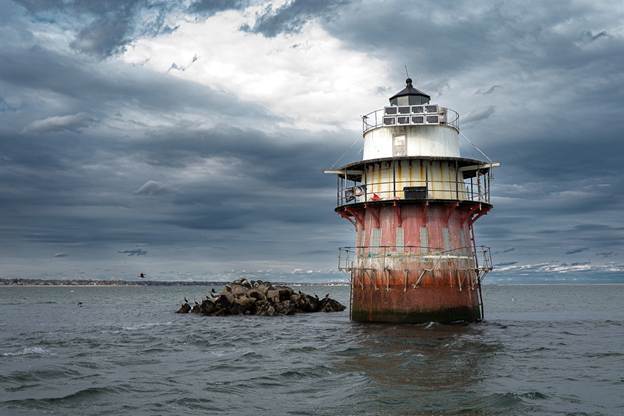
Toward the end of our meeting, Hunter takes me and photographer Jim Curran for a ride out to Bug Light – off the tip of Long Beach – in the largest of his four-boat fleet, a 34-footer built for the town in Maine in 2004. It’s basically a lobster boat in size and design and is the offshore, heavy weather inboard diesel vessel that’s in the water year-round for emergency response, towing, and maintaining shark and swim buoys.
Climate change and associated sea-level rise will be changing coastlines worldwide ensuring the harbormaster’s job will change as well.
“I never know what any day will bring,” says Hunter as we head back from Bug Light. And he seems to like that just fine.
Peter Zheutlin – a freelance journalist who has written for The Boston Globe, The Christian Science Monitor, and many other publications – brings the perspective of a Plymouth newcomer to the Independent. He is the author or co-author of nine books, including the New York Times bestseller “Rescue Road: One Man, Thirty Thousand Dogs, and a Million Miles on the Last Hope Highway.” Zheutlin can be reached at pzheutlin@gmail.com.