
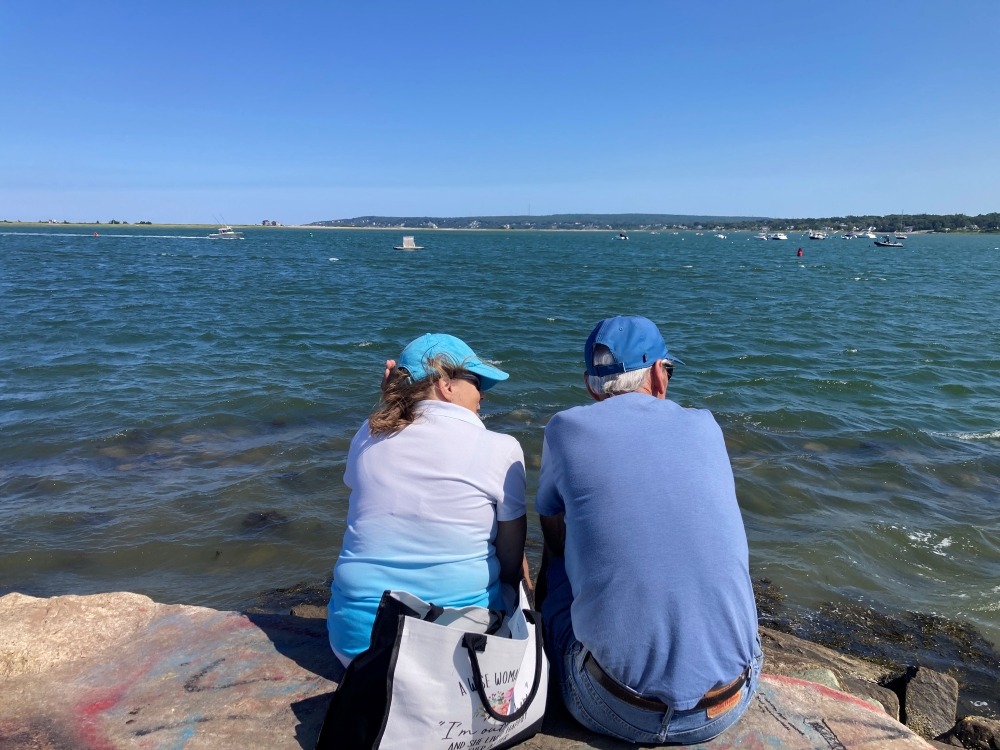
Watch your step. And don’t wear flip flops. Those are my two pieces of advice if you decide, as well you should, to walk the entire length of the Plymouth Harbor breakwater, informally known as “the Jetty.” On a magnificent day last week, I did just that with my cousin Emily, visiting from Orlando. It’s a walk unlike any other in town.
Since moving to Plymouth last December, I have often taken in the view of the harbor from Coles Hill, and in the warmer months often bring the dogs, a camp chair, and a book. But I never gave much thought to what the scene might look like looking back toward town.
The jetty offers a different visual perspective of downtown, the harbor, and Long Beach than any other walk in Plymouth. Downtown seems nestled cozily at the water’s edge and, because of the gentle slope away from the water, looks almost two-dimensional from this vantage point. It has a timeless, intimate feel you don’t necessarily get standing in town and looking toward the water. Short of being on a boat, the jetty allows you to stand in the harbor, not just gaze upon it. And Long Beach, with its thin alternating layers of sand and greenery when viewed from across the water, seemed notably closer because, well, it is.
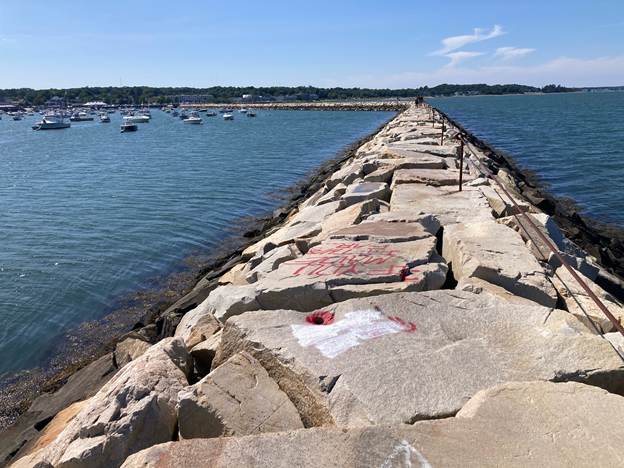
Then there was the walking itself. It was just plain fun to step from one massive granite slab to another while minding the deep crevices that, with one misstep, could cause all kinds of orthopedic mayhem. I’m serious, though – it was fun giving some thought to the easiest and most logical next step since there were always several options. It was somewhat reminiscent of a childhood game of hopscotch or solving a puzzle with your feet because you can’t afford not to give some conscious thought to your next step.
But the jetty was thoughtfully designed. Maneuvering thousands of granite blocks, most weighing, I would guess, several tons, and still creating a relatively even walking surface must have been a challenge.
No step ever felt ill-advised, either, and not just because the surface of each massive stone is relatively flat and level with all those around it. I didn’t encounter one, as is so often the case on structures where rocks are piled on top of other rocks, given to wobbling and forcing a hasty, possibly treacherous next move.
For those who might need a little support or feel more comfortable holding onto something for balance, a steel cable runs the length of the jetty, threaded through eyes in iron posts anchored into the rock.
It’s about 3,500 feet from the footbridge at its start to the jetty’s end, a little more than half a mile. Walking it at a modest pace takes between 15 and 20 minutes each way. Depending on the tide, the top of the jetty sits about five to 10 feet above the water. Perhaps not surprisingly, but somewhat disappointingly, graffiti mars many of the stones, but it’s a minor ding in the jetty’s otherwise considerable appeal.
The jetty was constructed in the late 1960s by the U.S. Army Corps of Engineers at federal expense to provide additional protection for the harbor. According to Plymouth Harbormaster Chad Hunter, even Long Beach was inadequate protection from waves six to eight fee high, and winter ice floes that sometimes swept around the point. Both were capable of doing “significant damage to moored vessels and infrastructure,” according to Hunter.
“The objective was to create a harbor refuge,” he said.
The jetty is officially open from dawn until dusk, though I didn’t see anything that would prevent you from enjoying its nighttime charms. You can easily walk to the land side terminus from anywhere downtown; it’s on the northeast corner of Town Wharf. The closest public parking lot is in front of the East Bay Grille at 173 Water St.
When I have day visitors to Plymouth, I typically take them to Coles Hill for the view of the harbor and to tell them I was the model for the statue of Massasoit (that dude was a specimen). Then we head to Manomet Point where, on a clear day, you can see Pilgrim Monument in Provincetown with the naked eye, and finally to the bird observatory (Manomet Conservation Sciences) for its spectacular and sweeping south facing view of the bay. Now I have another must-do on the list: walk the jetty.
Oh, one final piece of advice. Secure your cellphone. I shudder to think how many have been laid to rest deep in the countless crevices along the jetty.
Peter Zheutlin – a freelance journalist who has written frequently for The Boston Globe, The Christian Science Monitor, and many other publications – brings the perspective of a Plymouth newcomer to the Independent. He is the author or co-author of nine books, including the New York Times bestseller “Rescue Road: One Man, Thirty Thousand Dogs, and a Million Miles on the Last Hope Highway.” Zheutlin can be reached at pzheutlin@gmail.com.