
Plymouth County jury has issued a decision that is directly relevant to Plymouth and the sand and gravel mining operations occurring in the town, including the Industrial Park along Route 3 and the proposed development on 71 Hedges Pond Road.
On Aug. 11, a Plymouth Superior Court jury awarded two Carver residents $530,000 in damages, equaling about $760,000 with interest, after many years of impacts from an abutting Meadow Street sandmining. The jury found G. Lopes Construction and the landowner liable for nuisance and negligence after dust, sand, sediment and other material entered their home, cars and property; testimony also established that the dust contained carcinogenic respirable crystalline silica.
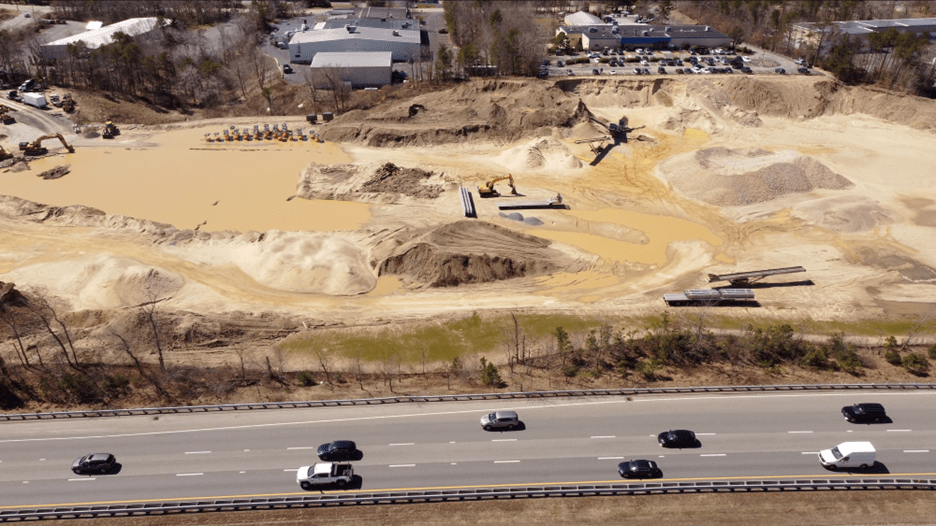
The current most visible example in Plymouth is the large excavation at the Industrial Park along Route 3, where a promised manufacturing building has not begun.
As the Plymouth Independent reported, the Planning Board approved excavation of the 19-acre site in 2022 for proposed future manufacturing use. The site remains an open pit, and a 2025 zoning permit for an abutting lot expanded the mining area to 23 acres. Plymouth should require clear engineering evidence that removal on this scale is necessary for productive land use.
The Independent also reported that on windy days dust from the open pit periodically blows across Route 3, described by one resident as “like the Sahara desert.”
The Industrial Park is not the only example.
The EJ Pontiff company’s 33-acre site at 71 Hedges Pond Rd. is another example: a proposed commercial complex removing millions of dollars’ worth of sand for “site preparation,” even though the end use remains only a concept plan, as the DPW’s own engineer described it.
At the Aug. 17 ZBA hearing it was revealed that the Town has never required an Earth Work Balance report from Pontiff or the Plymouth Foundation for the 71 Hedges Pond Rd. mine. That standard engineering analysis would show whether earth removal is necessary to develop the site. An expert testified that the site could be developed with no earth removal. Yet the property remains for sale, with no timetable for building the proposed warehouses.
The lesson from Carver is that dust leaving a sand mining operation is not merely a nuisance in the casual sense. When a sand mine sends dust, noise and vibration onto someone else’s property and substantially interferes with the use of that property, there can be real legal consequences.
The Carver residents experience shows why enforcement after the damage occurs is not enough. They began seeking help from local officials as early as 2014, but their remedy came from a jury more than a decade later. No Plymouth resident should have to spend ten years documenting dust, truck traffic and other impacts before receiving protection.
The Town needs enforceable controls on large-scale sand and gravel removal.
This recent verdict should be a wake-up call: Plymouth should review earth-removal approvals, require proof that excavation is necessary, enforce dust and traffic controls, and protect residents and the environment before the damage is done.
– Rachel Atkins