

Gov. Maura Healey’s push to bring nuclear power plants back to the state was dealt a potentially fatal blow earlier this month when state senators voted overwhelming against her idea to take the decision away from voters.
On July 1, the State Senate voted 32-8 to adopt a sweeping energy bill which keeps intact a 44-year-old requirement for a statewide referendum before any new nuclear power plant can be built.
Healey has been pushing to jettison the requirement – one many say is an insurmountable obstacle given the electorate’s feelings on nuclear – as part of her plan to use smaller nuclear reactors to stem rising energy costs.
The House voted overwhelmingly in favor of the governor’s plan in February. The two divergent versions – small pieces of a sweeping energy package designed to make power more accessible and less expensive – are now headed for a negotiation in a joint conference committee.
“It just didn’t make sense to repeal this ballot initiative,” said Sen. Julian Cyr, D-Cape and Islands, who was one of the leaders of the move to keep the statewide referendum adopted by ballot initiative in 1982.
Cyr argued that even if the referendum was repealed, it would be very unlikely any company would want to develop small nuclear reactors in Massachusetts given the stringent requirements around building a nuclear facility in the state under public health and safety laws and regulations. He said the Senate is not interested in weakening those requirements.
The setback could have an enormous effect on Plymouth, where talks of nuclear power have been a hot button political issue since before the Pilgrim Nuclear Power Plant in Manomet was decommissioned in 2019. The owner of the decommissioned plant, Holtec International, also owns 1,671 surrounding acres in serious demand by environmentalists, developers and town officials.
Whether or not it becomes a viable future site for a nuclear reactor changes the landscape on those negotiations. Experts say if nuclear power comes back to Massachusetts, the Pilgrim location would be a logical and cost-effective location.
But during her push last year to bring nuclear energy back to the state, Healey reportedly told a delegation of Plymouth elected officials she was not thinking of the Pilgrim site as a possible future nuclear site.
“We talked about the concern in the community that she was looking to keep new nuclear in Plymouth, and she said that that was not something that she was looking to do,” said Select Board member Kevin Canty, who was present at the June 2025 meeting.
“So, she was looking to put new nuclear near other areas of the Commonwealth, more populated areas, cities, or urban areas. That’s what she said.”
Canty said Healey did not specify which cities she was considering.
State Sen. Dylan Fernandes, who was among the 32 who rejected Healy’s effort to jettison the referendum, was also among those who listened to Healey’s pitch last year.
“The Governor’s office has been adamant this is about [Small Modular Reactors],” Fernandes said. “There are other places in the Commonwealth that have expressed interest in it and it’s perfectly fine with me if those places that have expressed interest in it want to pursue it.”
Gov. Healey declined to provide a statement to the Independent and instead referred a reporter to her Office of Energy and Environmental Affairs.
In an emailed statement, a spokesperson for EEA Secretary Rebecca Tepper sidestepped the question about whether Plymouth has been ruled out as a site for a future nuclear plant.
“The administration has not considered any sites for new nuclear facilities,” the spokesperson said. “Should there be any interest in siting new nuclear facilities, the administration would be interested in siting models like collaborative siting, which would involve extensive community engagement and prioritizing sites where the community has expressed interest in hosting a facility.”

The 1982 requirement forcing a statewide referendum on any new nuclear facility was largely in reaction to the 1979 meltdown at Three-Mile Island in Pennsylvania.
According to the Healey administration, it’s time for a reality check as energy consumption and costs continue to increase.
“We need an all-of-the-above approach to ensure reliability and keep costs down, which is why Governor Healey is working with other New England Governors to explore advanced nuclear technologies,” said Tepper’s spokeswoman in an email. “Like small modular reactors and microreactors that require a smaller footprint, produce less waste, and can be factory-assembled. At the same time, she has called for a safe and expeditious decommissioning of the Pilgrim Power Plant, held Holtec accountable, and ensured strong community engagement in Plymouth as the site is restored.”
Holtec has made no secret of its desire to build new nuclear power plants featuring small modular reactors at sites in Michigan, Tennessee, New Jersey, and Utah.
The company has said the Michigan reactors could go online as soon as the early 2030s.
Holtec spent $87,000 on lobbyists to represent its interests before the Massachusetts legislature last year.
What Holtec wants for Plymouth, however, remains unclear.
The company still owns about 1,671 acres around the former nuclear plant site, which it predicts would be fully decommissioned by 2035. The high-voltage lines that used to connect the plant to the power grid are still in place, owned by Eversource.
Patrick O’Brien, Holtec’s government affairs and communications director, said in an email that the move to eliminate the requirement for a statewide referendum to approve any new nuclear plants “still has a long way to go.”
And repeal of the 1982 law alone, O’Brien said, would still leave Massachusetts back in the queue behind many other states that have historically been more welcoming to nuclear power.
“Repeal is a long way from any project trusting a state to provide the assurance to finance a multi-billion-dollar project across multiple administrations to be able to construct,” O’Brien said. “We’ll wait and see what comes from the Governors nuclear roadmap, but the reality is Massachusetts has a multi-decade history of being adverse to nuclear.”
However, O’Brien acknowledged Pilgrim would be the ideal spot in the state.
“Based on the historical workforce, infrastructure to connect into the grid and a community that understands the benefits and risks it certainly would be at the top” of sites for a new nuclear plant in Massachusetts, he said.
Canty, who is the Select Board’s representative on the state’s Nuclear Decommissioning Citizens’ Advisory Panel, said Holtec has shown no interest in a small modular reactor in Plymouth.
“I know a lot of people believe Holtec wants to open new nuclear power plant here, but I have not seen any indication that that is the case, and in fact, my conversations with Holtec representatives have essentially been that as of right now, it’s a non-starter.”
Long-time opponents of the Pilgrim nuclear power plant argue that the Governor and the House are moving towards eliminating the only safeguard the town has against having another nuclear plant.
“To think that the legislators would remove these basic democratic rights is very serious,” said Diane Turco, executive director of the watchdog group Cape Downwinders.
Supporters of getting rid of voters’ right to veto nuclear plants say the referendum acts as an effective ban on new plants because it discourages companies from considering Massachusetts for nuclear power.
In March, all six New England governors committed to preserving existing nuclear assets and exploring new nuclear applications. The two remaining New England nuclear power plants provide 20 to 25% of the region’s power needs.
Massachusetts no longer has any nuclear power plants.
The existing Pilgrim license only allows Holtec to possess Pilgrim’s used fuel while the plant is disassembled and cleaned up, said Scott Burnell, a spokesperson for the U.S. Nuclear Regulatory Commission, who adds Holtec would need to file a new reactor application to build anything else at the site.
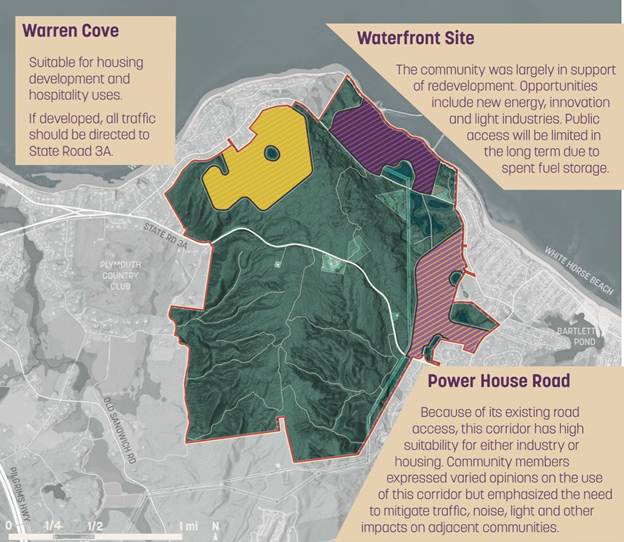
The valuable property around Pilgrim Holtec is divided into two parts.
144 acres of waterfront property owned by Holtec includes the former power plant itself, as well as spent fuel casks.
Another 1,527 acres between Rocky Hill Road and the Pinehills development is designated as forestry land. Under an agreement with Holtec in effect until 2031, the town has the right of first refusal should Holtec decide to sell those acres.
Of those, about 400 acres between Rocky Hill Road and Route 3A are restricted from sale by the license that Holtec holds from the U.S. Nuclear Regulatory Commission and cannot be sold until the NRC approves, O’Brien said.
Canty said he would like the town to buy the 1,527 acres, keeping most of the land in conservation but with room along Powerhouse Road for what he calls a Woods Hole North area (after the Woods Hole Oceanographic Institution in Falmouth) devoted to scientific research and spinoff businesses. The town has accumulated $11 million in a special fund, likely to fall far short of the market value, to buy the land.
Last year, after extensive input from residents, the Select Board accepted a consulting firm’s report proposing how Plymouth could use the 1,527 acres in Manomet.
Under the proposal, most of the site would be kept as open space, with a trail system for hikers and mountain bikers. But Sasaki, the consulting firm, said the town could opt to allow 110 to 210 housing units and 110 to 190 hotel rooms in the northwestern part of the land, near Warren Cove, with an access road to be built from Route 3A. Along Powerhouse Road, the consultants proposed light industrial use and small pockets of retail space. Sasaki said the town could rezone some of the property to attract innovative industries. The consultants also recommended establishing a network of recreation and ecotourism destinations on the land that would include lodging and restaurants.
But first, the town would have to acquire the land.
Karen Grey, president of the Wildlands Trust, said Holtec could have other plans for its property besides small modular reactors, such as a battery farm or a data center. Grey also sits on the Board of the Plymouth Independent.
“The real money is [in] deciding whatever they want to do there in the future,” she said.
Grey said Holtec turned down “a considerable amount of money” from the Wildlands Trust to buy most of the 1,527 acres.
O’Brien said Holtec has no plans for any of the 1,527 acres until it has decommissioned the plant.
“We are focused on decommissioning, and any property use/reuse are subsequent to that effort,” O’Brien said.
If the town was also able to buy some of the 144-acre waterfront site where the former plant sits, Sasaki offered several options. They included connecting to potential future offshore wind developments, small modular nuclear reactors, utility-scale battery energy storage systems, and rooftop solar to power adjacent light industry or to supply the town with cheaper electricity. Sasaki said the town could negotiate payments in lieu of taxes with Holtec or a subsequent owner of the property.
Fred Thys can be reached at fred@plymouthindependent.org