
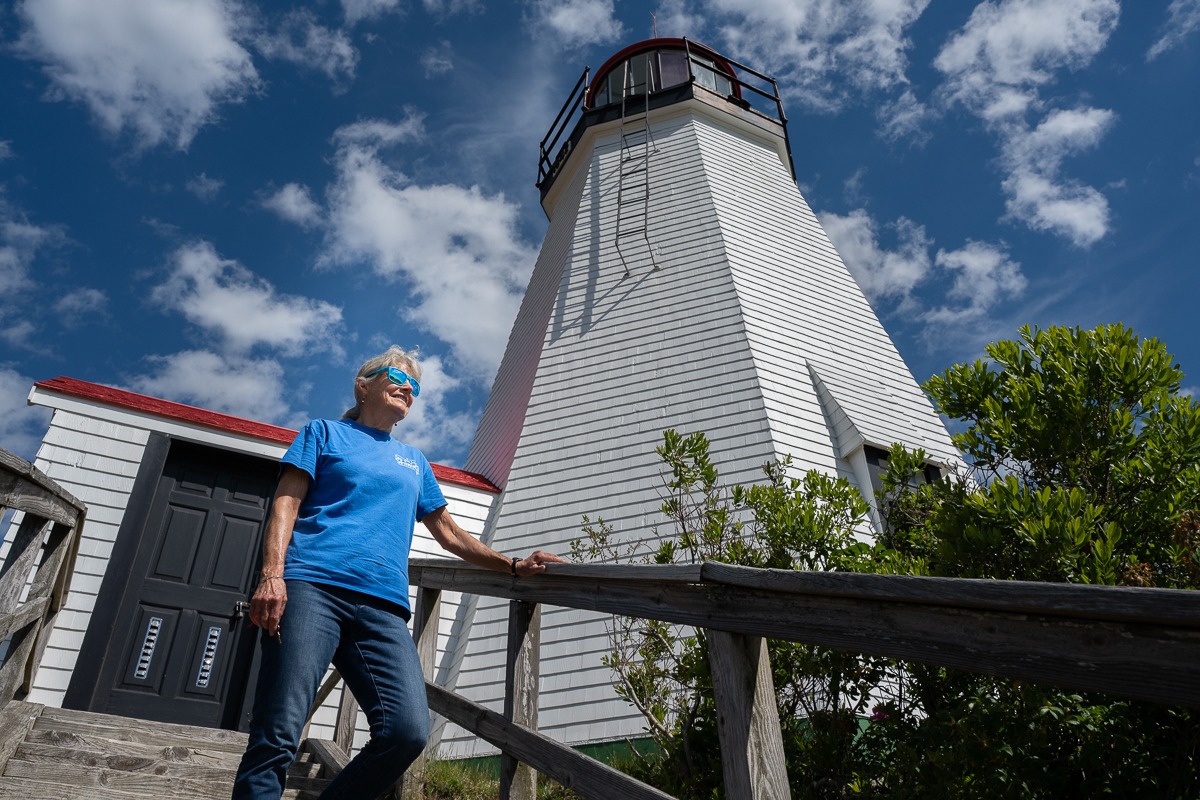
Standing beside the keeper’s cottage on the tip of Gurnet Point, with Plymouth Harbor spread out below and Provincetown visible across the bay, Dolly Snow Bicknell began her tour not with a history lesson, but with a poem.
Written by Edgar Guest, The Lightkeeper Wonders imagines a lighthouse keeper confronting automation after decades of tending a light by hand. Near the end, the keeper asks:
“And I wonder now — will the grass stay green,
Will the brass stay bright and the windows clean?”
Standing beneath Plymouth Light nearly a century since the poem was written, the line felt especially fitting, because today, the story is more about stewardship than technology.
Last month, after more than two years of federal review, Project Gurnet & Bug Lights Inc. officially became the owner of Plymouth Light Station, also known as Gurnet Light, which includes the historic lighthouse, keeper’s cottage and surrounding property. There will be a transfer ceremony in mid-September.
For Bicknell, however, ownership is not the destination. It is the key to the next chapter in a mission that began long ago.
Project Gurnet & Bug Lights has for decades had the responsibility of caring for Plymouth Light, but not the authority to fully manage it. Ownership may change the equation, giving the organization year-round access and the ability to make preservation decisions to help ensure the landmark remains part of Plymouth’s maritime identity for generations.
Plymouth Light, better known as Gurnet Light, is the white wooden lighthouse first built in 1768, perched at the end of Gurnet Point off Duxbury Beach.
The ownership transfer is the culmination of a long-held preservation effort.
Project Bug Light was first formed in 1983 after local residents learned that the Coast Guard planned to replace Bug Light with a navigational beacon mounted atop a fiberglass pole. Rallying around the slogan “Save Bug Light,” volunteers raised funds and convinced the Coast Guard that the historic lighthouse was worth preserving.
The Duxbury Pier Light, known as Bug Light, is the distinctive cast-iron lighthouse resembling a giant spark plug marking the harbor entrance since 1871.
When the light again fell into disrepair a decade later, Dr. Don Muirhead assembled a new group of volunteers, including Bicknell, now president, who joined the effort in 1993.
Since then, the organization — which became Project Gurnet & Bug Lights Inc. — has maintained, restored and advocated for both historic lighthouses.
The group applied for ownership of Plymouth Light more than two and a half years ago after the U.S. Coast Guard declared the property excess federal property. Last month, the long-awaited approval finally arrived.
“We’ve been taking care of it for many years,” said Bicknell. “Ownership is an important step in preserving it for the future.”
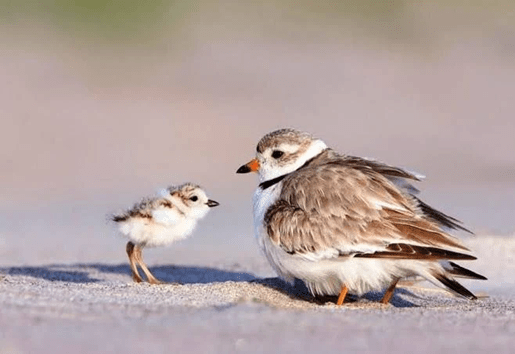
Under federal ownership, Project Gurnet & Bug Lights was required to follow seasonal restrictions designed to protect the nests of endangered piping plovers. While the more than 200 private property owners on the Gurnet and Saquish beach could access their homes throughout the summer, the organization’s stewardship activities were restricted during the very months when maintenance, fundraising and public access opportunities were most valuable.
The limitations also affect the Keeper’s Cottage, one of the nonprofit’s most important revenue sources. The cottage sleeps up to 14 people and its rental program is a key fundraising asset. Yet under federal ownership, summer rentals — the season most in demand — were largely unavailable. What’s more, the organization was restricted from making repairs during those months as well, the optimum time for repair work.
Bicknell said one of her greatest challenges has been navigating overlapping responsibilities between agencies charged with preserving both historic resources and endangered wildlife. The Gurnet’s beach environment serves as nesting habitat for piping plovers, a federally protected shorebird whose presence can trigger significant travel restrictions. In some cases, even residents traveling to and from their homes have been required to use escorted vehicle convoys when chicks occupied the roadway.
While those protections are intended to safeguard an endangered species, they also create obstacles for the nonprofit’s preservation work. As a result, volunteer caretakers were restricted from even visiting the lighthouse grounds in the spring and summer months, let alone completing maintenance projects.
Bicknell said ownership changes the game.
For the first time, she hopes the organization can fully access the property year-round, maximize rental opportunities, pursue grants and perform repairs in key warm-weather months that are critical to preservation efforts.
The ownership transfer does raise questions about the future management of piping plovers, the small shorebirds often nesting along the Gurnet and Duxbury Beach each spring. The birds are protected under both the Massachusetts Endangered Species Act and the federal Endangered Species Act. The Massachusetts Division of Fisheries & Wildlife (MassWildlife) and the U.S. Fish and Wildlife Service have authority over activities affecting the species or its habitat. While local officials and property managers implement seasonal protections such as fencing, vehicle restrictions and access limitations, those measures are developed in consultation with state and federal wildlife agencies to prevent harm to the threatened birds.
Contacted by the Independent, MassWildlife officials said the agency had not yet evaluated whether the change in ownership would have any effect on management of the habitat.
“We were not aware of the change in ownership, so at this time cannot comment on how this change may affect piping plovers,” said Carolyn Mostello, Coastal Waterbird Biologist with the Massachusetts Division of Fisheries & Wildlife. “Regardless, compliance with the state and federal management Guidelines for piping plovers is critical for avoiding unauthorized take of this state- and federally listed species.”
The agency’s response suggests ownership alone does not alter the legal protections afforded the birds.
“Of course, we will comply with all restrictions set by the Massachusetts Division of Fisheries & Wildlife and work with the Duxbury Beach Reservation, which manages access to Gurnet Point, putting in place any required protections for plovers,” Bicknell said.
Officials at Duxbury Beach Reservation did not respond to a request for comment. However, Bicknell said her group works closely in partnership with the organization.
Built in 1768, Plymouth Light was the 8th lighthouse established in the U.S. During the Revolutionary War, the site served as a fort, with 60 soldiers and six cannons. From 1801 to 1924, there were twin towers at the site. White octagonal twin towers were rebuilt in 1842 after earlier structures were lost. In 1924, the Bureau of Lighthouses discontinued one of the twin lights as it phased out multiple lights. The remaining tower was moved back 48 feet in 1998 to counter erosion. It is touted as the oldest freestanding wooden lighthouse in the U.S.
The site is also associated with one of the most remarkable figures in lighthouse history: Hannah Thomas, who assumed lighthouse duties while her husband, Brigadier General John Thomas, served in the Revolutionary War. After his death from smallpox in 1776, she continued as keeper, becoming America’s first female lighthouse keeper. Bicknell and the organization helped locate and commemorate Thomas’s grave in Kingston with a lighthouse service marker in 2019.
For Bicknell, aside from maintaining its history, the work is deeply personal.
She grew up immersed in lighthouse history as the daughter of Edward Rowe Snow, the legendary historian, author and lecturer whose books introduced generations of readers to the maritime heritage of the New England coast.
Snow was also known throughout the region as the “Flying Santa,” delivering Christmas gifts to isolated lighthouse keepers throughout New England for more than 40 years. As a child, Bicknell accompanied him.
Long before she became president of Project Gurnet & Bug Lights, Dolly understood lighthouses were more than navigational aids. They were places of stewardship — where people lived, worked, farmed, raised families and became part of the history of the communities they served.
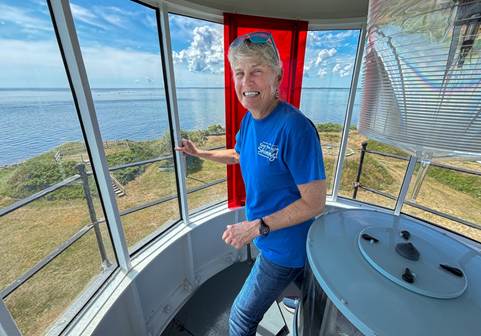
During a recent tour, Bicknell moved between historian, tour guide, preservation advocate and caretaker. One moment she was explaining how a Fresnel lens magnified light visible for miles at sea. The next she was pointing toward the bluff and noting how much shoreline has disappeared to erosion.
From the top of the lighthouse, she gestured toward the remains of Fort Andrew, where six cannons once guarded Plymouth Harbor. Looking out across the bay, she pointed to where edifices once stood, now lost to the sea.
She knows where the leaks are inside the tower. She remembers climbing the lighthouse stairs to clean it just weeks earlier.
“We have taken really good care of them,” she said. That sense of responsibility runs through nearly every accomplishment the organization has achieved.
Since its founding, Project Gurnet & Bug Lights has contributed more than 100,000 volunteer hours, raised hundreds of thousands of dollars, restored historic structures and maintained both lighthouse properties through agreements with the Coast Guard. She hopes to one day re-establish the Memorial Day public open house at the property.
The work is often unglamorous but constant. Volunteers clean the lighthouse and keeper’s cottage, wash windows, mow the grounds around historic Fort Andrew, paint exterior surfaces, repair leaks and tackle preservation projects that most visitors never notice. In the past year alone, the group completed soil remediation, repainted the lighthouse exterior, repaired leaking lantern room windows and continued stabilization work at Bug Light.
Yet many of those efforts had to be carefully scheduled around seasonal access restrictions. Under federal ownership, the organization was generally unable to visit Plymouth Light Station between mid-May and early September because of rules protecting nesting piping plovers, limiting when maintenance and preservation work could be completed. Ownership now gives the group greater flexibility to care for the property throughout the year while continuing to respect environmental protections.
The work is far from finished.
The Coast Guard will continue to maintain the active navigational aids at both Plymouth Light and Bug Light, including the lanterns, fog signals and solar equipment that keep the lights operational. But preserving the historic structures falls to Project Gurnet & Bug Lights.
Bug Light alone, which the group obtained ownership of in 2018, requires an estimated $1.5 million in restoration work, including structural stabilization, repairs to the roof and catwalk, interior restoration and exterior painting.

The pair of lighthouses are woven into Plymouth’s maritime identity, landmarks that have guided mariners for generations and connected residents to centuries of local history. For generations of sailors, fishermen, Coast Guardsmen and pilots, the lights have been more than structures on the horizon. They have been points of reassurance, helping people find their way home.
As we left the Gurnet and headed back down the sandy road toward Duxbury’s Powder Point Bridge, the question seemed unavoidable.
What would have happened if the organization hadn’t been awarded ownership?
Bicknell said someone within the group had asked exactly that during the long federal review process.
“What would we have done if we didn’t get ownership?” she recalled someone asking.
She recalled someone else in the group answering the question: “Well, this is our mission. It’s what we do.”
For more than four decades, Project Gurnet & Bug Lights has served as caretaker, advocate and keeper of Plymouth’s lighthouse history. Ownership does not change that mission. It gives the organization the tools to continue it — access to apply for grants, rental income from the keeper’s cottage, and the ability to care for the property throughout the year.
But preserving the landmarks — and the stories, memories and history — remains the work of dedicated volunteers.
Nearly a century after Edgar Guest imagined a keeper wondering whether automation would replace human care, the question still resonates at Plymouth Light. Modern technology may guide ships safely into Plymouth Harbor, but stewardship is the critical piece.
The light still needs tending. The grass still needs to stay green. The brass still needs to stay bright. And the windows still need to be clean.
For more information, to volunteer or donate, please go here.