
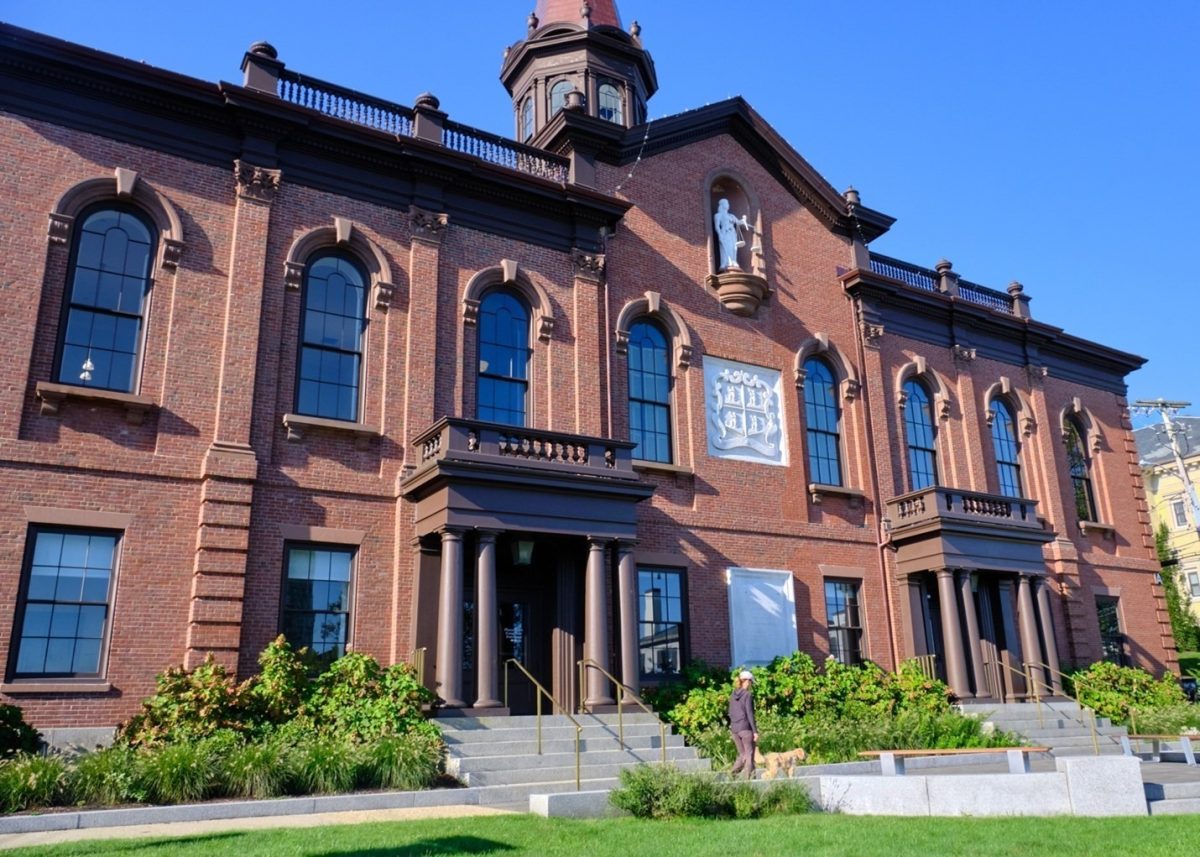
Every month, an official committee of the Town of Plymouth sits down in Town Hall to make this a more welcoming place. I have sat in that room as an associate member. The committee is not idle, per se. It manages a social-justice book collection at the library, has hosted speaker series, and organizes an annual Black History walking tour and an elaborate Martin Luther King Jr. weekend. Yet for a body created to protect the marginalized, it is remarkably selective about which marginalized people it actually protects, and it plainly prefers the work that can be wrapped in a pretty bow before it is presented to the community.
That selectiveness has a structure behind it. The committee’s monthly meetings feature a standing rotation of liaison reports that consume a fair amount of meeting time. The faith communities in that rotation are an interfaith clergy association (PAICA), and separately and individually, a Protestant church’s social action committee, and a synagogue’s social action committee. These are good neighbors doing real work, but why do individual congregations hold a place in the rotation instead of teaming up with PAICA? Additionally, there is no Muslim voice in that structure, nor a variety of other faith organizations active in this town.
There is a structural problem here that goes beyond who feels welcome. Once a town committee opens its meetings to faith-based reports and seats an interfaith association with an additional two specific congregations, it has put the town in the business of choosing which houses of worship get a standing microphone. That invites an obvious question. If these specific congregations may report their social action at a public committee, why not every denomination or congregation in Plymouth that wishes to do the same? If the answer is that only the currently seated faiths may report, then a government body is granting preferential access to some religious groups over others, and any congregation it turns away may have a real constitutional grievance, since the government generally may not favor one faith over another in a forum it controls.
So let’s follow the logic to where it leads. If the committee’s monthly meeting is the place where congregations report their good works, then where is New Hope? Plymouth’s evangelical community does outreach too. Shouldn’t the town committee hear from them? And St. Bonaventure, surely the Catholics are up to some worthy social work worth a standing slot of public time. The point is that the committee has no principled way to admit the faiths currently seated while turning the rest away, and no one appears to have asked the questions: Should a public committee be hosting standing faith-outreach reports in the first place? Shouldn’t its public time belong to its own work?
There is also the more difficult conversation to be had, which is that religious organizations can be a source of exclusion. Some congregations believe that being gay is immoral. Some congregations across religions believe that Palestine doesn’t exist, or that the displacement of Palestinians is necessary, or deny their genocide altogether. Some churches believe their faith should be mandated as a national identity; others believe that anyone who doesn’t practice their faith is going to Hell. One could go on all day. Religion doesn’t always preach a “for all” mentality, and congregations are often, by nature, exclusive groups built around specific ideologies.
Let’s move on to more specific incidents of exclusion. In July 2025, the committee announced it had planned to co-sponsor two documentary screenings, then disclosed that No Other Land, would not be shown, citing the current geopolitical issues involving the Israeli-Palestinian conflict. No Other Land is the Academy Award–winning film made by a joint Palestinian-Israeli team about the destruction of Palestinian communities in the West Bank. This came just weeks after one of the committee’s own affiliates attacked a booth containing pro-Palestine content at June 2025’s Plymouth Pride. An anti-hate committee, presented with an award-winning work by Palestinian and Israeli filmmakers together, decided Plymouth was not ready to see it. It seems that when it comes to Palestinians, the committee’s instinct is to erase the issue entirely to keep the room comfortable. Meanwhile, a curated list of pro-Israel titles were shared with PFA with plans on providing them to the Public Library.
Palestinians are not some distant people to be discussed in the third person. We have Palestinian neighbors in Plymouth, residents active in this community, who have run into an invisible wall when they try to take part in the very committee that claims to exist for them. I have heard people who contribute regularly to this committee repeating debunked narratives that dehumanize Palestinians, generalizing Palestinians and anyone who says “Free Palestine” as antisemitic, denying genocide, and specifically condemning Jews who wear keffiyehs and say “Free Palestine.” These have been statements made in a room and distributed by email to members of an organization that, on paper, is dedicated to standing against exactly that kind of erasure.
At last year’s Plymouth Pride, an altercation broke out at the booth of the Workers Party of Massachusetts, South of Boston chapter. According to those present and to the Workers Party’s public account, it began when the booth’s pro-Palestinian display drew a violent attack, which widened into a broader confrontation with the booth and the people staffing it. The person who attacked the booth was, at the time, affiliated with Plymouth’s own No Place for Hate committee, the body now called Plymouth for All. As a result, both Plymouth for All and the Workers Party were shut out of Pride entirely. People who were present at the event and members of the Workers Party have confirmed that the inciting issue was pro-Palestine content available at their booth. None of this caught the committee unaware. Its own April 2024 minutes record a police report after a Plymouth for Palestine demonstration, in which a local group posted that the protesters were standing close enough together that one grenade would wipe them all out. More than a year before Pride, it was on the record that Palestinian advocacy here was drawing threats. A year later, one of their own was engaging in the same sort of behavior.
Their actions tell every other space in Plymouth which residents and which politics are the acceptable ones to push out. Avoidance at the top becomes exclusion on the ground. The people who came to these spaces because they were supposed to be safe are the ones feeling targeted or avoided. This is a textbook example of the ways committees meant to fight hate actually make certain types more palatable, and it has a name: institutional passive hate. This is a structural prejudice where an organization tolerates or indirectly perpetuates discrimination. Instead of overt hostility, it manifests through systemic neglect, superficial programming, or ingrained practices that harm marginalized groups.
So I will ask the questions this committee should be asking itself. Why does a body chartered to advance human rights have standing seats for some faith communities and none for others? Why, given a chance to show Plymouth an award-winning Palestinian story, did it choose not to? Why is there no real accountability when a resident is harmed by one of its own, and no shared training or conduct standard for the people who speak in the town’s name?
None of this requires reinvention. Towns across Massachusetts, including Lexington, Belmont, Arlington, Hingham, Dedham, and Amherst, have moved past the pledge-and-programming model and stood up real Human Rights Commissions. These are standing bodies with defined membership and conduct expectations, with a mandate to receive discrimination and hate complaints and address discrimination in housing, employment, and public services, and report their findings to the Select Board each year. That is what Plymouth needs. A serious body built to confront the specific barriers that leave specific people out, including the quiet assumption that some residents’ right to be seen, heard, and represented matters less than others’. Its job would be to do that work, not to keep the room comfortable. A real human rights body does not get to decide whose dignity is negotiable. That is the entire point of having one.
Plymouth deserves a committee that lives up to the name “Plymouth for All.” Right now we have one that requires an asterisk and some fine print: Muslims and Palestinians excluded.
– Meg Ash