
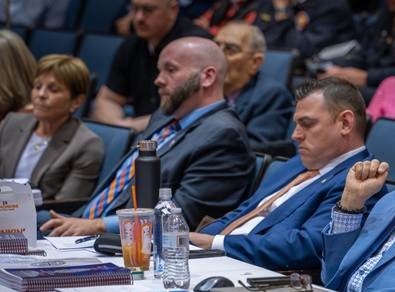
The Select Board’s recent 3–2 vote for a conditional waiver of the Town’s Chapter 61A right of first refusal (ROFR) on the Landers property deserves closer scrutiny for consistency and fairness. Chair Iaquinto and two members with conflicts of interest, Mr. Canty and Mr. Golden, waived the right to conserve the land subject to nine “conditions” in a Memorandum of Understanding (MOU). The nine MOU conditions are legally unenforceable and at best aspirational.
By Chair Iaquinto’s own account, Canty and Golden declined to assign the ROFR to the Community Land & Water Coalition (CLWC) because “there was not sufficient certainty” about financing and execution. The Chair described reviewing information on CLWC’s financing, acquisition plans, and organizational capacity, and concluding there was insufficient certainty to transfer “a right of such importance.”
Yet the MOU the three Select Board members agreed to is itself riddled with contingencies and open‑ended terms. One condition requires preserving at least 40% open space but is vague and open ended and does not apply this to all undisturbed forested upland, other than a sliver of a Zone II well protection area, and allows it to include degraded cranberry bogs. Five items Sheridan need only “pursue,” “consider,” or “evaluate,” including a walking trail, a sidewalk, an easement for an access road, a contiguous open‑space strip, and feasibility of a wastewater treatment facility. The eighth “condition” is to provide access to a Town owned parcel, something that will cost Sheridan nothing. The ninth condition limits sand mining to an “incidental” operation, apparently meaning under the Town’s Earth Removal Regulations of the Zoning Bylaw. One need only look at 71 Hedges Pond Road or the giant hole on Route 3 to see what the Town Building Commissioner, Zoning Board of Appeals and Planning Board all permit as “incidental” sand mining. The MOU has no mention of housing – affordable or otherwise.
The MOU further states that issuance of a special permit or subdivision approval shall be deemed full satisfaction of all conditions, with no further release, examination or verification required. The MOU framework embeds uncertainty about outcomes while providing the developer, Sheridan, a shortcut to finality once permits or a subdivision approval issues. The MOU presupposes the Zoning Board of Appeals and Building Inspector will issue those permits and approve “incidental” sand mining. The Select Board has no authority over the issuance of permits — it is executive branch, not the administrative branch of government. Yet, it tried to bargain away that power gaining nothing.
Meanwhile, CLWC presented a specific pathway to meet Landers Purchase and Sale Terms and offered to match Sheridan’s offer. CLWC committed to fund the $2,500 deposit by the August 13, 2026 deadline and to meet title, survey, and insurance commitments with private funds, and described a plan to secure the purchase price by October 15, 2027 through private, public, and government sources. This would cost the Town nothing and save on infrastructure and education costs. CLWC also stated it does not intend to develop the land and outlined coalition ownership and conservation restriction structures commonly used in conservation acquisitions. Despite having several more months to decide, the Select Board rushed the vote through, never asking CLWC any further questions. Did the Select Board get financials from Mr. Sheridan to guarantee he will follow through on the deal? Why the double standard?
The Board cannot credibly reject assignment to CLWC for “uncertainty” while adopting a waiver whose operative provisions hinge on aspirations rather than enforceable deliverables. Plymouth residents deserve a process that applies the same standard of certainty to community proposals as it does to closed door developer‑negotiated terms, with transparent rationale and verifiable benchmarks before surrendering a valuable Chapter 61A statutory right. The Board’s “conditional waiver” involved approximately 138 acres, a portion of the Native American Wampanoag Great Lot and a $5 million transaction—stakes that warrant rigor, not a double standard.
– Meg Sheehan
Community Land & Water Coalition