
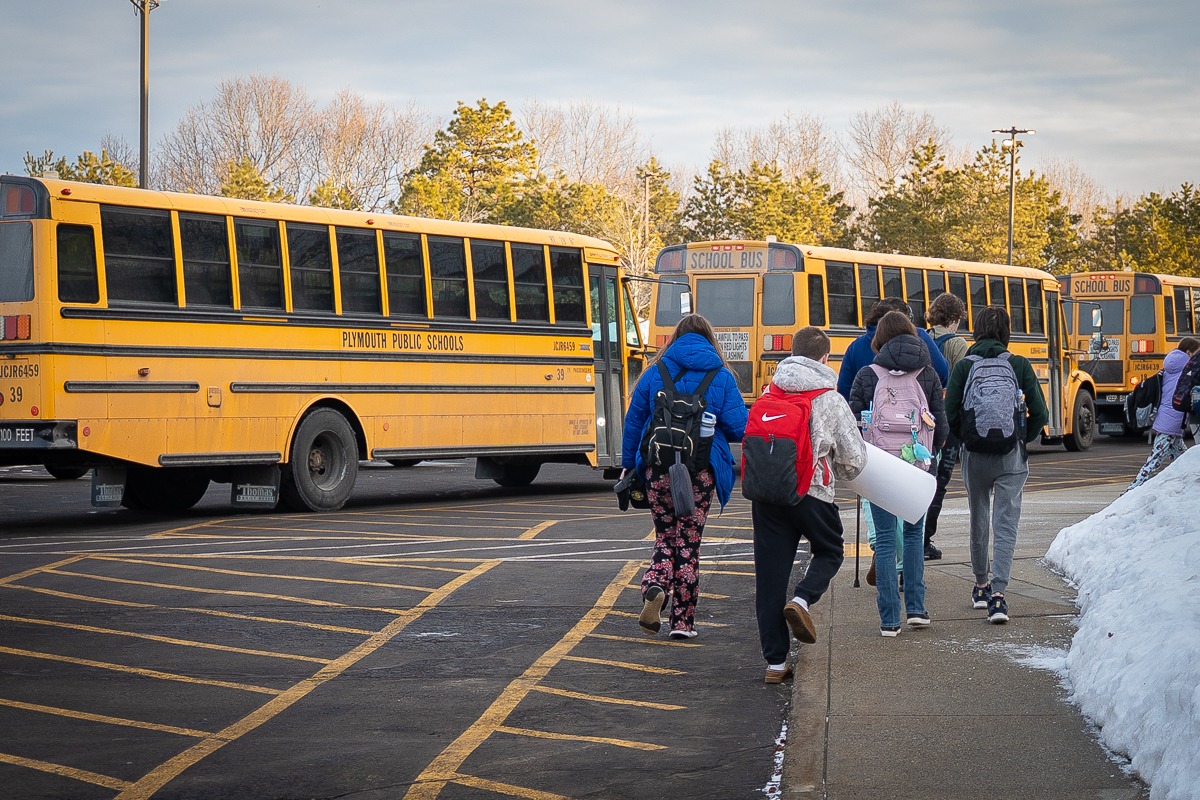
As the price of hiring private bus contractors to transport students through Plymouth’s sprawling geography exceeds $6 million per year, public school officials are considering taking over the service.
It’s the first time Plymouth Public Schools officials have put so much consideration into such an enormous move, one which would put the burden on taxpayers to buy a fleet, hire drivers, and manage the new service.
The bus contract is up at the end of June, leaving officials in a quandary about how to move forward, said Adam Blaisdell, the district’s business director.
“There’s a lot to it,” Blaisdell said. “You have to buy a fleet of buses. You have to maintain them all yourself. You then have to incur all the HR work that goes into hiring about 80 people.”
Last year, the school system hired a consultant to conduct a feasibility study and compare the costs, and the headaches, of running its own bus service through the largest geographical school district in the state.
The report found transportation costs increased by a whopping 47% from the 2018-2019 school year to the 2024-2025 school year.
The report found the cost to Plymouth to run its own school buses would exceed the cost of contracting it out by $303,508 a year. However, the report also predicted the upward trend in contract costs, which means the schools could soon reach a tipping point at which it will be cheaper to run the service itself.
Only two private bus companies have bid to take over the contract in July: First Student, the current contractor, and NRT Bus. The bids are confidential until the final choice is made.
If the school board decides to keep the privately contracted service, it has the option to continue the current contract for another year.
Every day, 65 Plymouth school buses travel a total of 4,200 miles.
They transport 5,486 students daily: 4,433 “regular” students, 303 special education students, 435 vocational technical students, 236 charter students, and 89 students without homes or in foster care.
The $6 million figure represents what it will cost this year to transport the 4,804 students who take yellow school buses. The schools are paying $499.83 per bus per day, Blaisdell said, or $89,969.40 per 180-day school year. That places Plymouth in the middle of the pack. Bedford pays $538 a day per bus, Middleborough $517, Chelmsford $481, and Norwood $480. Worcester, Framingham, and Randolph are among the schools already operating their own school transportation, according to the Massachusetts Association of School Business Officials.
Typically, students whose Individualized Education Plan requires specialized transportation, students who are without homes, and students who are in foster care are transported in vans, which are more expensive than the larger yellow buses.
Because the number of students without homes can fluctuate overnight, the schools sometimes must scramble for van transportation and have had to pay as much as $600 to $900 a day to transport each student, said Blaisdell.
He said Plymouth’s costs are complicated by geography. Because Plymouth – at over 100 square miles – is the state’s largest town by area, students can take long routes to school. The state does not reimburse large-area towns for their outsized costs of transportation.
Like all school districts, Plymouth is required by state law to provide transportation to all students.
In part because the routes are so long and Plymouth’s students are so spread out, the buses often make fewer stops and carry fewer students, so they can get to schools on time.
On a recent morning, buses arriving at Rising Tide Public Charter School carried 6 to 10 students on average, with some buses carrying just a single student.
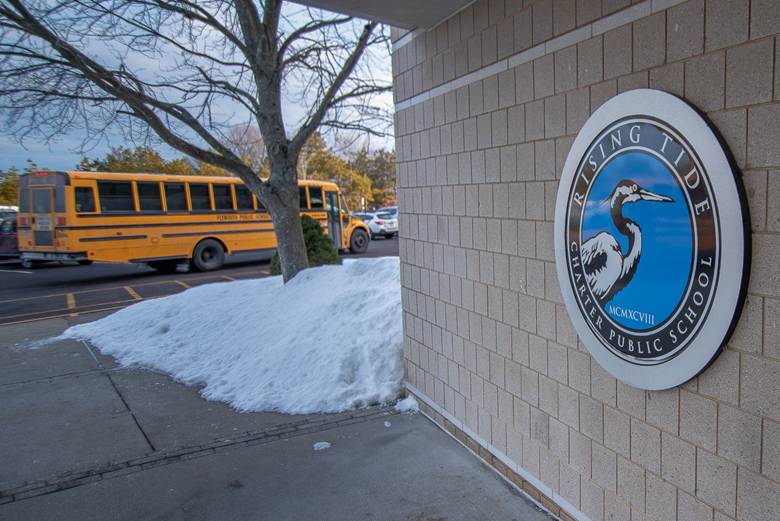
Rising Tide is not alone. Last year, Plymouth South High School and Plymouth North High School each had a bus that transported just five students, according to the 2025 study commissioned by the public schools to help them decide whether to take over bus transportation.
Two students interviewed by the Independent seemed satisfied with the quality of the service.
Patrick MacPherson, a ninth grader at Rising Tide Public Charter School, gets on the number 28 school bus just outside the Pinehills, at 6:50 a.m.
“Bus drivers are super nice,” said MacPherson. “They’re always there on time. It’s a good experience.”
Cassidy Maciel, a senior who lives on Bourne Road, near the Ponds of Plymouth, in South Plymouth, gets on the same bus even earlier, by 6:36 a.m.
The bus drops them off at school between 7:15 and 7:20.
Maciel and MacPherson are among the 17 students that take the 28 along one of the longest bus routes in Plymouth by time, taking 43 to 48 minutes over its 33-mile run from Bourne and Gunning Point Roads in South Plymouth to Rising Tide.
“Plymouth is very large,” explained Blaisdell. “It has a lot of roadways, and sometimes [it] can take an extended period of time to go from the school to the farthest point in Plymouth.”
Each bus must make three trips twice a day, carrying high school students first, then middle and elementary school students. Under its bus contract with First Student, the town must pay for all three trips no matter how few students are on each trip.
“So, it doesn’t save us any more if we say your high school route doesn’t have that many kids on it, don’t do it,” Blaisdell said. “We still have to pay.”
As a result, the high school buses, the buses with the longest routes because they cover the largest territories, are not as full and the elementary school buses, those with the shortest routes because they cover the most compact areas, are the fullest.
High school afternoon buses have even fewer students because many stay in school for sports and other activities.
And then there are those distances, more than 400 miles of roads. It requires a lot of buses to pick up the students on time.
“If you ever had to drive from South High School to Buttermilk Bay and then try to make it back to South Middle School, just you driving without stopping, think of a bus where you have to stop every so often to let kids off,” Blaisdell said.
It is a trip taking 45 minutes even without stops, but 45 minutes is all the time it has including stops, he said.
The buses leave South high school at 2:05 p.m. and must be at South middle school by 2:40. Some are inevitably late, arriving at 3.
“If you make it, you’re lucky, but if you start dropping kids off along the way, you don’t make it in time for the next dismissal,” Blaisdell said.
Each bus cannot have too many students aboard so it can get to the next school on time.
Superintendent Chris Campbell said the schools are now in confidential negotiations with a preferred bidder. He predicted the School Committee could take up the matter in April.
Fred Thys can be reached at fred@plymouthindependent.org.