
Almost every Plymouth neighborhood has a home or business in disrepair no one seems to care about. From trash-strewn yards to sagging siding to rusting cars propped on blocks, they are the definition of blight.
But the stories behind them can be nuanced. Maybe they’re the result of financial hardship or illness, physical and mental. It could be generational dysfunction.
Or perhaps the owner just doesn’t give a damn about being a decent neighbor.
It’s a touchy subject. Telling someone “home, sweet home” looks like a landfill is fraught. Ordering the owner to clean up the mess, that’s where it can get really dicey.
The drawn-out saga over the now disappeared Bert’s restaurant building on Warren Avenue illustrates the public’s sensitivity to government regulation of private properties. Even though the ramshackle structure was undeniably ugly and unsafe, some people said the town shouldn’t have been able to force its demolition.
Local officials disagreed, and thanks in part to the persistence of Town Meeting member Richard Serkey, Bert’s finally bit the dust in December.
Like restrictions on other liberties – yelling “fire” in a crowded theater being the time-worn example – the rights of property owners have limits. The line between the greater good and an individual’s prerogative, however, is paper thin.
I bring this up because several readers reached out following my recent story about the razing of an office building on Sandwich Street to make room for an expanded gas station and convenience store complex. They said tearing down the architecturally uninteresting building – which was not forced by the town – temporarily bettered the landscape. Whether the new gas station complex being built there will be an improvement is another matter.
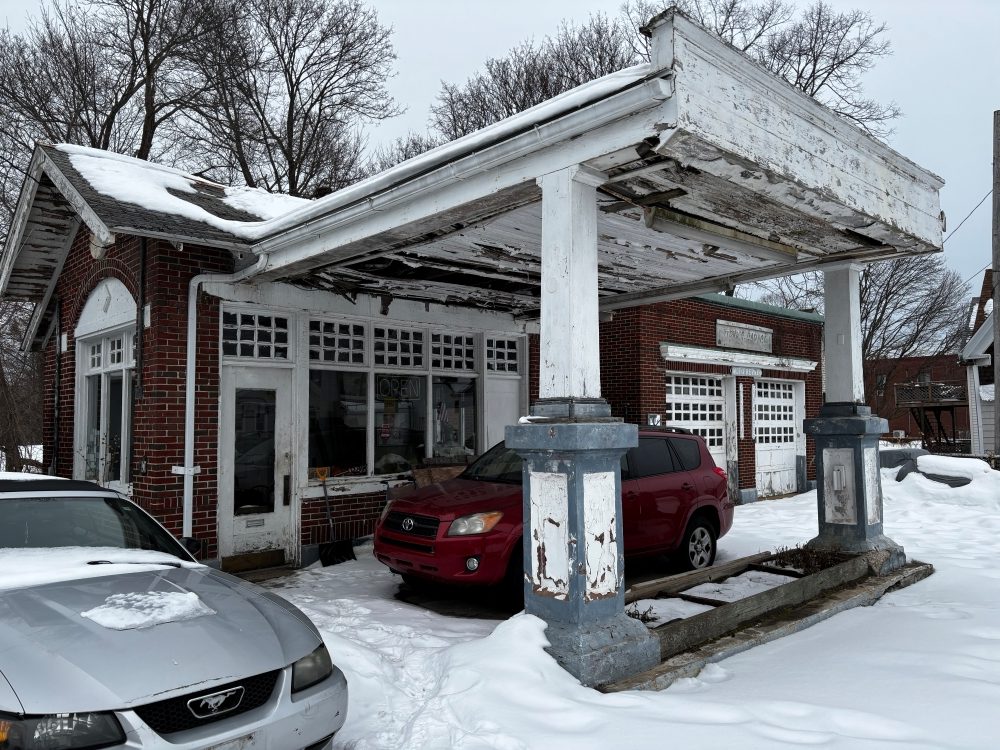
One reader also asked what I knew about a business just to south on Sandwich Street – Steve’s Auto Repair. It’s been in shambles for decades. If Bert’s had a companion automotive shop, Steve’s would be it.
Independent columnist Bill Fornaciari called the structure an “architectural gem that remains virtually unchanged since the day it was built” in 1924.
I won’t argue with an architect, especially a nice one like Bill. The problem is Steve’s looks like it hasn’t been maintained since then. The paint job is shredded, exposing rotting wood. A canopy that once covered the now-removed gas pumps appears precarious. There’s stuff plunked all over the place.
Last week, 10 vehicles without visible license plates were parked every which way on the tiny parcel, creating a de facto junk yard. Footprints in the snow offered evidence someone had been there recently. But no one answered the door and the phone number is out of service. In my many years of living in Plymouth, I’ve passed by Steve’s Auto thousands of times without noticing any activity.
Jason Silva, the town’s director of inspectional services, told me properties like this fall into a kind of gray zone – they’re aesthetically awful, but don’t necessarily present a reason for remedial action.
“It’s in rough shape, there’s no question,” Silva said. “We all can agree on that.”
But he thought I was “baking some assumptions” into my observations. “You say that it’s an eyesore, that it’s a problem,” Silva said, adding how such statements “are kind of subjective, right?”
Objectively, I had to admit he was right. But what about all those old cars – and a truck? By my reading, town bylaws prohibit the “storage of two or more unregistered vehicles” on private property. Steve’s predates that stipulation, so it’s exempt.
That’s a loophole that perhaps could be tightened by a bylaw amendment at Town Meeting.
Or not.
In October 2023, officials, led by Town Manager Derek Brindisi and Silva’s predecessor, Nick Mayo, proposed modifying the rules to give them more latitude in dealing with unsightly buildings and lots. Town Meeting rejected the changes.
Blame it on the grass.
“The original bylaw failed because it had text that related to overgrowth and vegetation that made Town Meeting members concerned that there would be an unofficial ‘lawn police’ where neighbors report their neighbors for not mowing often enough,” Select Board member Kevin Canty explained in an email. “If I brought it back, I would restrict the text to nuisance structures.”
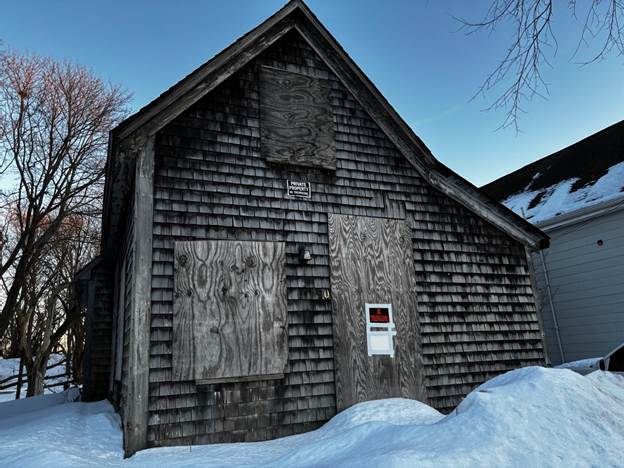
As an example of a property that an amended bylaw would allow the town to address, he cited a house at 90 South St. You’ve likely driven by it many times.
“That was abandoned when I was looking for houses back in 2015-16,” Canty said. Ten years later, it remains vacant – to the detriment of neighbors’ home values and quality of life.
Patricia Meachen, the town’s treasurer/collector, told me the property taxes have not been paid for several years. As of Feb. 13, nearly $10,000 was owed on 90 South St., which is assessed at $240,500. The town plans to begin foreclosure proceedings later this year. That could lead to it being bulldozed. Eventually.
Silva knows the house well. As bad as it looks, he said, “The building’s nice and secure, it’s been plywooded over, it’s not a fire hazard, there are no openings in it… We haven’t had calls of homeless people living in it.”
For years the building was exposed to the elements and people did appear to be living there, without electricity or running water. Nothing was done then, either. And despite Silva’s assessment, it sure looks like a fire waiting to happen.
“If the town ever passes something” to deal with addresses like 90 South St., “we’d be enforcing it,” he said, “but right now we’re stuck with just the state building code.”
And by those standards, neither it nor Steve’s are out of compliance.
I sympathize with Silva’s position. People expect him to be a neighborhood problem solver. Complaints can include “anything from stormwater runoff to lights that shine in the backyard to not even painting your house so that thereby a neighbor’s house is less valuable,” he said. “Things like these wouldn’t be a reason for the town to act. The town does not want to take over people’s properties…But I don’t disagree that there is at least a moral or ethical obligation to try to not harm your neighbors.”
We ended our conversation at a slightly higher altitude – by talking about a fraying social fabric that may inflate tensions between neighbors.
Online exchanges via platforms like Facebook’s All Things Plymouth page have supplanted in-person interactions. Despite living close to each other, people are often isolated inside their homes, furiously typing out grievances in fractured sentences. It’s easier to vent on a computer than to negotiate on a sidewalk. It’s less productive, too.
Basically, they’re mad as hell and want someone else to do something about it.
“I support what your intuition is telling you,” Silva said. “We can get a phone call [and someone says] ‘there’s overgrowth in the front yard, or there’s an incomplete addition on the side of my neighbor’s house. We’ll send one of the guys out, they’ll bang on the door and say, ‘Hey, what’s going on?’ The homeowner might say something like, ‘I’m so sorry, my husband’s got cancer. I’ve been in and out of the hospital for the last six months. I haven’t had time. We don’t have any money left.’”
“Then you go to the person that made the complaint and you say, ‘Did you talk to your neighbor?’ And they say, ‘No.’ One person feels like they’re being like harassed and the person who made the complaint feels like they’re not getting any results. Honestly, just simple communication sometimes would avoid the complaints that end up in our office.”
Sadly, that feels like a heavy lift in this time of unbridled vitriol.
“Good fences make good neighbors,” the poet Robert Frost wrote in 1914. Falling-down fences do not.
Mark Pothier can be reached at mark@plymouthindependent.org.