
As much as I love Plymouth, I don’t appreciate the extended time from shortly after the new year starts until about St Patrick’s Day. Just the other day it was so dark and gray midmorning that the outside Christmas lights, which I haven’t taken down, turned on. Ugh. It’s not so much the cold I despise as the cold partnered with the short, bleak days common this time of the year.
The only place I really enjoy in mid-winter is at home, ideally – when I get around to it – with a fire going in the fireplace. I love a home fire so much that a few years ago I seriously thought of moving to a house with a fireplace in every room in hopes that would cure my winter blues.
The house in question was the Bishop Harlow House at 22 Summer St., which hit the real estate market in the spring of 2018 with a listing price of $440,000. It has long been a favorite of mine. Built sometime after 1789, it is a classic Federal period home featuring a pedimented entry door, symmetrical front facade, brick ends – and eight fireplaces. Yes, it was the eight fireplaces that were the big draw for me.
The floor plan featured a classic four-room plan on the first floor, replicated on the second floor and joined by a central staircase hall. Each room has a fireplace, with the kitchen boasting a bake oven. Even more appealing was a modern unobstructed basement with full sized doors and windows at the rear of the house, opening onto a patio overlooking Town Brook. It looked like a perfect space for my architectural practice to occupy, shortening my commute from 10 minutes to one.
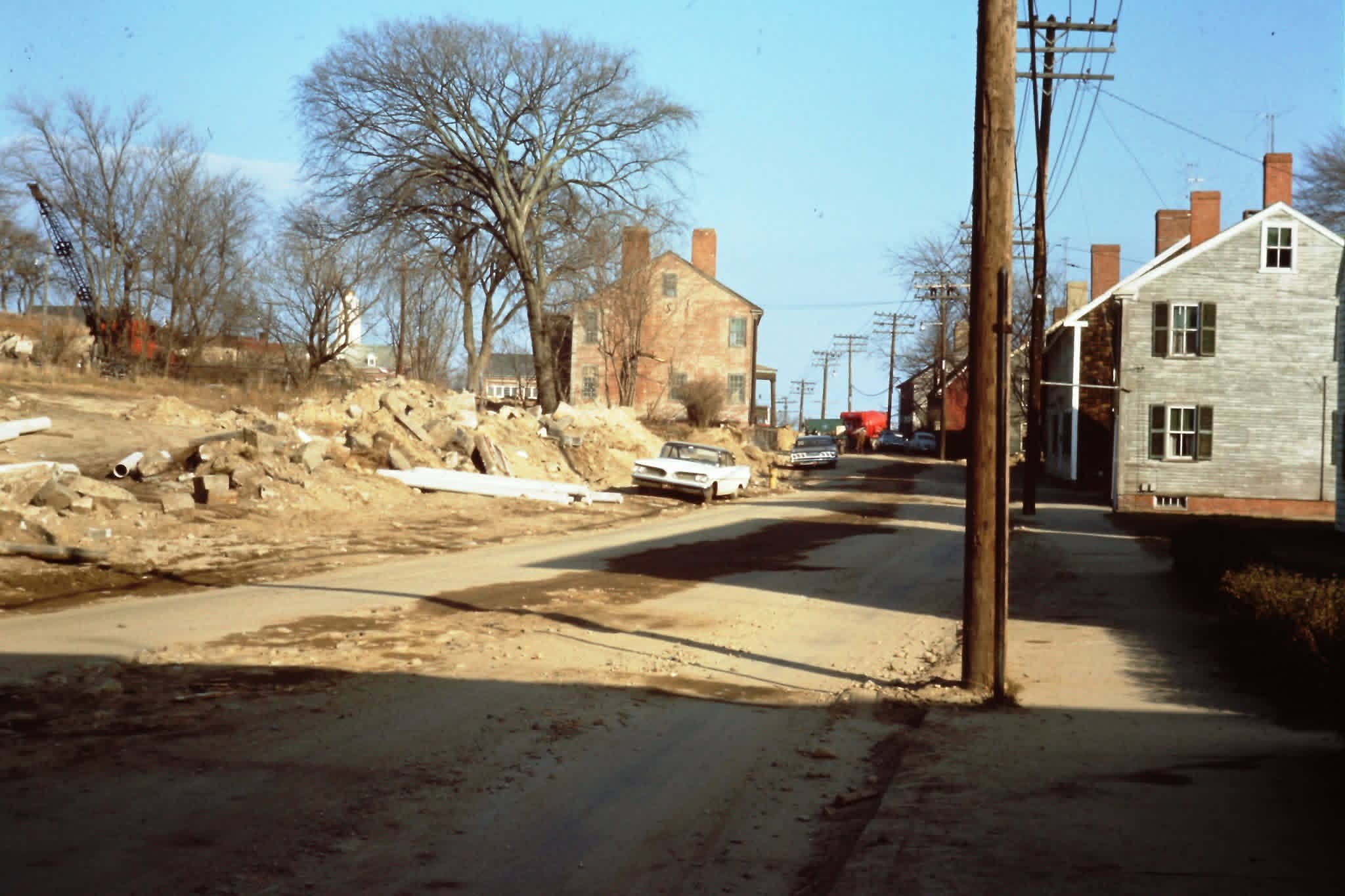
The basement, clearly, was not from the original building, which in 1966 was moved diagonally across the street from its old location to save the historic house from the wrecking ball that was moving fast throughout the neighborhood.
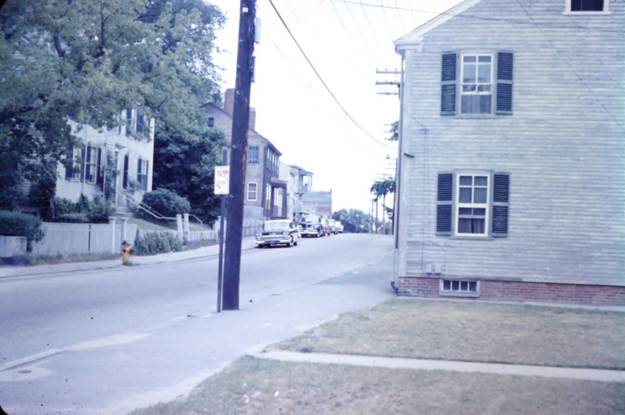
Urban renewal was then in vogue, and Plymouth was one of the first towns in New England to apply the forces of mid-20th century “progress.” Readers have long asked me to write about what happened almost 60 years ago that changed a significant portion of our downtown. Truth be told, I have been hesitant, because for so many Plymouth residents, the land clearing and subsequent redevelopment remains a raw and open wound.
The Plymouth Development Authority was established in 1958 by an act of the selectmen. The authority was given the responsibility to apply federal urban renewal funds to improve and clear “blighted” neighborhoods. The target area was a 30-acre parcel that included Summer, High, Spring, Market, and Russell streets. In today’s world, it’s the area that is home to the John Carver Inn, the Spring Hill apartment blocks and the parking lot that is between Main Street Extension and Market Street. It also included the area around the La Bamba restaurant.
At the time, the neighborhood was filled with textbook examples of Georgian and Federal architecture, as well as multiple properties constructed in the 1600s. Spring Street contained a row of small Cape Cod style buildings that may well have been the oldest standing structures in America. Granted some of these properties lacked heat, running water, and sanitation, but a good majority of them were in great shape, including one that had been refurbished by an aunt and uncle of mine.
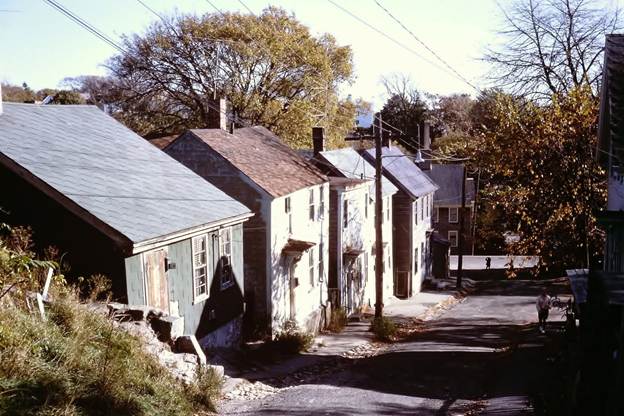
On a side note, the Summer/High Street project was a case study in a historic preservation class during my college years. The professor noted that Plymouth and Boston’s West End were the only locations in Massachusetts that received federal money for urban renewal. When the Plymouth site was cleared, officials from Salem, Portsmouth, Newport, and Newburyport visited – and subsequently, the professor told us – no New England city sought money for urban renewal. I’m not sure how true the story was, but the fact that those cities have managed to maintain large swaths of their historic downtown cores suggests the professor wasn’t far off.
For those interested in learning more about the redevelopment process, I highly recommend “Beyond Plymouth Rock, America’s Hometown in the 20th Century, Volume II,” edited by John Chafee, and Karin Goldstein’s “From Pilgrims to Poverty,” both available at the public library. They detail the story in depth from the residents’ point of view as well as the Redevelopment Authority’s stance.
Returning to my story, the homes targeted and scheduled for removal were appraised and an offer was made to the owners. David Kaplowitz, who owned the Bishop Harlow house, refused. Further complicating matters, the federal grant money did not provide an avenue to restore or move properties deemed worthy of restoration. It was 1965 and by chance a summer resident overheard a protest of the removal of an elm tree in the project boundaries. Upon investigating, she learned about the plight of the Bishop Harlow house.
Mrs. Eric Wentworth, better known as Muffie, was a summer resident of Manters Point and was very well connected politically. Springing into action, she requested a two-week reprieve for the house to raise funds. Wentworth reached out to her friend, Senator Edward Kennedy, who in a remarkably short time was able to rewrite legislation to support moving historic properties within urban renewal sites. With funding established for moving the house, Wentworth helped start the Plymouth Heritage Trust and quickly raised the $30,000 needed for the restoration.
The building found a home across the street on the site of a former 18th century building that had already been demolished. (The irony of that is comical.) For all the machinations, the home still belonged to Kaplowitz. Through negotiations, he finally agreed to a sale price of $13,500, an offer he considered “a settlement, not as concession that is all the property is worth,”
On Nov. 9, 1966, the Redevelopment Authority sold the building for $1 to the Trust. After restorations, the Trust leased the upper floor apartment to a family while the lower level was rented to the Plymouth County Visiting Nurses Association. The Nurses Association eventually owned the entire property, but sometime in the 1990s the building was sold and returned to single-family use. In 2018, I entered the picture, hoping to add my own page to the history of the Bishop Harlow home.
My husband and I visited the house three times. Our last visit, expecting to soon complete the signing and purchase, was on a warm mid-summer day. All the windows were open, and we gathered in the front parlor to discuss our final offer and contingencies. Our conversation was interrupted when a pack of motorcycles roared by. The house shook and we couldn’t hear each other over the din. Ben looked at me and said “nope.” That ended my dream of owning a classic Federal home with eight fireplaces.
The house is still there and is even available on VRBO. I suffer through winter with one fireplace and still have an arduous 10-minute commute. Sometimes I get through the winter by dreaming of an architectural project that would replicate the old Summer Street neighborhoods. If they had survived, I imagine the area would be one of the most desirable places to live in Plymouth, even with motorcycle noise.
Architect Bill Fornaciari is a lifelong resident of Plymouth (except for a three-year adventure going West as a young man) and is the owner of BF Architects in Plymouth. His firm specializes in residential work and historic preservation. Have a question or idea for this column? Email Bill at billfornaciari@gmail.com.