
It’s a beautiful location offering sweeping harbor views.
But Pulte Homes’ proposed six-story condo building on Sandri Drive also overlooks a mostly empty expanse of weeds and trees once declared a toxic waste site by federal environmental authorities.
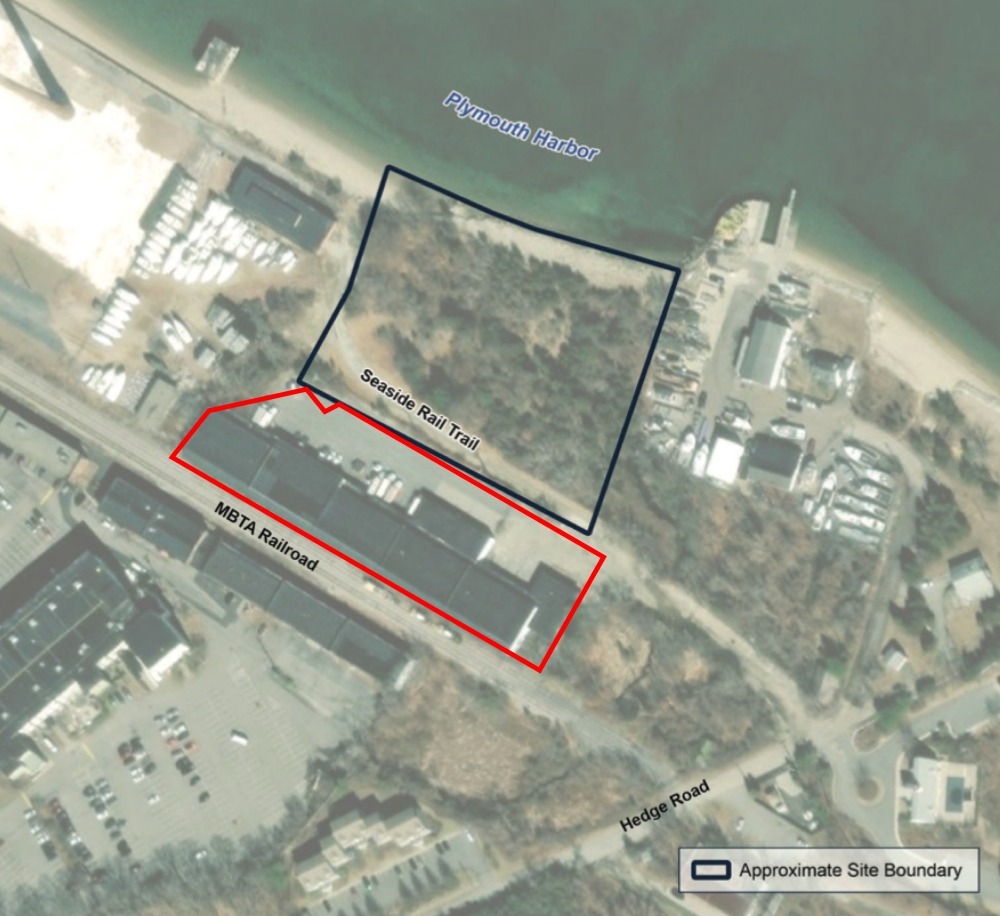
It is the Plymouth Harbor/Cannon Engineering Corp. Environmental Protection Agency Superfund site, where officials found lead, fuel oil and other hazardous substances leaking from above-ground storage tanks in 1980.
Though the site was cleaned and removed from the Environmental Protection Agency’s National Priorities List in 1993, it still is subject to five-year reviews.
In addition, there is a continuing deed restriction on the property — prohibiting construction of housing on the site. It also cannot be used for recreation.

The revelations about ongoing environmental concerns near the already controversial 163-unit condominium complex could give its neighbors and opponents another foothold in their long battle to stop it.
The Superfund site sits beside the largest of three buildings proposed for the condominium complex.
Select board member Deb Iaquinto, a vocal critic of the project, called news of the adjacent Superfund site “one more shocking revelation.”
“The question is who knew what, when and how this project can continue to move forward without the developer and property owner fully and publicly addressing these serious issues,” she said.
“I think we should hit the pause button on any decisions regarding this development until we have full transparency and accountability,” Iaquinto added.
Representatives of Pulte Homes of New England and the well-known Sheehan family, which owns the land set to be developed, did not return telephone calls seeking comment.
In their most recent five-year report issued in 2023, EPA officials said there was no evidence contamination has spread to other property but cautioned against future guarantees.
“The risks posed by climate change in New England could possibly impact the protectiveness of the remedy at the site in the future,” the report said.
“The impacts of sea level rise, flooding and/or storm surge could possibly adversely affect the clean soil cover because the site is located near Plymouth Harbor,” the report continued. “Sea-level rise could cause groundwater to rise. If the groundwater is contaminated, that could be an issue.”
At the now overgrown property, broken down fencing has enabled homeless people to erect tents and live there, the report says.
The land is owned by New Millennium Ventures, a company associated with Joseph Jannetty, who developed Cordage Park, the business and industrial area next to the Plymouth Harbor.
Cordage Park property manager Kristin Ligouri said: “While there is the possibility of reusing or redeveloping the site on Sandri Drive in the future, there are no plans currently.”
The EPA determined that an industrial or commercial business could operate on the site.
Beyond the questions raised by the proximity to the Superfund site, there are potential environmental issues within the Pulte site itself — a former warehouse for L Knife & Sons, the Sheehan family business.
This fall, environmental consultants found arsenic and other harmful chemicals in the soil and water at L. Knife’s Sandri Drive location.
The arsenic was present in a sufficient quantity to require removal, as ordered in an Oct. 1 “urgent legal letter” from the state Department of Environmental Protection to the property owners.
DEP documents show Eight Mates LLC had 7,500 gallons of water containing arsenic removed from the site and 200 tons of arsenic removed from soil.
Long term exposure to arsenic can pose serious health risks and is a known human carcinogen.
So far neither Pulte nor the Sheehan family has publicly disclosed these concerns.
The purchase and sale agreement signed in November 2023 between Pulte and the two Sheehan family companies, L Knife & Sons and Eight Mates LLC, doesn’t mention any environmental concerns or its proximity to the Superfund site.
Instead, the agreement declaratively states “there has been no discharge, spillage, controlled loss, seepage or filtration of hazardous waste on, under or within the property or any contiguous real estate.”
A new draft amended purchase and sale agreement—obtained by the Independent — acknowledges arsenic was found on the Sandri Drive site as well as a different piece of the project on Hedge Road.
“Buyer has identified on the portion of the property located at 0 Sandri Drive a historical release of arsenic in soil and groundwater at levels that require further action under Environmental Law,” the draft agreement says.
“Buyer has identified on the portion of other the property located at 39 Hedge Road elevated concentrations of arsenic in a soil stockpile. Buyer also identified other potential environmental concerns at the property,” the draft amendment says.
The new P&S requires Eight Mates to dispose of the contaminated materials.
With all the critiques of the Pulte proposal — it’s out of character with the neighborhood, it will create too much traffic and not enough parking — major environmental concerns have yet to emerge.
But environmental experts, including the former head of the Superfund program, said they would be comfortable living nearby as long as they were sure a thorough cleanup had been completed.
“By all the reports I read, the remedy for the Cannon site was successfully implemented – the focus being on soil remediation and placing clean fill over the contaminated soils,” said Jim Woolford, the former longtime director of the EPA Superfund program.
“That location though does raise a future concern with sea level rise from global warming,” he added.
“The question is whether the site is or could be subject to flooding say from a strong nor’easter or hurricane. In that case could the “cover” over the contaminated soil left in place erode to the point that the contaminated soils become suspended and could migrate…” he said.
He pointed out that fencing around the property had fallen into disrepair, even though EPA officials said the fencing may no longer be needed.
“This (fencing) is an important aspect of the remedy to keep individuals off the site so they can’t compromise the remedy or cause themselves exposures,” Woolford said.

As for the Pulte site itself, Lenny Siegel, who heads the California-based Center for Public Environmental Oversight, said after reviewing various DEP reports, “there is no reason to believe it is unsafe to build at the site due to the current levels of contamination.
“But I think that potential risks due to anticipated sea-level rise should be evaluated. It’s easier to protect against such risk when building a project than later, when people are already living there” he said.
The 2.5-acre Plymouth Harbor/Cannon Engineering Corp. site contained three aboveground storage tanks holding lead and low levels of dangerous chemicals called polycyclic aromatic hydrocarbons, or PAHs.
According to EPA documents, the tanks, which all sat between 50 feet and 180 feet from Plymouth Harbor, were originally constructed in the 1920s and used for storing fuel and oil unloaded from barges.
In 1975, the company started storing motor oils, industrial oils and other hazardous substances in the tanks, the documents said.
The company transported and stored hazardous waste at the Plymouth facility and incinerated it at its Bridgewater, Massachusetts facility until 1980, when the facilities went into receivership, according to the EPA.
The site was placed on the National Priorities List in September 1983. After cleanup, EPA took the site off the list in November 1993.
Over the years, the Sheehan family has offered various proposals for redeveloping their North Plymouth properties.
In 2017, Sheehan floated the idea of building a school in the neighborhood, with student housing, and a community center, according to news reports at the time.
Even earlier — in the late 1980s and early 1990s — Eight Mates LLC. proposed an apartment complex for the land between Prince s and Hedge Road. It would not have been a 40B affordable housing project.
Called the Village at Hedge Road, the plan consisted of 74-one-and-two-bedroom apartments in 34 detached buildings, with a traditional design featuring cedar shingles and peaked roofs.
The company obtained permits from the Zoning Board of Appeals and other town committees. The approvals were extended multiple times, but the project never moved forward. Town documents don’t say why.
“I think the neighborhood would prefer the site remain undeveloped,” said select board member, Kevin Canty, a North Plymouth resident. “However, past proposals were more in line with the character of the area and fit better into the fabric of North Plymouth. They would have been more palatable to the neighborhood and its residents.
“I think anything would be better than this megaproject built by an out-of-town developer who clearly couldn’t care less about the concerns of the people living nearby,” Canty said.
Andrea Estes can be reached at andrea@plymouthindependent.org.