
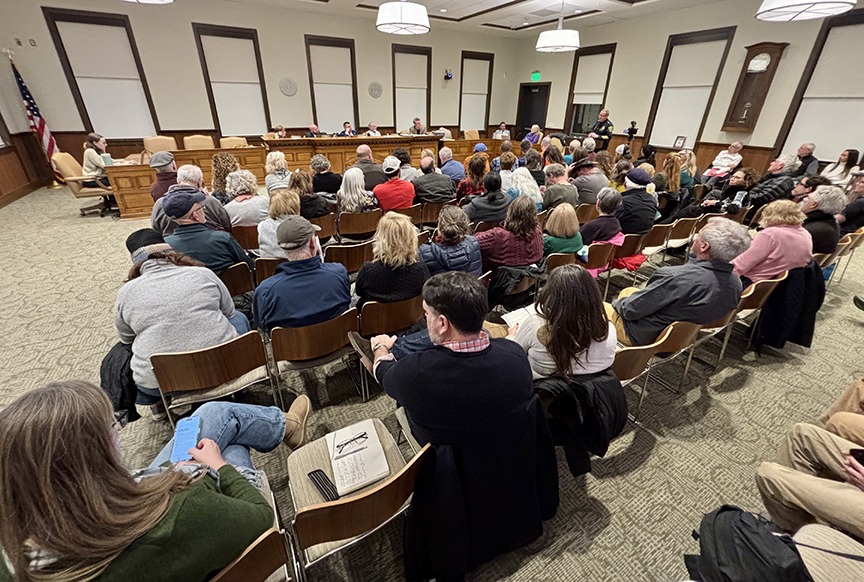
In a marathon five-hour session Tuesday night before a rare standing-room-only crowd at Town Hall, the Select Board considered a policy to further restrict town officials from participating in federal actions against any undocumented residents.
In the end, the board voted unanimously not to change the policies after Police Chief Dana Flynn detailed restrictions already in place severely limiting his officers’ ability to participate in immigration enforcement.
The vote came around 11 p.m. after some 30 impassioned residents each used their three-minute time slot to voice their opinions.
A second room at Town Hall had to be used to accommodate the overflow crowd.
The public comments and discussion lasted so long the board postponed a vital discussion of the town’s budget crisis until Friday.
Tuesday’s debate over the local policies on cooperation with U.S. Immigration and Customs Enforcement was prompted by a series of high-profile raids last year, including two in North Plymouth, home to many Brazilian immigrants, prompting fear in that community.
One ICE arrest in September came under scrutiny after a Brazilian resident was pulled out of his car in front of a school bus full of students and the car left in the middle of an intersection.
“We would not be having this conversation if not for the manner and means that ICE has chosen to conduct itself in the community,” said board member Kevin Canty, whose initial proposal to change town policies prompted the debate.
Flynn said he sought an explanation from ICE about the September incident and was satisfied with their reasons for abruptly leaving the scene as crowds began to gather. He said by the time Plymouth police arrived the vehicle had already been cleared from the road.
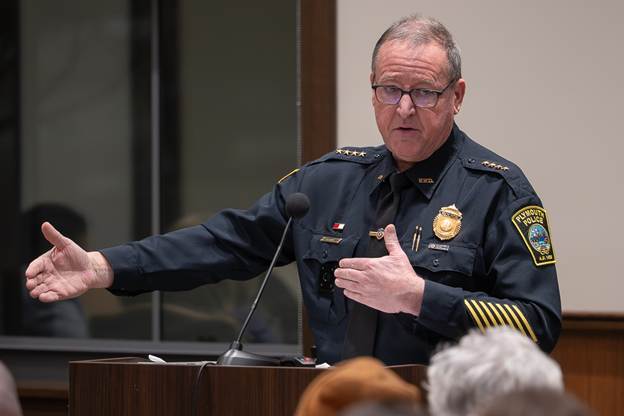
Flynn said he is aware of about a half dozen ICE arrests in Plymouth in 2025.
Some residents who spoke Tuesday were not satisfied the policies were restrictive enough.
“I’ve never seen this level of fear in our community,” said Kristin Thomas, cofounder of Together We Can, a group formed to support immigrants.
“If you are Black, brown, or speak with accent, you feel like a target. Parents are afraid to send their kids to school. People are afraid to go to work, church, even the grocery store.”
Several board members said they were surprised last week to learn Flynn had already instituted restrictive policies on his department’s participation in ICE raids.
During his slide show presentation, the chief said the police department is not involved in immigration enforcement and officers do not ask about immigration status except when a suspect is in custody for a violent felony or in some cases involving distribution of drugs or weapons or has a prior conviction for a violent felony.
He also said his officers do not assist federal authorities on immigration-related investigations but have periodically received cooperation from ICE on a number of criminal investigations.
Flynn said additional restrictions would “add confusion to a polarizing topic and puts my department and officers in the midst of a political argument that we, as an apolitical organization, should not be in.”
He also said he doesn’t want to “jeopardize our well-established relationships with essential law enforcement partners that will inevitably put all of our community, regardless of their immigration status, at risk.”
Flynn said the department is governed largely by a 2017 decision from the Massachusetts Supreme Judicial Court, Commonwealth v. Lund, which prohibits local police from arresting or holding anyone based solely on their immigration status – even if the person is the subject of a federal immigration detainer, a request from ICE to hold a person for immigration proceedings.
He said ICE typically alerts the department when it operates in Plymouth. He said communication with ICE has improved over recent months but added that he would still like ICE to let police know when they detain someone.
“That would alleviate a lot of angst with family members” wondering about the whereabouts of their loved one, he said.
Flynn said the police department has not participated in any ICE operations.
“When people jump out of an unmarked car with masks on, without a warrant, grab someone off the street, pull them in, and hold them, that is the act of a fascist government,” said resident Bill Arienti.
Canty initially proposed a town policy to codify existing police policy but also restrict other town employees from cooperating with ICE in non-criminal matters. Canty’s proposal made exceptions for a list of violent offenses.
“It would hamstring us,” Flynn objected, pointing out that Canty’s proposal did not make exceptions for some violent offenses such as kidnapping or arson.
Others endorsed the chief’s push to recognize the police department’s policy as the only one.
“We need one policy, not two,” said Alice Baker, chair of the Manomet Village Steering Committee. “He’s got a policy. Please support the police chief.”
In the end, Canty agreed to withdraw his proposal and proposed the board adopt the police department policy as its own as it relates to police.
The board voted 4-0, with Dick Quintal absent, to support that proposal.
Fred Thys can be reached at fred@plymouthindependent.org.