
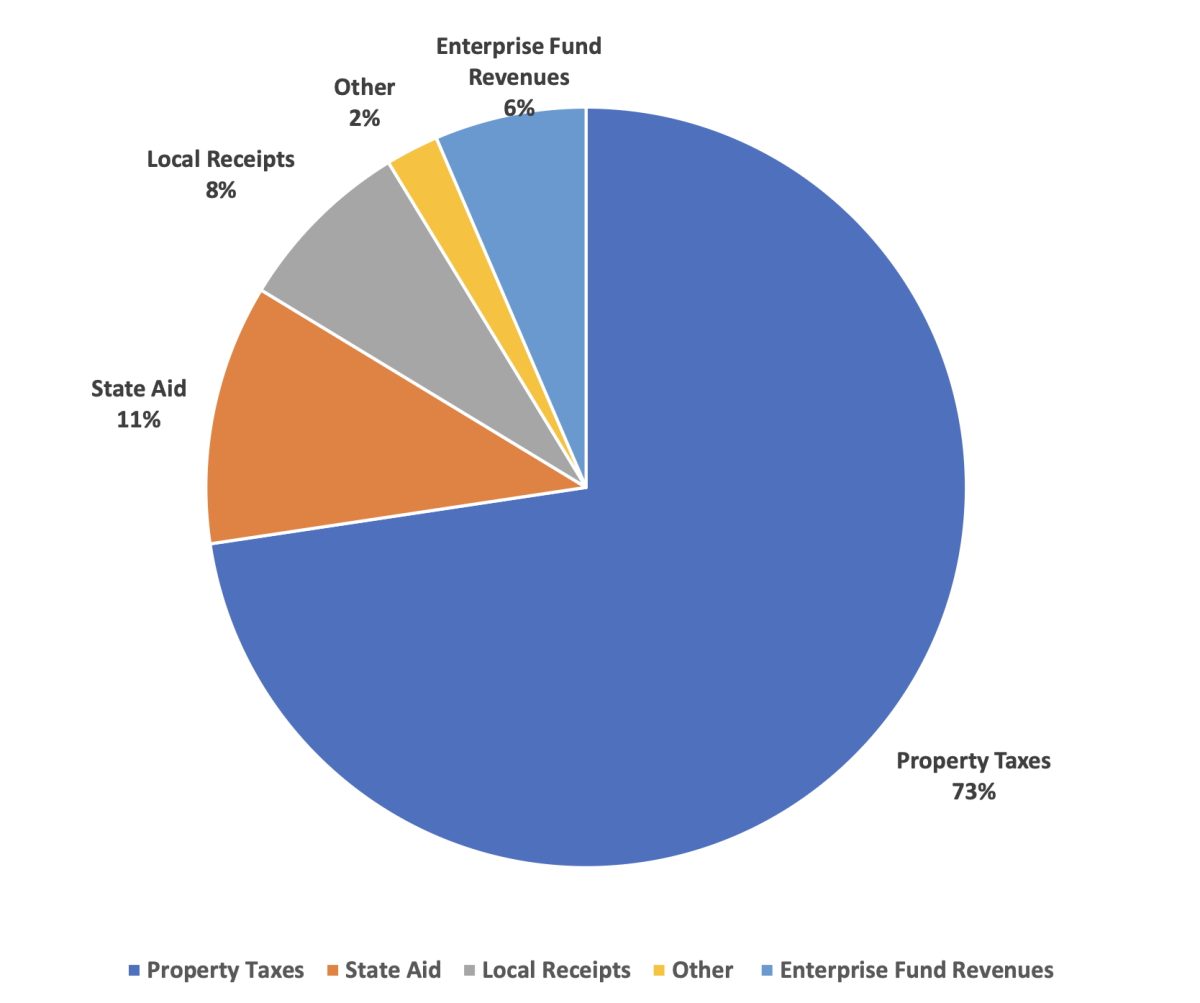
Whenever discussion of a budget includes the mention of potential layoffs and a tax override, alarm bells sound.
That’s what happened during Tuesday’s Select Board meeting, where members and Town Manager Derek Brindisi raised the specter of a Proposition 2 1/2 override and layoffs within one or two years unless the town can better control its spending, especially the cost of health insurance for employees.
“I feel like we’re running headlong into an override discussion,” said board chair David Golden. “So, we really need to start talking about how we can tighten our belts.”
Proposition 2 ½ limits the total amount of taxes a city or town can raise without the approval of voters. An override – which is a permanent tax increase – allows them to collect more through real estate assessments. Such votes are rare, and successful ones are even more unusual.
Golden added that the town must also do more to promote industrial and commercial growth if it wants to prevent raising taxes on homeowners.
“Otherwise, in a year or two, we are going to be talking about an override,” he said.
“I agree,” Town Manager Derek Brindisi said.
In a presentation of his proposed budget for fiscal year 2027, which begins July 1, Brindisi projected that town spending would increase by 5.9 percent to $73.6 million, and school spending would increase by 3.4 percent to $133.1 million.
Brindisi, who became town manager in 2022, said this is “easily the most challenging budget” he has had to present.
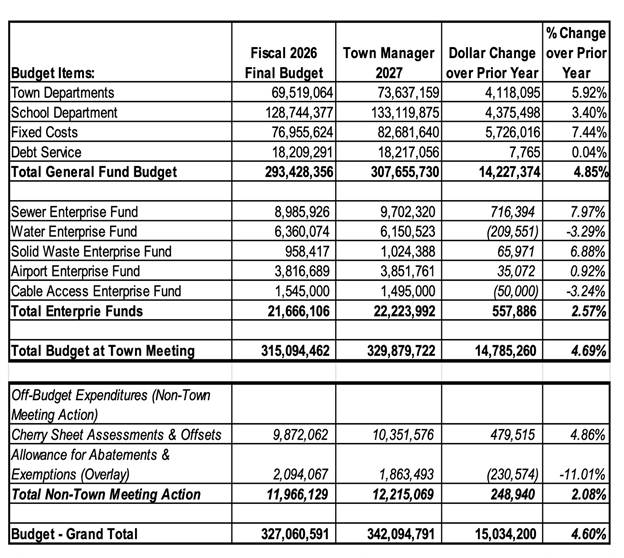
The schools are projected to receive 56 percent of the budget and the town administrative side is expected to receive 44 percent. Salaries represent 49 percent of expenses and benefits account for another 23 percent.
“If you’re looking for significant cuts, unfortunately, it comes down to people,” Brindisi said. “Our revenues cannot keep pace with our expenses.”
That’s at odds with what he told WATD radio earlier this year when discussing the current fiscal year budget.
“The Town of Plymouth, financially, is in a great position,” Brindisi said in April. “Our finance director, Lynne Barrett, working very closely with the business team over at the School Department, have done a tremendous job developing the FY26 budget.”
He added that though modest cuts had to be made, “we were able to balance the budget and not have to even have [a] conversation about overriding.”
“Quite frankly, I don’t think we’ll have a conversation about overriding for years to come,” Brindisi told WATD.
Just months later, however, the forecast has taken a turn for the worse.
To balance the upcoming fiscal year’s budget, Brindisi proposed taking $939,000 from the town’s excess levy capacity and not making contributions to the town’s nuclear mitigation and capital maintenance funds, which normally would get $500,000 each. The nuclear mitigation fund is a pot of money the town is building to buy land from Holtec Decommissioning International, the company that owns the former Pilgrim nuclear power plant.
Health insurance costs are projected to increase by $4.5 million, a 13.6 percent increase, Brindisi said. Pensions are expected to increase by $1.7 million.
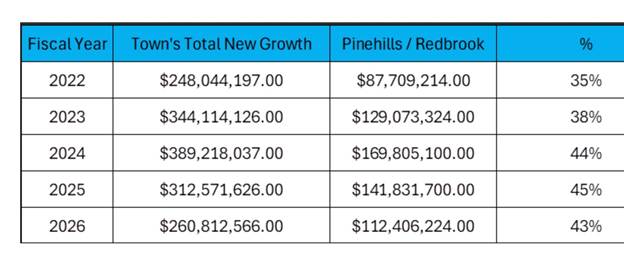
As those costs spike, property tax revenue from new development is flattening, having peaked at $5.3 million in 2024, Brindisi reported. For 2026, that number had plummeted to $3.3 million. He said the “vast majority” of new growth in property tax revenue over the last five years has come from the Pinehills and Redbrook developments. The Pinehills is expected to be fully built out in the next year or two, Brindisi said, with Redbrook not far behind.
“It doesn’t bode well for the future of our finances,” he said.
Brindisi proposed reducing health care costs by charging town employees a deductible for the first time. Such a change would have to be negotiated with unions.
One drug category alone, GLP-1, sold under brand names such as Ozempic and Wegovy, is expected to cost the town $3 million next year, Brindisi said. The drugs, initially aimed at controlling diabetes, are widely used to promote weight loss.
“We need to eliminate that drug for all those except for those individuals that have a medical diagnosis that requires that drug,” Brindisi said. He estimated that the town could save seven percent on health insurance premiums by making the change.
Brindisi also said the town could consider joining the state health insurance program.
Among his other cost-saving ideas: delaying new hires in the town’s information technology department, postponing buying two new police cruisers, no longer having police enforce White Horse Beach parking restrictions, and putting a hold on the hiring of eight firefighters.
Brindisi did not immediately respond to requests for comment Wednesday.
During Tuesday’s meeting, Select Board member Dick Quintal criticized his fellow board members for focusing on “agendas and policies” over the last few months rather than on the budget. He singled out the board’s practice of holding meetings in Plymouth neighborhoods to respond to residents’ concerns.
“We have spent a lot of time wasted when we should have been paying attention to stuff like this,” Quintal said.
Fred Thys can be reached at fred@plymouthindependent.org.