
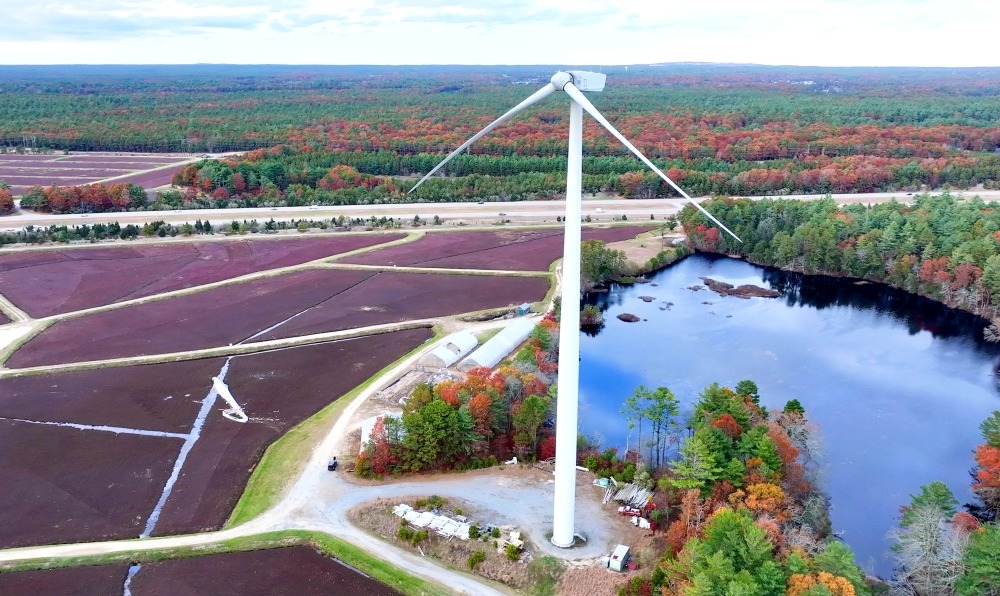
A week after a blade from a 300-foot-tall wind turbine fell into a cranberry bog on Head of the Bay Road, RWE, the company that owns the project, says it’s already begun an “exhaustive” analysis of the incident with Spanish company Siemens Gamesa, which built and maintains the equipment.
“The project has been shut down as a precaution, and the other three turbines at the site were also shut down,” Patricia Kakridas, a spokesperson for RWE, said in an email. “Once it is determined the site is safe, work will begin to remove the fallen blade.”
According to the U.S. Department of Energy, such accidents are not common.
A “failure in which a turbine blade detaches mid-operation, is virtually impossible with modern turbines due to improved engineering and the use of hazard sensors,” the energy department says.
Yet, that is exactly what happened in Plymouth Nov. 7. And it was not the first time that a Siemens Gamesa turbine blade has broken off. In 2024, one fell into the North Sea. That turbine was a more modern version than the one that lost its blade in Plymouth.
A different kind of turbine mishap occurred closer to home, at an offshore Vineyard Wind turbine in 2024. In that case, a portion of a 350-foot blade made by GE Vernova snapped. A thorough explanation of what might have happened can be found in this New Bedford Light article. It reported that it was the third such blade to have snapped in a matter of weeks. (The other two accidents occurred in the North Sea.)
RWE describes itself as the third largest renewable energy company in the United States.
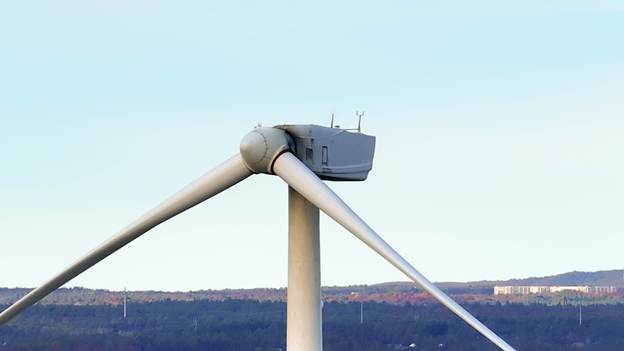
Plymouth has five wind turbines, the four at the South Plymouth site, known as Future Generation Wind, and one more in the Camelot industrial park, according to the United States Wind Turbine Database. All are privately owned.
The Plymouth Fire Department estimated the fallen blade is 75 to 100 feet long.
The Future Generation Wind turbines came online in 2016, according to the database. Each can produce 2 megawatts of electricity. The Camelot Park turbine came online in 2012 and can produce 1.5 MW. It was manufactured by Goldwind, a Chinese company.
The town appears to have no oversight over the safety of wind turbines. Its inspectional services department issues building permits for construction, but plays no role beyond that, said Jason Silva, the department’s director.
“Inspectional services has no responsibility for wind turbines,” Silva said in an email. “Inspectional services is tasked with issuing a permit to those who demonstrate they can meet the state code requirements. The permit holder and property owner is the responsible party for any structures or otherwise.”
The South Plymouth cranberry bog where the Future Generation Wind turbines are sited is owned by Keith Mann. He could not be reached for comment. He put the property up for sale in August and it is under agreement.
“When we issue a permit like these, we get engineers to provide affidavits which accept responsibility as the state building code states,” Silva said. “Then at the conclusion of the project we get final affidavits which request final sign off and affirm all has been completed as per code and those engineers legally accept responsibility.”
Inspectional Services issued the permits for the turbines in 2015 to the contractor, Scott Spencer.
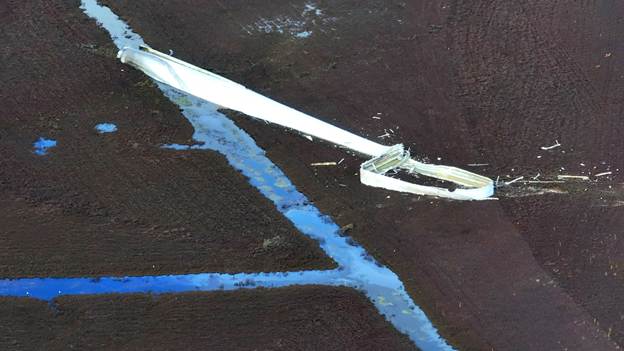
The Plymouth Fire Department responded to a call Nov. 7 alerting it that one of the three blades on the turbine was missing, according to a press release.
Firefighters found the heavily damaged blade several hundred feet away from the base of the turbine, in a cranberry bog.
No one was injured.
“We were fortunate that this turbine is located out in the middle of the cranberry bogs and not in a residential area,” Fire Chief Neil Foley said. “Thankfully, no one was hurt, and the turbine automatically shut itself down as designed.”
Foley did not respond to a phone call requesting further information.
The state Department of Environmental Protection is responsible for oversight of wind turbines, but only to make sure a project complies with environmental regulations. According to a spokesperson, MassDEP responded to the incident on the day of the accident and instructed RWE to take measures to reduce any further risks. A licensed site professional is developing a plan to remove the blade and MassDEP says it is continuing to monitor the situation.
Fred Thys can be reached at fred@plymouthindependent.org.