
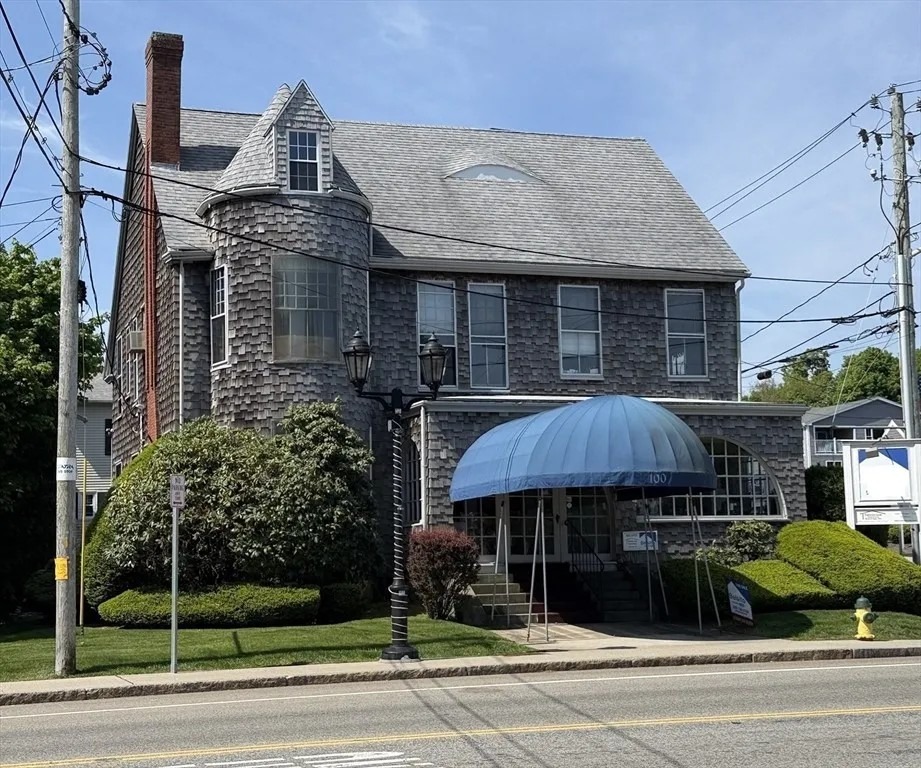
A recent Plymouth real estate listing hit the trifecta for this architect. One of my favorite architectural styles? Check. Notable architect? Check. Prominent Plymouth resident involved? Check.
The property in question is 100 Court St., home of the Belsito real estate offices. It’s on the market for $1.25 million.
Given the building’s style, architect, and original owner, it’s no wonder that it commands the corner of Court and Samoset streets.
Our story begins in 1884 when prominent Plymouth businessman Leavitt Taylor Robbins Jr. bought the vacant lot. Robbins and his family are generally associated with the wharf and lumber yard at the base of Robbins Road from the early 1830s until the early 20th century.
Robbins Road begins at Court Street at the northern corner of Holmes Field and extends down to the harbor. The lumber yard was located between the rail line and the harbor. At one point, the property featured a large pier that extended into the harbor. In Google satellite photos, remnants of the wharf pilings are still visible. Established in 1831 by the Leavitt T. Robbins Sr., Robbins would require a wharf to allow ships to deliver goods to town. That’s because the railroad would not extend to Plymouth until the 1840s. In 1870, Leavitt Robbins Jr. began running the business upon the death of his father. It operated for more than 75 years under the Robbins name and then under different owners.
Trust me, this all ties into 100 Court St.
In 1845, Theodore Minot Clark was born in Boston. He became an architect after graduating from Harvard in 1866 and began a career in New York City. By the mid-1870s Clark had moved back to Boston and was sharing an office with Harvard classmate Edwin Curtis. By the time Robbins bought the Court Street lot, Clark was a wildly successful Boston architect. He often collaborated on projects with friend and fellow architect H.H. Richardson (who designed Trinity Church in Copley Square) as well as designing several Back Bay mansions on his own. Clark also served as the second architectural dean at MIT and published several architectural education manuals.
Robbins’s purchase of the Court Street property was a brilliant marketing move. As the owner of a lumber company, what better way to advertise than to build a new home in a burgeoning residential district? At the time, Court Street north of Samoset Street was developing into a rather posh neighborhood. Large Victorian mansions occupied both sides of Court Street from Samoset to Allerton. Additionally, Robbins’ future home was within walking distance of the train station, so throngs of visitors to Plymouth likely passed by it, seeking accommodations at the Samoset House Hotel on the corner where the Levis service station is now. The icing on the cake for Robbins was the fashionable architect he hired, T.M. Clark. He designed a spectacular house using a trend-setting new kind of shingling that called attention to Robbins’ lumberyard products.
The shingle style of architecture has its origins in New England. It is generally believed to have been born out of the 1876 Chicago Centennial Exhibition that featured a shingled New England building. Architects liked the simplicity and considered it an alternative to the decorative Queen Anne Victorian style that was sweeping across the country.
Shingles covered the entire building, forgoing trim whenever possible. Grand porches and small multi-paned windows also became hallmarks of the style. Roof and wall surfaces blended into one another and large gable surfaces dominated the facade.
Clark incorporated many of these details into the Robbins residence, which was completed by 1886. A large, almost continuous gable faces Samoset Street. It was a striking sight for people traveling south into Plymouth on a streetcar in 1886 and remains so today. The Court and Samoset sides feature large porches. Both are now enclosed. Large multi-paned windows are found throughout. The exterior walls and roof were once covered with shingles. Today, the roof is covered with asphalt shingles, but the connection between the walls and roof are separated only by a thin fascia and gutter profile.
One of my favorite elements of the house, and a classic shingle style detail, is the thin eyebrow window on the third floor. (It’s now covered over.) The “squashed” elliptical window just barely pokes above the roof surface.
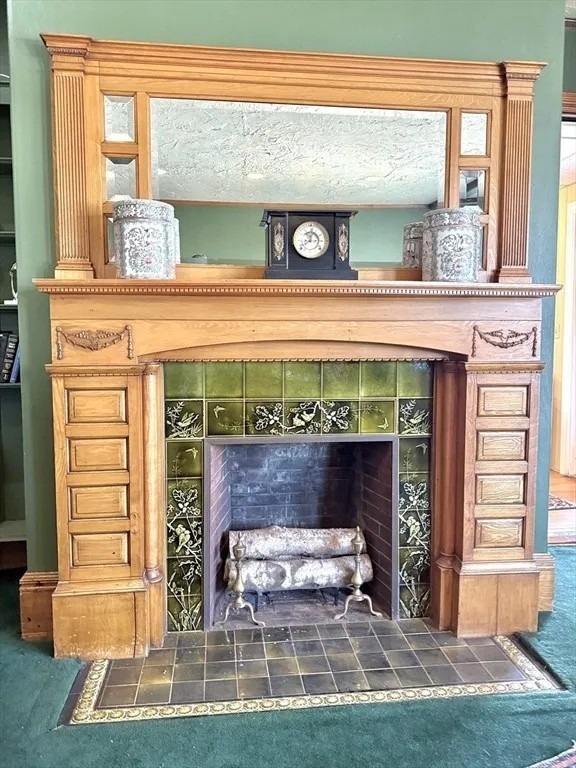
The interior photos available online show that a majority of the inside remains intact. Rich woodwork and elaborate fireplaces remain in their original condition. Comparing the original floor plans with the existing layout reveals the home has undergone minimal changes, a rarity for mansions of that period. Homes of this size usually were converted into apartments over the years. The fact that this one has remained virtually intact for 139 years is rare.
The exterior is protected by the Historic District Commission, but those rules don’t apply to its interior. I hope that whoever buys the building will respect this gem from a bygone era. If anyone wants to front me the purchase price, I’m game.
Architect Bill Fornaciari is a lifelong resident of Plymouth (except for a three-year adventure out west as a young man) and is the owner of BF Architects in Plymouth. His firm specializes in residential work and historic preservation. Have a question or idea for this column? Email Bill at billfornaciari@gmail.com.