
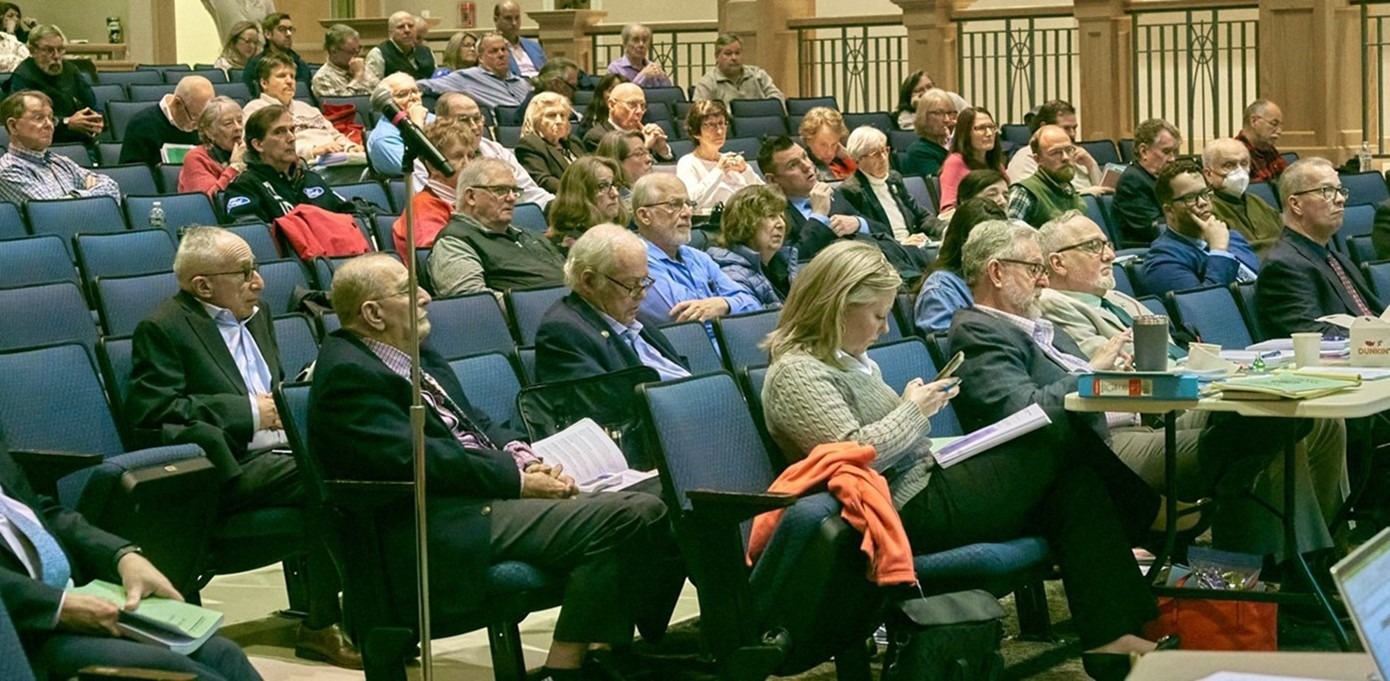
Plymouth’s fall Town Meeting is scheduled to convene at 8 a.m. Saturday morning at Plymouth North High School.
Among the issues elected Town Meeting members will decide are whether to fund reconstruction of a runway and taxiway at the airport, a full-access trail at Jenney Pond, and a report on the viability of making expensive renovations to rundown Memorial Hall.
Town Meeting, with 162 elected members, is Plymouth’s Legislature, which means it gets the final say on major issues, including how millions of dollars in taxpayers’ money is spent. It is overseen by longtime moderator Steve Triffletti, who only votes in the event of a tie.
Each of Plymouth’s 18 voting precincts elects nine members to three-year terms. Those terms are staggered so that three members from each precinct are elected in May’s annual town election.
The public can attend Town Meeting in person, but it will also be streamed live on YouTube by The Local Seen. Anyone can speak, including non-residents, but they must wait until after Town Meeting members have spoken on a particular agenda item.
If all business is not finished on Oct. 18, the meeting will be extended to the evening of Oct 20.
This fall’s warrant contains 26 articles, which are the items approved by the Select Board for discussion and votes.
Here are summaries of some of the most significant articles:
Article 4, Items A5 and A6: Runway 6/24 and Gate 3 Taxi Lane Reconstruction

The reconstruction of Runway 6/24, one of two runways at Plymouth Municipal Airport, is a $9.2 million project. The Federal Aviation Administration is paying for 90 percent of the work, and the Massachusetts Department of Transportation will pick up another 5 percent. The remaining 5 percent, or $460,000, is the town’s share. It would be paid for out of the airport’s enterprise fund.
The runway was last rebuilt in 1998. Parts of it have cracks ranging from two to four inches wide.
The project will not lengthen the runway. The last time Town Meeting considered a runway extension, in April 2024, the proposal was soundly defeated by a 117-26 vote, after neighbors complained about noise and the Airport Commission’s alleged failure to consult them about the expansion plans.
The gate 3 taxi lane replacement would cost $870,000. The FAA would cover 86 percent, MassDOT 7 percent, and the airport enterprise fund 7 percent, or $59,000.
Article 16: Dark Orchard Trail
The Community Preservation Committee is recommending spending $900,000 from the Community Preservation Fund to build what will be called the Dark Orchard all persons trail starting behind the cul-de-sac at the end of the Jenney Pond parking lot and leading into the woods away from the pond.
“That all-persons trail will allow anyone with mobility issues a beautiful path that leads you up into the woods through the red maple swamp,” said David Gould, the town’s director of energy and environment, in a July interview with the Independent. “It will have ropes and guides for people with visual issues so they can walk back there.”
Article 20: Memorial Hall Historic Structure Report
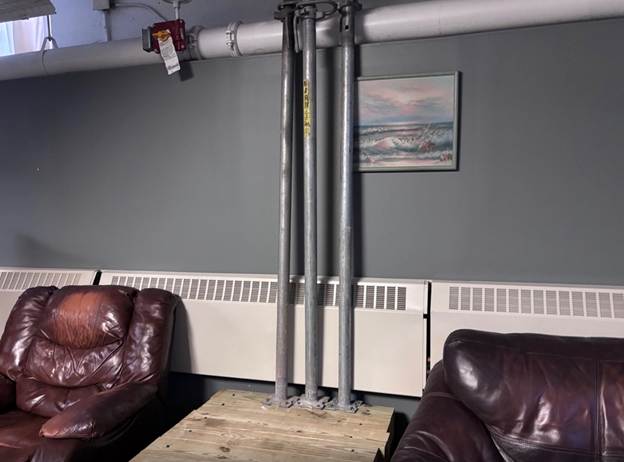
The Community Preservation Committee is recommending allocating $90,000 from the Community Preservation Fund to pay for a study of Memorial Hall, which is deteriorating and in need of major work if it is to remain functional.
The report “will be a written and illustrated reference document that provides a thorough historic and architectural evaluation of Memorial Hall,” the town said in its application to the CPC seeking the study. The article was submitted by Historic Resources Coordinator Connor Anderson on behalf of Town Manager Derek Brindisi and the Select Board. “It will identify significant original and subsequently added features and spaces, existing appearance and condition, and historic events associated with the building,” the application said.
Most important, the report will serve as a guide as the town decides whether it is worth saving Memorial Hall and if so, what its restoration would cost.
Bill Keohan, the Select Board’s representative on the committee, called the report a roadmap for restoring the building while determining what aspects of it are historic.
“We’re bringing in the professionals to look at the building and tell us whether it’s historic or not, what the materials are, how they’re performing, and how best to fix them,” Keohan said. “If [the work] isn’t done correctly, it can come back to haunt you in five or 10 years. If you’re going to touch that building, you really need to have this report.”
The CPC was divided on the value of the study, voting 5-2 to recommend that Town Meeting appropriate the funds. The vote reflected differing opinions in town about what should be done with the 100-year-old building, which was built as memorial to World War I veterans and has served the community as a venue for everything from concerts to high school graduations to mixed martial arts fighting to pickleball.
Committee member Karen Buechs expressed the majority opinion, saying the hall should be preserved.
“Everybody I talk to wants it fixed,” Buechs said earlier this year.
But Paul Churchill, who cast one of the two votes against funding the historical preservation study, urged the town to first fix chronic water leaks that threaten Memorial Hall’s structural integrity and should have been addressed years ago. Brindisi has said the building will have to close within two years if major renovations and repairs are not made.
“You’re asking to do a study on something that has water leaking into it,” Churchill said. “Fix the water. Then come back to the study.”
Committee member Len Levin also opposed funding the study and questioned whether the building is worth saving. The total cost of a restoration is estimated at about $34 million. A pared-down plan could cost about $22.6 million.
“We keep talking about fixing that building. That building is not fixable,” Levin said. ‘The people that I’ve talked to and the sentiment of the people in this town say that building is not [fixable].”
Under the Community Preservation Act, Plymouth collects about $4 million a year from a 1.5 percent surcharge on property taxes. The CPC recommends to Town Meeting whether to approve applications for spending those funds, which can only be used for affordable housing, open space and recreation, and historical preservation.
Article 25: Digging into the details on sand mining
A citizen petition to impose a temporary moratorium on earth removal permits in Plymouth will not be considered at Town Meeting on Saturday.
Rather than push for a vote on the moratorium, however, both the sponsors of the article and town planning groups agreed to start a formal review of the town’s existing earth removal bylaw and consider changes that would improve its effectiveness.
“We thought that the town meeting article was a way to get the attention that the sand mining issue deserved,” said Nancy Mukundan, a member of the Plymouth Stewardship Alliance, which proposed the article. “Now, we are pleased that this will be a balanced, collaborative process moving forward. This is what the PSA hoped for.”
After the petition was filed, town planning officials said they anticipated potential “unintended consequences” of a blanket moratorium, including the stopping of projects across town that involved modest earth removal but were not threats to the environment.
PSA members and town planning staff discussed their options and a compromise emerged – jumpstarting the process of reviewing the existing bylaw, which was the stated purpose of the article in the first place.
On Oct. 8, the Planning Board voted unanimously to create a nine-member Earth Removal Bylaw Review Committee to do just that. Three members will each be appointed by the Select Board, the Planning Board and the Town Meeting’s Committee of Precinct Chairs.
“I’m always in support of reviewing what we have, to see if we can make it better,” said Planning Board Chair Steven Bolotin.
Applications to serve on the new committee are available here. The deadline to apply is Nov. 11.
Article 26: Limiting town employee participation in the Plymouth Foundation.
This citizen petition would urge the Select Board to prohibit town employees from serving on the board of directors of the Plymouth Regional Economic Development Foundation Inc.
But Triffletti, the town moderator, has ruled the petition out-of-order and will not entertain a motion on the article. He said it is the equivalent of a non-binding resolution, seeking Town Meeting to offer an opinion on a question that is out of its purview.
“We have to stay in our lane to be an effective town meeting,” Triffletti said. “And we don’t want to infringe on branches of government.”
Commonly called the Plymouth Foundation, the nonprofit was formed in 2001 by a partnership of the town, the Plymouth Chamber of Commerce, and the Plymouth Industrial Development Corp. (a now-dissolved entity that built the Plymouth Industrial Park) to promote business development, job growth, and increased tax revenue for the town.
The Plymouth town manager, chair of the Select Board and community development director, or their designees all have standing seats on the foundation board, which is a private entity and not subject to the state’s open meeting or public records laws.
Recently, the foundation has come under scrutiny for its role in the development of a business park off 71 Hedges Pond Road. The project included significant earth removal to level the site for development. Critics say the involvement of town officials on the private board is not in the public interest because it does not promote governmental transparency.
Triffletti said the sponsors of the article can ask the Select Board directly to take the action they seek, and do not need Town Meeting’s approval to do so.
“This was tantamount to a resolution, and I have a history of more than 30 years of not allowing resolutions at Town Meeting. That’s not our role,” Triffletti said.
Still, town Meeting could overrule Triffletti with a two-thirds vote to consider the article.
Fred Thys can be reached at fred@plymouthindependent.org.
Michael Cohen can be reached at michael@plymouthindependent.org.