
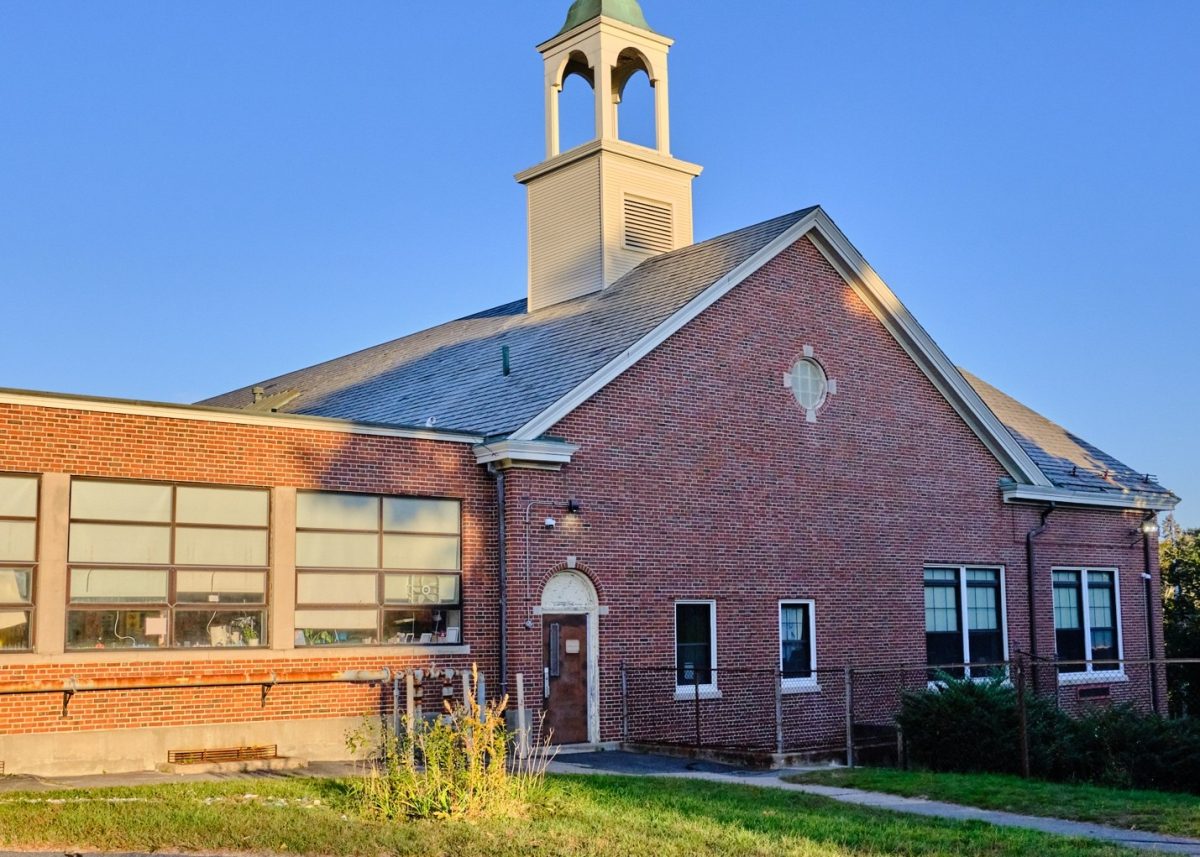
There’s a lot going on in North Plymouth these days. It is under assault by developers and has been the focus of ICE actions. And now two historic buildings are about to face significant changes: use of the Hedge and Cold Spring elementary schools are under study.
Both buildings are central to the North Plymouth community and, as you may have guessed, a good part of my history. My parents attended elementary school at Hedge, with my mom beginning the first grade without speaking a word of English – not that different from some students who currently attend the school. She also liked to recount tales of rulers slapped across her knuckles when she attempted to write with her left land.
My elementary education was at Cold Spring because of an unusual district line. My parents’ home on Standish Avenue was right on the divide between Hedge and Cold Spring, giving them the choice of which school I would attend. Cold Spring, then a relatively new building, featured a cafeteria and a hot lunch. Hedge School did not, and students were dismissed for lunch to walk home. Mom and Dad said they chose Cold Spring to spare me the lunchtime walk home, though in truth, it was probably to give Mom a break as my brother was still a toddler. It still amazes me that it was a time when I would walk the half mile to and from Cold Spring unaccompanied.
The history of Cold Spring begins with the construction of a two-room schoolhouse at 190 Court St. sometime in the mid 19th century. Cold Spring was named after the spring that once flowed in front of Benny’s Plaza. In 1895, faced with an increased school population, the town replaced the two-room school with a new Queen Anne Victorian structure with four classrooms. Opened in 1896, the new school served the school department until the late 1940s when population growth demanded the town add to its classrooms.
A town-owned parcel on Alden Street was selected for a new school, which opened in 1951. The modern Cold Spring school was a brick structure containing classrooms, a multipurpose room, cafeteria, kitchen, and even a dentist’s office. I remember the dentist’s office as the place where my generation of students were required to chew some type of red tablet that revealed what terrible brushers we were. Shortly after the school was built, it was clear it wasn’t large enough and several more classrooms were added.
I attended first grade in 1968 and was placed with Katherine McCarty, a popular teacher in Plymouth whose career spanned 22 years. We occupied the extra-large classroom facing Alden Street. What made this classroom special was its own door on Standish Avenue, its own bathroom, as well as a large wooden slide.
The wooden slide disappeared by the time my brother entered Cold Spring four years later, joining the wooden bell that had initially hung in the cupola when my Uncle Phil was a student there in the early ‘50s. Phil was the only one of my paternal grandparents’ children to attend Cold Spring. My dad and his middle brother attended Hedge, which even then was already 25 years old. Hedge replaced several smaller schools in North Plymouth.
The first school in North Plymouth was located at 278 Court St. and built in 1830. Most likely, it was a one-room building similar to the Little Red Schoolhouse in Cedarville. The site later became home to the larger Knapp School, which was converted to the Ellis Curtain factory after a fire destroyed the second floor. The building is now residential condominiums.
There were other smaller schools in North Plymouth, including one at Spooner Street and Seaview Ave, as well as a tiny two-room schoolhouse at the location of what later became the North Plymouth fire station since replaced by a newer fire station.
To alleviate overcrowding at these small schools, the town purchased the land at the intersection of Standish Avenue and Cherry Street for $20,000 early in the 20th century. The original block of Hedge School was constructed in 1910 as a one story, two-room schoolhouse and was designed by the Boston firm of Cooper and Bailey. Coincidentally, Cooper and Bailey also designed the Colt School in Bristol, R.I., a building I passed almost daily as a student at Roger Williams University.
The original building is now the northern section of Hedge along Standish Ave. Shortly after it was opened, the building was overwhelmed by a record enrollment of 185 students, necessitating a second-floor addition in 1912. In 1923, the school expanded to the west with a two-story addition for more classrooms. At the same time, a major addition to the south was built, with a hyphen structure for an auditorium connecting to the two-story south building. The south building was designed as a similar but not identical version of the north building.
I never attended Hedge, but I did cast my first vote there as an 18-year-old. Voting at Hedge began my slow progression through Plymouth’s precincts, all in numerical order. When populations shifted, and I was still living with my parents, my voting moved to Cold Spring and Precinct 2. Upon moving back from California and living downtown, I was a resident of Precinct 3, with Nathaniel Morton my home for civic duty. Finally, when I bought my home on Sandwich Street, I graduated to Plymouth North and Precinct 4. And now, in a move I question only because I adored the women who ran the polling station in Precinct 4, I will vote at Plymouth Community Intermediate School.
The oldest section of Hedge School is now 116 years old; Cold Spring clocks in at 75. Despite the age of both buildings, the schools provide their neighborhood children with an excellent education, safe learning environments, and serve as anchors in their neighborhoods. But both schools clearly have their shortcomings. Neither school is air conditioned and their energy plants are not the most efficient. The technology certainly is not up to date.
The Plymouth school district faces major decisions moving forward. In consultation with residents, I hope for the best. I would love both schools to survive, if only for the sake of my nostalgia. But not if that means giving our children less than the best learning environment.
Architect Bill Fornaciari is a lifelong resident of Plymouth (except for a three-year adventure going West as a young man) and is the owner of BF Architects in Plymouth. His firm specializes in residential work and historic preservation. Have a question or idea for this column? Email Bill at billfornaciari@gmail.com.